
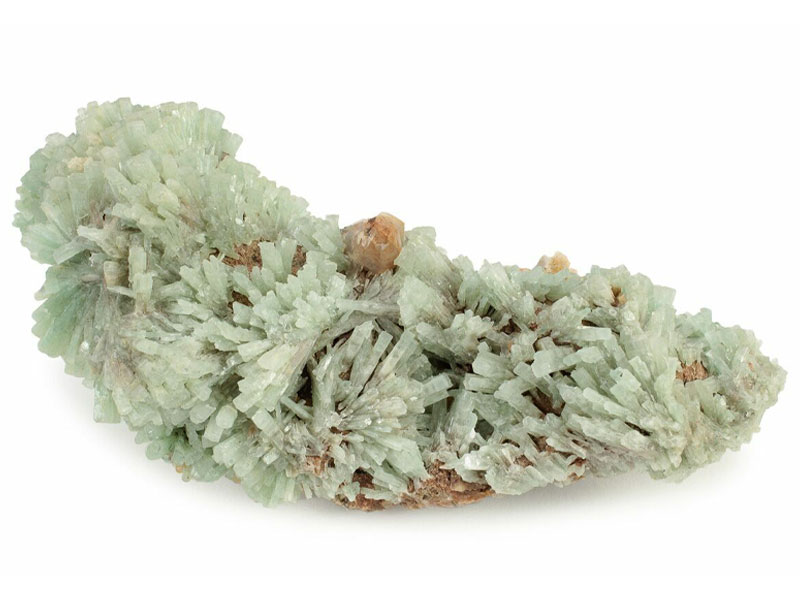
Green barite is a rare and strikingly beautiful mineral variant of the barium sulfate family. Its green color results from the presence of trace elements or inclusions, often giving it a unique, translucent appearance. This mineral is known not just for its aesthetic value but also for its high specific gravity and broad range of industrial applications. As green barite becomes increasingly recognized in the global market, both collectors and industries are taking greater interest in its potential. Whether as a gemstone, drilling additive, or a geological specimen, green barite is carving its place across diverse sectors. Its rarity compared to other barite colors adds to its commercial and geological value.
What Is Green Barite?
Green Barite is a naturally occurring variety of barite, a mineral composed primarily of barium sulfate (BaSO₄). It is distinguished by its green to greenish coloration, which may result from trace elements, mineral inclusions, or the specific geological conditions under which the barite formed. Like other forms of barite, Green Barite is characterized by its relatively high density, distinctive cleavage, and low hardness.
Green Barite Properties and Specifications
Chemical Composition
Green Barite is primarily composed of barium sulfate (BaSO₄), which is the fundamental chemical compound of the barite mineral group. Its natural composition can vary depending on the geological origin of the deposit and the presence of associated minerals or impurities. For industrial applications, buyers typically evaluate the BaSO₄ content, chemical purity, and impurity levels to determine whether the material meets the requirements of a specific application.
Specific Gravity
Specific gravity is one of the most important properties of barite because its high density makes the mineral particularly valuable for applications that require a heavy, chemically stable material. The specific gravity of Green Barite can vary according to its purity and mineral composition. For commercial transactions, the actual specific gravity should be confirmed through laboratory testing and documented in the supplier’s technical specification or Certificate of Analysis (COA).
Color and Appearance
Green Barite is recognized by its green to greenish coloration, which distinguishes it from more commonly encountered white or colorless barite. The exact shade and intensity may vary between deposits due to differences in geological conditions, trace components, and mineral inclusions. Green Barite can occur in different crystal forms and textures, but its color and visual appearance should not be considered a direct indication of its industrial grade or chemical purity.
Hardness and Cleavage
Barite is a relatively soft mineral, with a Mohs hardness of approximately 3 – 3.5, and it exhibits well-developed cleavage. These characteristics influence the way the mineral breaks during extraction, crushing, and processing. For commercial applications, understanding the hardness and cleavage of Green Barite is useful when selecting appropriate processing methods and producing the required particle size while minimizing unwanted fines or material loss.
Particle Size and Commercial Specifications
The particle size and commercial specifications of Green Barite depend on the intended application and buyer requirements. Depending on the end use, buyers may require a particular mesh size, micronized material, or a defined particle-size distribution. Other important specifications can include BaSO₄ content, specific gravity, moisture, and impurity levels. Vornaco can evaluate customer requirements and provide the available technical specifications and COA for the relevant Green Barite grade, helping buyers select material suitable for their intended application.

Green Barite Formation and Occurrence
Green Barite forms through geological processes that allow barium-rich fluids to interact with sulfate-bearing fluids or minerals. When the chemical conditions are suitable, barium sulfate (BaSO₄) precipitates from these fluids and gradually develops into barite crystals or aggregates. The geological environment, temperature, pressure, fluid composition, and associated minerals can influence the size, shape, purity, and color of the resulting barite.
How Green Barite Forms
Green Barite typically forms in hydrothermal veins, fractures, cavities, and sedimentary environments where barium-bearing fluids encounter sulfate-rich conditions. During mineral formation, trace elements and microscopic mineral inclusions may become incorporated into the barite structure or occur alongside the crystals, contributing to its characteristic green coloration. The exact cause of the green color can vary between deposits, so the appearance of Green Barite may differ in intensity and shade from one geological source to another.
The resulting material can occur as individual crystals, crystalline aggregates, or massive mineralized zones. These differences in formation conditions can also affect the mineral’s specific gravity, chemical composition, crystal habit, and associated impurities, making the geological origin an important consideration when evaluating Green Barite for commercial or industrial use.
Green Barite Properties and Specifications
Green barite exhibits several physical and chemical properties that make it highly desirable. It typically has a high specific gravity of around 4.5, making it one of the heaviest non-metallic minerals. Its color ranges from light to deep green, influenced by the presence of elements like copper or organic materials. The mineral is usually transparent to translucent with a vitreous luster. It has a Mohs hardness of 3 to 3.5, making it somewhat soft and delicate. Green barite also shows perfect cleavage in one direction, which contributes to its distinct crystal shapes. These unique traits contribute both to its functional value and aesthetic appeal.
Chemical Composition
Green Barite is primarily composed of barium sulfate (BaSO₄), the same fundamental mineral compound found in other varieties of barite. Its exact chemical composition can vary depending on the geological origin and associated minerals within the deposit. For industrial applications, buyers typically evaluate BaSO₄ content along with relevant impurities and other chemical parameters to determine whether the material meets the required grade and application standards.
Specific Gravity
One of the defining physical properties of barite is its high specific gravity, which makes it valuable in applications requiring a dense mineral material. The specific gravity of Green Barite can vary depending on its purity and associated minerals. For commercial use, the actual value should be confirmed through laboratory testing and the supplier’s technical specification or Certificate of Analysis (COA).
Color and Appearance
Green Barite is characterized by its green to greenish coloration, which distinguishes it from more common white or colorless barite. The intensity and shade of green can vary depending on the geological environment, trace elements, and mineral inclusions present in the material. Green Barite may occur as crystals, massive material, or mineralized aggregates, and its appearance can differ considerably between deposits.
Hardness and Cleavage
Barite is a relatively soft mineral, with a Mohs hardness of approximately 3–3.5, and it has well-developed cleavage. These properties influence how the mineral breaks, is crushed, and is processed into different particle sizes. Because of its relatively low hardness and cleavage characteristics, Green Barite should be handled and processed using methods appropriate for the desired commercial grade and particle-size specification.
Particle Size and Commercial Specifications
The required particle size and commercial specifications of Green Barite depend primarily on its intended application. Industrial buyers may require specific mesh sizes, micronized material, or a defined particle-size distribution, together with requirements for BaSO₄ content, specific gravity, moisture, and impurity levels. Vornaco can evaluate buyer requirements and provide the applicable technical specifications and COA for the available material rather than applying a single specification to every Green Barite product.
Green Barite Formation
Green barite forms in low- to medium-temperature hydrothermal environments. These conditions allow for the precipitation of barium sulfate from barium-rich fluids. When the environment contains elements such as copper, nickel, or organic material, green coloration may result. Often, green barite occurs in veins and cavities within sedimentary rocks, especially limestone. The growth environment directly influences the quality and size of the crystals. Geological factors like temperature, pressure, and mineral-rich fluids all contribute to its final appearance. The formation process makes each green barite specimen unique and valuable to geologists and collectors alike.
Green Barite Occurrence
Green barite is found in various regions around the world, although in significantly smaller quantities than other barite colors. Countries like Morocco, China, the United States, and Peru have reported green barite deposits. In the U.S., notable green barite specimens have been discovered in Nevada and Colorado. Moroccan green barite, in particular, is highly prized for its clarity and vibrant hues. These occurrences are often located in regions rich in hydrothermal activity. Because of its limited availability, green barite from specific localities is often labeled as a premium collectible item. The rarity of deposits contributes to its high market value.
To understand the broader context of Green Barite, it’s important to explore What is Barite, as it explains the mineral’s composition and uses in various industries.

Green Barite in Industrial Applications
Green barite, like its more common counterparts, is widely used in industrial applications. One of its primary uses is in the oil and gas industry, where it serves as a weighting agent in drilling mud. The high specific gravity helps control pressure and stabilize boreholes. It is also utilized in the production of paints, rubber, and glass, where it acts as a filler or weighting material. Though green barite is often more expensive, it may be chosen for niche applications requiring its specific properties. Its inertness and chemical stability make it safe for a variety of industrial uses. These characteristics ensure that green barite remains a viable mineral in multiple sectors.
Green Barite in Oil and Gas Industry
Green barite’s role in the oil and gas industry cannot be overstated. Due to its density, it is commonly used in the formulation of drilling fluids to prevent blowouts by balancing formation pressure. The mineral’s purity and chemical inertness make it ideal for high-performance muds. Even though green barite is rarer and more costly, it may be selected in regions where high-quality material is required. In offshore and deep drilling, the reliability of green barite becomes particularly valuable. Its low solubility ensures it doesn’t react with other components in the fluid. This makes green barite a critical asset in drilling operations.
For those interested in exploring other vibrant forms, consider reading about Red Barite, another unique variety of barite.

Green Barite vs Other Barite Colors
When compared to other barite colors like white, blue, or yellow, green barite stands out due to its rarity and vivid appearance. White barite is the most common and used extensively in industrial processes. Blue and yellow varieties are also popular among collectors but lack the unique formation conditions of green barite. The presence of trace elements or organic compounds gives green barite its distinctive hue. This makes it more sought-after in the collector’s market. Its rarity also makes it more expensive, often reserved for decorative or specialty uses. The contrast in color and availability sets green barite apart significantly.
Green Barite Market Demand and Pricing
The demand for green barite has been steadily increasing, driven by its industrial utility and aesthetic appeal. As collectors and jewelry designers become more aware of its uniqueness, market interest rises. Prices for green barite vary widely based on factors like origin, clarity, size, and crystal quality. Moroccan green barite, for example, often commands higher prices due to its superior form and color. Industrial-grade green barite is less common but still finds niche applications. Online marketplaces and mineral shows frequently feature green barite specimens at premium prices. The limited supply adds to its investment potential in mineral markets.
Green Barite Mining and Processing
Green barite mining typically involves open-pit or underground methods, depending on the deposit location. The extraction process must be carefully managed to preserve the crystal integrity, especially for specimens intended for jewelry or collections. After mining, the ore is crushed, washed, and separated based on density. Further beneficiation may include flotation to remove impurities. In some cases, hand-picking is used to select high-quality green barite crystals. The processing ensures that the material meets industry or collector standards. Sustainable and ethical mining practices are increasingly important to buyers and regulatory bodies alike.
برای بررسی عمیقتر انواع مختلف باریت، از جمله باریت زرد ، حتماً مقاله مربوطه را بررسی کنید.
تامین کننده، صادرکننده و عرضه جهانی باریت سبز
تامین باریت سبز
شرکت وورناکو (Vornaco) مواد معدنی و خام صنعتی را مطابق با نیازهای فنی و تجاری خریداران بینالمللی تأمین میکند. برای باریت سبز، خریداران میتوانند قبل از ثبت سفارش، مشخصاتی مانند میزان BaSO₄، وزن مخصوص، اندازه ذرات، ترکیب شیمیایی، میزان ناخالصی، رطوبت، بستهبندی و مقدار مورد نیاز را بررسی کنند. این رویکرد به اطمینان از مناسب بودن ماده تأمینشده برای کاربرد صنعتی مورد نظر کمک میکند.
وورناکو میتواند با خریداران برای ارزیابی نیازهای محصول همکاری کند و مشخصات فنی موجود، گواهی آنالیز (COA)، گزینههای بستهبندی، حداقل مقدار سفارش و قیمت تجاری بر اساس عیار درخواستی را ارائه دهد. از خریداران دعوت میشود مشخصات و کاربرد مورد نیاز خود را ارائه دهند تا مناسبترین ماده باریت سبز ارزیابی شود.
صادرات باریت سبز
وورناکو از صادرات مواد معدنی به بازارهای بینالمللی پشتیبانی میکند و با خریداران برای هماهنگی الزامات فنی، تجاری و لجستیکی هر محموله همکاری میکند. ترتیبات صادرات باریت سبز میتواند شامل مشخصات محصول، مقدار، بستهبندی، الزامات حمل و نقل، اسناد صادرات، بندر بارگیری، مقصد و شرایط تحویل مورد توافق بین خریدار و تأمینکننده باشد.
برای سفارشات بینالمللی باریت سبز، الزامات ممکن است بسته به کشور مقصد و کاربرد مورد نظر متفاوت باشد. وورناکو میتواند در مورد اسناد و مدارک لازم و جزئیات حمل و نقل با خریداران هماهنگ کند و یک پیشنهاد تجاری بر اساس درجه محصول، مقدار، بستهبندی و مقصد درخواستی تهیه کند. برای بحث در مورد الزامات تامین و صادرات باریت سبز با وورناکو تماس بگیرید.
نحوه خرید باریت سبز
هنگام خرید باریت سبز، در نظر گرفتن چندین عامل برای اطمینان از ارزش و اصالت مهم است. به دنبال نمونههایی با رنگ غنی، تشکیل کریستال خوب و حداقل آسیب باشید. همیشه در مورد منشأ آن سؤال کنید، زیرا محل میتواند تا حد زیادی بر قیمت و مطلوبیت آن تأثیر بگذارد. از قطعاتی با تعمیرات آشکار یا رنگهای غیرطبیعی که ممکن است نشان دهنده فرآوری باشند، خودداری کنید. در صورت خرید برای مصارف صنعتی، تأیید کنید که باریت با مشخصات فنی مانند خلوص و وزن مخصوص مطابقت دارد. فروشندگان معتبر باید مستندات و پشتیبانی مشتری را ارائه دهند. چه برای جمعآوری و چه برای صنعت، خرید آگاهانه منجر به رضایت و ارزش بیشتر میشود.
مقاله ما در مورد باریت آبی را که به یکی دیگر از انواع جذاب باریت میپردازد، از دست ندهید .

سوالات متداول در مورد باریت سبز
باریت سبز چیست؟
باریت سبز نوعی باریت به رنگ سبز طبیعی است، یک ماده معدنی که عمدتاً از سولفات باریم (BaSO₄) تشکیل شده است. رنگ سبز آن میتواند با عناصر کمیاب، آخالهای معدنی و شرایط زمینشناسی که تحت آن ماده معدنی تشکیل میشود، مرتبط باشد. مانند سایر گونههای باریت، باریت سبز با چگالی بالا مشخص میشود و میتواند برای کاربردهای صنعتی و کانیشناسی مورد ارزیابی قرار گیرد.
فرمول شیمیایی باریت سبز چیست؟
فرمول شیمیایی باریت سبز BaSO₄ است که نشان دهنده سولفات باریم است. ترکیب معدنی اساسی آن مانند سایر گونههای باریت است، در حالی که تفاوت در رنگ و ظاهر میتواند ناشی از اجزای کمیاب، مواد معدنی مرتبط یا شرایط زمینشناسی باشد. برای کاربردهای تجاری، محتوای واقعی BaSO₄ و میزان ناخالصی باید از طریق تجزیه و تحلیل آزمایشگاهی تأیید شود.
آیا باریت سبز برای حفاری مناسب است؟
باریت سبز در صورتی که مشخصات فنی مورد نیاز برای باریت درجه حفاری را داشته باشد، میتواند برای کاربردهای حفاری مناسب باشد. رنگ سبز آن به تنهایی مناسب بودن آن را تعیین نمیکند. پارامترهای مهم شامل وزن مخصوص، محتوای BaSO₄، توزیع اندازه ذرات، رطوبت و میزان ناخالصیهای مربوطه است. خریداران باید مشخصات فنی فعلی یا گواهی تجزیه و تحلیل (COA) را درخواست کنند تا تأیید شود که این ماده الزامات حفاری آنها را برآورده میکند.
هنگام خرید باریت سبز چه مشخصاتی را باید بررسی کنم؟
هنگام خرید باریت سبز برای مصارف صنعتی، خریداران باید میزان BaSO₄، وزن مخصوص، اندازه ذرات، ترکیب شیمیایی، رطوبت، میزان ناخالصی، مبدا، بستهبندی و گواهی آنالیز (COA) را بررسی کنند. مقادیر مورد نیاز به کاربرد مورد نظر بستگی دارد. خریداران همچنین باید قبل از ثبت سفارش بینالمللی، مقدار موجود، حداقل مقدار سفارش، شرایط حمل و نقل و مقصد تحویل را تأیید کنند.
آیا وورناکو میتواند باریت سبز عرضه کند؟
وورناکو میتواند نیازهای تأمین باریت سبز را برای خریداران بینالمللی بر اساس کاربرد، گرید، مشخصات، مقدار، بستهبندی و مقصد مورد نیاز ارزیابی کند. خریداران میتوانند الزامات فنی خود را برای ارزیابی مواد موجود، مشخصات، COA و شرایط تجاری به وورناکو ارائه دهند. برای اطلاع از موجودی فعلی، قیمتگذاری و شرایط صادرات، مستقیماً با وورناکو تماس بگیرید و مشخصات مورد نیاز خود را ارائه دهید.


