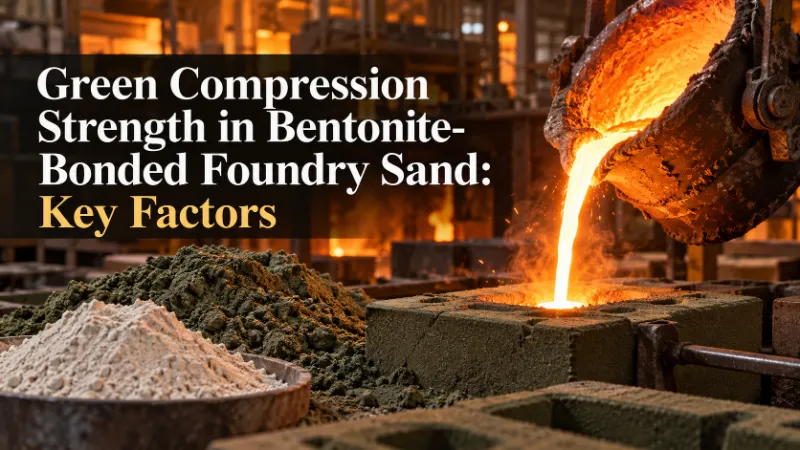
Green Compression Strength in Bentonite-Bonded Foundry Sand: Key Factors
Green compression strength is an important property of clay-bonded foundry sand. It describes the ability of a prepared molding sand specimen to withstand compressive loading while it remains moist and has not undergone drying or baking.
In green sand casting, bentonite acts as a binder that helps hold sand grains together. When the clay is properly hydrated and distributed throughout the mixture, it develops bonding interactions that allow the mold to retain its shape during handling and metal pouring.
However, adding more bentonite does not automatically produce a stronger mold. Moisture content, sand grain characteristics, clay activity, mixing conditions, and compaction all influence the final result.
Understanding these relationships helps foundries assess bentonite performance more accurately and maintain consistent molding sand properties.
What Is Green Compression Strength in Foundry Sand?
Green compression strength is the compressive strength of a molding sand specimen in its moist, uncured condition. It is one of several mechanical properties used to evaluate the suitability of green molding sand for foundry operations.
The term green refers to the condition of the mold rather than its color. The sand mixture contains moisture, and its strength develops through the interaction between the clay binder, water, and sand grains.
Green compression strength indicates how well the prepared mixture resists compressive loading. It should not be confused with dry compression strength, which is measured after the specimen has been dried under specified conditions.
A foundry needs more than a high compression-strength reading. The molding sand must also provide suitable permeability, moldability, surface integrity, and resistance to handling damage.
These properties work together. A mixture that develops high strength but restricts gas escape excessively may create other casting difficulties. For this reason, green compression strength should be interpreted alongside the other relevant properties of the molding sand.
How Bentonite Develops Strength in Green Sand Molds
Bentonite is a clay material containing smectite minerals, particularly montmorillonite. Its interaction with water allows it to develop bonding behavior that is useful in green sand molding.
When bentonite is mixed with water, the clay hydrates and becomes more effective at coating and binding sand grains. During mixing and compaction, the hydrated clay contributes to the cohesion of the molding mixture.
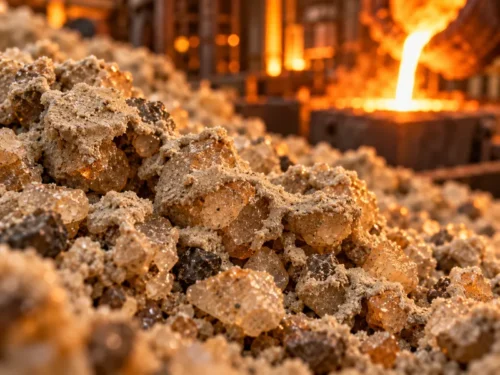
The resulting mold strength depends on the condition of the clay and how effectively it is incorporated into the sand.
Three aspects are particularly important:
- Hydration: Water enables the clay to develop its binding characteristics.
- Distribution: Mixing determines how uniformly the clay is distributed across the sand grains.
- Compaction: The molding process establishes the density and structure of the prepared sand.
If the clay is inadequately hydrated or poorly distributed, the mixture may not develop uniform bonding. If moisture or compaction is unsuitable, the mold may also show inconsistent strength even when the bentonite content remains unchanged.
For information about industrial bentonite materials, see Vornaco’s Bentonite product page.
Key Factors Affecting Green Compression Strength
Green compression strength results from the combined behavior of the binder, water, sand, and preparation process. The following factors explain why two molding mixtures containing bentonite may develop different mechanical properties.
1. Moisture Content
Moisture is one of the most influential variables in bentonite-bonded green sand.
Water activates the clay binder and allows it to develop cohesive interactions around sand grains. If the mixture contains insufficient available water, the bentonite may not hydrate adequately, limiting its binding effectiveness.
Excessive moisture can also be detrimental. Additional water changes the consistency and packing behavior of the mixture and may reduce green compression strength beyond the optimum moisture range for that particular sand system.
Consequently, the relationship between moisture and strength is not necessarily linear. Strength may increase as moisture approaches a suitable range and then decrease when additional water moves the mixture away from its optimum condition.
The optimum moisture content depends on the sand, bentonite, active clay content, additives, and molding process. A single moisture percentage should not be treated as universally suitable for every foundry mixture.
2. Bentonite Content and Active Clay
The amount of bentonite affects the quantity of binder available to develop bonding between sand grains.
When the binder content is too low for the mixture, the sand may not develop sufficient cohesion. Increasing the amount of suitable bentonite can improve green strength when binder availability is limiting.
However, the relationship is not unlimited. Excess clay can change compactability, permeability, and the overall balance of molding properties. Increasing binder content without controlling moisture and other variables may therefore fail to produce the desired improvement.
The condition of the clay also matters. Total clay content and active clay content are not identical measurements. Foundry sand may contain inactive or spent clay that contributes differently from freshly added, active bentonite.
For this reason, evaluating the active clay condition of a circulating molding sand system provides more useful information than considering the total clay percentage alone.
3. Bentonite Type and Mineral Characteristics
Bentonite materials differ in mineral composition, exchangeable cations, hydration behavior, and other properties that influence their interaction with water.
These differences can affect the development of bonding in foundry sand. Two bentonite materials added at the same percentage may not produce identical molding properties when the remaining mixture conditions are held constant.
Sodium-dominant and calcium-dominant bentonites can differ in swelling and water interaction. However, swelling behavior alone does not establish which material will deliver the best green compression strength in a particular foundry system.
The appropriate comparison is based on performance in the actual molding sand formulation and under consistent preparation and testing conditions.
Vornaco’s guide to sodium bentonite vs. calcium bentonite provides additional background on these differences.
4. Sand Grain Size and Distribution
The size, shape, and distribution of sand grains influence how the grains pack together and how the binder is distributed across their surfaces.
Grain size distribution also affects permeability and surface finish. A finer sand may provide a different surface texture from a coarser sand, but changes in grain size can also alter the amount of binder and water required to achieve suitable molding properties.
A broad or uneven grain distribution can produce different packing characteristics from a more uniform distribution. These differences affect the structure of the compacted mold and the space available for gas movement.
Research on green sand casting has investigated the effects of sand grain size and water content on green compression strength, confirming that these variables need to be considered together.
5. Mixing and Mulling Conditions
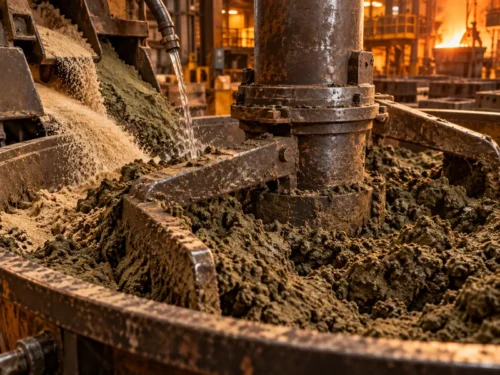
Mixing determines whether water and bentonite are distributed effectively throughout the sand.
Insufficient mixing may leave areas with different moisture levels or uneven binder distribution. This can lead to variations in the strength and consistency of the prepared molding sand.
Mulling is particularly important because it helps disperse the clay and water throughout the mixture. The effectiveness of this process depends on the equipment, mixing sequence, material condition, and operating settings.
Consistent mixing helps reduce variability between batches. It also makes test results more useful because differences in measured strength are less likely to arise from uneven preparation.
6. Compaction and Mold Density
Compaction affects the density and structure of the prepared mold.
A specimen compacted under different conditions may show a different compression-strength result even if its basic ingredients are unchanged. The way the sand packs together influences particle contacts, pore spaces, and the distribution of the hydrated binder.
For meaningful comparisons, specimens must be prepared using a consistent method. Otherwise, the results may reflect differences in compaction rather than differences in bentonite performance.
This is why standardized specimen preparation is an important part of foundry sand testing.
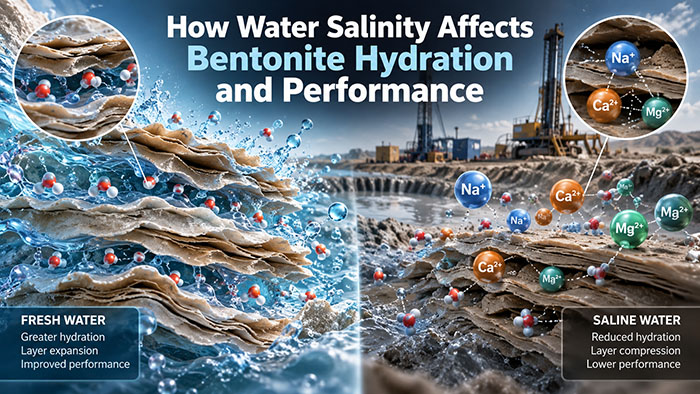
7. Water Chemistry
The chemical composition of the mixing water can influence bentonite hydration and particle interactions.
Dissolved salts, particularly calcium and magnesium ions, can alter the behavior of bentonite in water. These changes may affect the consistency and binding behavior of a clay-containing molding mixture.
Water chemistry is therefore relevant when a foundry experiences changes in molding sand properties despite maintaining similar nominal moisture and binder contents.
The effect depends on the dissolved ions, their concentrations, and the characteristics of the bentonite and sand system. It should not be assumed that all water sources will produce identical results.
How Green Compression Strength Is Measured
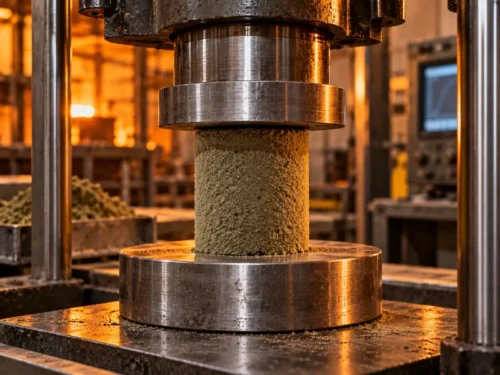
Green compression strength is determined by preparing a molding sand specimen and applying a compressive load under a specified test procedure.
The American Foundry Society identifies standardized methods for preparing green sand specimens and measuring green or dried compression strength.
A typical test workflow includes the following stages:
- Prepare the sand mixture. The sand, bentonite, water, and other formulation components are mixed according to the selected procedure.
- Prepare the test specimen. The molding sand is placed and compacted using the prescribed specimen preparation method.
- Apply the compressive load. The prepared specimen is tested using suitable strength-testing equipment.
- Record the result. The maximum compressive stress sustained before failure is reported according to the test method.
- Compare consistent results. Results are evaluated alongside moisture, active clay, compactability, permeability, and other relevant process measurements.
The specimen dimensions, preparation method, conditioning, and reporting units must be consistent when comparing test results.
The American Foundry Society provides technical training on wet and dry compression strength testing for green sand.
Green Compression Strength Is Not the Only Quality Indicator
A molding sand mixture must balance strength with other properties required for successful casting.
| Property | What it indicates | Why it matters |
|---|---|---|
| Green compression strength | Resistance to compression in the moist condition | Helps assess the mechanical integrity of the prepared mold |
| Green shear strength | Resistance to shear failure in the moist condition | Provides additional information about mold strength |
| Permeability | Ability of gas to pass through the molding sand | Influences gas evacuation during pouring |
| Compactability | Response of the molding sand to compaction | Helps evaluate molding consistency |
| Moisture content | Amount of water present in the mixture | Influences clay hydration and molding behavior |
| Active clay content | Amount of effective clay binder in the system | Helps assess the condition of circulating molding sand |
These properties should be interpreted together. A higher compression-strength value does not automatically mean that a molding mixture is superior in every respect.
The required balance depends on the casting process, the metal being poured, the molding equipment, and the quality requirements for the finished component.
Common Causes of Inconsistent Green Compression Strength
Variation in green compression strength can arise from changes in the raw materials or in the way the molding sand is prepared and maintained.
Common causes include:
- Changes in moisture content between batches.
- Uneven bentonite distribution caused by inconsistent mixing.
- Variation in the active clay content of recycled molding sand.
- Changes in sand grain distribution or the proportion of fines.
- Differences in compaction or specimen preparation.
- Changes in the chemical composition of the mixing water.
These variables can interact. For example, a change in sand grain distribution may alter the moisture required to achieve the same compactability, while a change in water chemistry may affect the behavior of the clay binder.
When investigating inconsistent strength, comparing test results with moisture, active clay, compactability, and permeability measurements helps distinguish between possible causes more effectively than changing the bentonite dosage alone.
Selecting Bentonite for Foundry Sand Applications
Bentonite selection for foundry use should be based on the requirements of the molding system rather than on a single general-purpose quality claim.
Relevant considerations include the clay’s hydration behavior, bonding performance, compatibility with the foundry sand, and consistency between supplied batches.
Buyers may also need to consider particle characteristics, moisture content, chemical composition, and the availability of supporting technical documentation.
Kaolin is another industrial clay material, but it should not automatically be treated as a direct substitute for bentonite in green sand molding. Their mineral characteristics and bonding behavior differ, and suitability depends on the specific foundry formulation.
For general information about industrial clay materials, Vornaco also provides a Kaolin product page.
A meaningful product comparison should focus on the properties relevant to the intended foundry process and on documented performance under comparable conditions.
Conclusion
Green compression strength is an important measure of the mechanical behavior of bentonite-bonded foundry sand, but it cannot be explained by bentonite content alone.
Moisture, active clay content, mineral characteristics, sand grain distribution, mixing, compaction, and water chemistry all influence how the molding mixture develops strength.
For foundries, the most useful approach is to evaluate green compression strength alongside other molding properties and to maintain consiste
Get in Touch with Us
Have questions or need more information about our premium detergent bentonite products? We’re here to help! At Vornaco, our team is dedicated to providing the best solutions for your industrial needs.
???? Call us now: +98 912 293 9278
✉️ Email us: info@vornaco.com
Let’s connect and find the perfect solution for you!