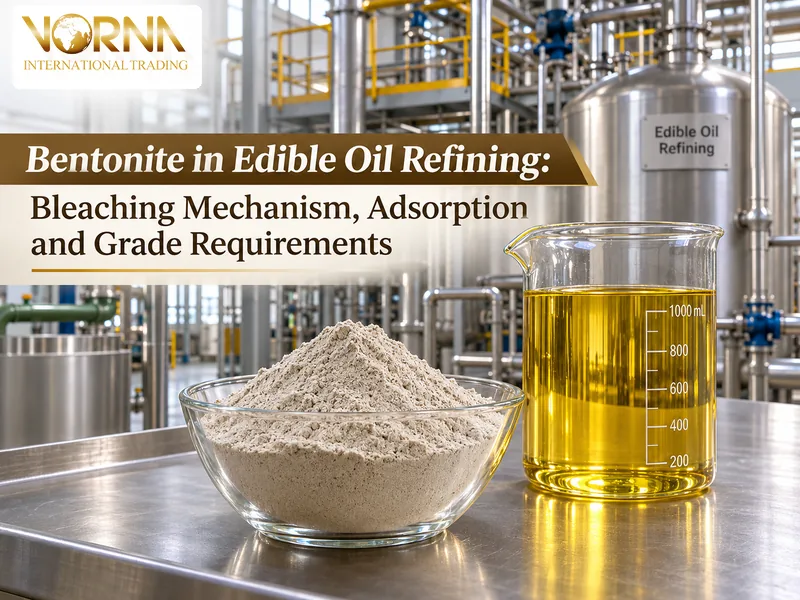
Bleaching is one of the most important quality-control stages in edible oil refining, yet the term can be misleading. The purpose is not simply to make vegetable oil lighter in color. A properly managed bleaching process also reduces selected pigments, residual soaps, phospholipids, trace metals and oxidation-related compounds that can affect the quality of the finished oil.
Bentonite-based bleaching earth plays a major role in this operation because its mineral structure can be modified to develop the surface properties needed for adsorption. However, the effectiveness of a bleaching clay depends on much more than whether the original material is described as sodium or calcium bentonite.
For refinery operators, choosing the right grade means balancing pigment removal, oil retention, filtration behavior and the potential formation of undesirable compounds during processing.
What Does Bentonite Do in Edible Oil Refining?
In a typical refining sequence, bleaching follows earlier treatment stages such as degumming and, where applicable, neutralization and drying. The oil is brought into contact with an adsorbent under controlled processing conditions before the spent material is removed by filtration.
Bentonite-based bleaching earth helps reduce several groups of unwanted substances:
- Chlorophyll and related pigments, which can affect color and oxidative stability.
- Carotenoids, which contribute yellow, orange or reddish tones.
- Residual phospholipids and soaps remaining after upstream refining.
- Trace metals, which may promote oxidation reactions.
- Certain oxidation products and other minor impurities, depending on the oil and adsorbent.
The relative importance of these targets differs between oils. Palm oil, soybean oil and sunflower oil do not enter bleaching with identical pigment profiles or impurity concentrations.
This is why a clay that performs well with one feedstock may not offer the best result with another.
How the Bleaching Mechanism Works
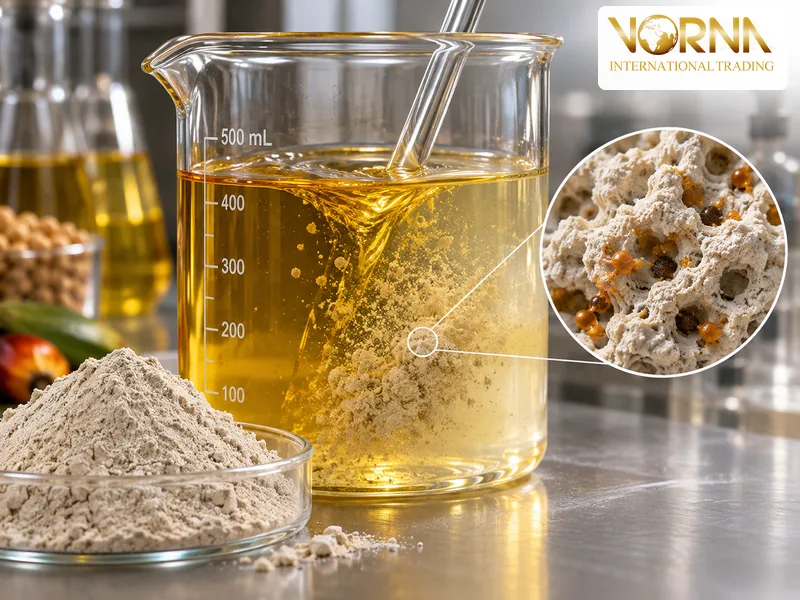
Bleaching earth contains mineral surfaces and pores that can interact with compounds dissolved or dispersed in oil.
Three mechanisms are particularly important.
Surface Adsorption of Pigments
Adsorption occurs when pigment molecules or other impurities become associated with the surface of the bleaching clay.
The interaction may involve physical attraction, electrostatic forces or chemical interactions with active surface sites.
Chlorophyll-related compounds and carotenoids do not necessarily follow identical adsorption pathways. Their removal depends on the characteristics of the adsorbent, the oil and the operating conditions.
This explains why bleaching performance should be tested against the actual target pigments rather than judged by a general claim of high adsorption capacity.
Pore Structure and Access to Active Sites
Surface area is important, but it is not the only factor that determines bleaching efficiency.
The distribution of pore sizes, accessibility of active sites and movement of pigment molecules through the oil–clay mixture also influence the result.
A material can have a relatively large measured surface area without achieving the highest pigment removal under practical refinery conditions.
The useful question is whether the available surface and pore structure can interact effectively with the impurities present in the specific oil.
Chemical Changes During Bleaching
Bleaching is not exclusively a physical adsorption process.
Interactions at acidic clay surfaces can also alter certain compounds, including oxidation products and pigments.
These reactions may improve some quality parameters, but excessive acidity or unsuitable operating conditions can create additional problems.
Refineries must therefore evaluate the overall quality of the treated oil, not just its appearance immediately after filtration.
Natural Bentonite vs Acid-Activated Bleaching Earth
Natural bentonite is commonly associated with montmorillonite-rich clay. However, not every natural bentonite grade has sufficient adsorption performance for commercial edible oil bleaching.
Many high-activity bleaching earth products are produced by treating suitable clay minerals with acid under controlled conditions.
Acid activation can modify the clay structure, create additional accessible pores and alter surface acidity. These changes may improve pigment removal.
The starting mineral matters. Calcium-dominant bentonite is widely used as a raw material for acid-activated bleaching earth, but performance depends on its mineralogy and the activation process.
Natural or less aggressively treated clays may also be appropriate for particular refinery requirements.
A useful comparison is therefore not simply “natural versus activated.” It is the measured performance and possible side effects of each grade in the intended oil.
For a broader explanation of the original clay types, see our guide to sodium and calcium bentonite differences.
Why Higher Bleaching Activity Is Not Always Better
A bleaching clay that removes more color at a given dosage may initially seem preferable. But color removal is only one part of refinery performance.
Highly acidic bleaching earth can create unwanted reactions under certain conditions. Industry guidance identifies potential concerns involving free fatty acid changes and the formation of contaminants such as 3-MCPD esters.
These risks depend on several factors, including the oil, processing conditions, adsorbent chemistry and subsequent refining operations.
Excessive clay dosage can also increase oil loss because some oil remains trapped in the spent filter cake.
A refinery should therefore aim for sufficient impurity removal at an economical dosage while maintaining acceptable oil quality and filtration behavior.
The best grade is not necessarily the strongest acid-activated product available.
Which Bentonite Properties Matter Most?
For edible oil bleaching, conventional swelling index or drilling-fluid viscosity results are not enough to establish suitability.
The following characteristics deserve closer attention.
| Property | Why it matters in edible oil refining |
|---|---|
| Bleaching efficiency | Indicates removal of the target pigments under defined test conditions |
| Surface area and pore structure | Influence the availability of adsorption sites |
| Surface acidity | Affects adsorption and potential side reactions |
| Particle-size distribution | Influences contact efficiency, dust handling and filtration |
| Moisture content | Can affect process conditions and handling |
| Residual soluble salts and impurities | Relevant to process compatibility and product safety |
| Oil retention | Influences oil losses in spent bleaching earth |
| Filtration performance | Affects filter cycle time, throughput and clarity |
These properties should not be evaluated as isolated numbers.
For example, reducing particle size may improve contact in some systems, but excessively fine material can complicate filtration.
Similarly, increasing activation intensity may improve certain adsorption results while introducing other process or quality disadvantages.
How Refiners Should Test a Bleaching Earth Grade
Before approving a new bleaching clay, a refinery should compare it with its current material using representative oil samples and controlled laboratory conditions.
A practical evaluation can follow five steps.
1. Establish the incoming oil condition. Record the relevant color, pigment levels, oxidation indicators, phosphorus or soap residues, and trace metals where applicable.
2. Set comparable treatment conditions. Test the candidate and reference adsorbents using consistent temperature, contact time, moisture conditions, mixing procedure and filtration method.
3. Compare more than one dosage. A single test concentration may hide differences in how efficiently the clays perform at lower or higher usage rates.
4. Measure both quality and losses. Evaluate the treated oil alongside filtration behavior and the amount of oil retained in the spent material.
5. Confirm performance under plant conditions. A successful laboratory test should be followed by an appropriately controlled production trial before large-scale substitution.
These steps help distinguish genuine improvements from differences caused by inconsistent test conditions.
Temperature, Contact Time and Dosage
Industrial bleaching often operates with heated oil under vacuum or reduced-oxygen conditions. The exact operating window depends on the refinery, oil type and adsorbent.
Temperature can improve mass transfer and influence adsorption kinetics. However, unnecessary heating may increase the risk of undesirable chemical reactions.
Contact time must be sufficient for the relevant adsorption processes, but extending the treatment indefinitely does not necessarily produce proportionate benefits.
Clay dosage presents a similar trade-off.
Insufficient dosage may leave unacceptable pigment or impurity levels. Excessive dosage raises material consumption, filtration load and potential oil retention losses.
Rather than adopting a universal dosage, refiners should establish a process-specific operating range based on controlled trials.
A common laboratory comparison evaluates several clay dosages under otherwise identical conditions and plots treated-oil quality against adsorbent consumption.
This reveals whether additional clay delivers a meaningful improvement or merely increases costs.
Filtration and Spent Bleaching Earth
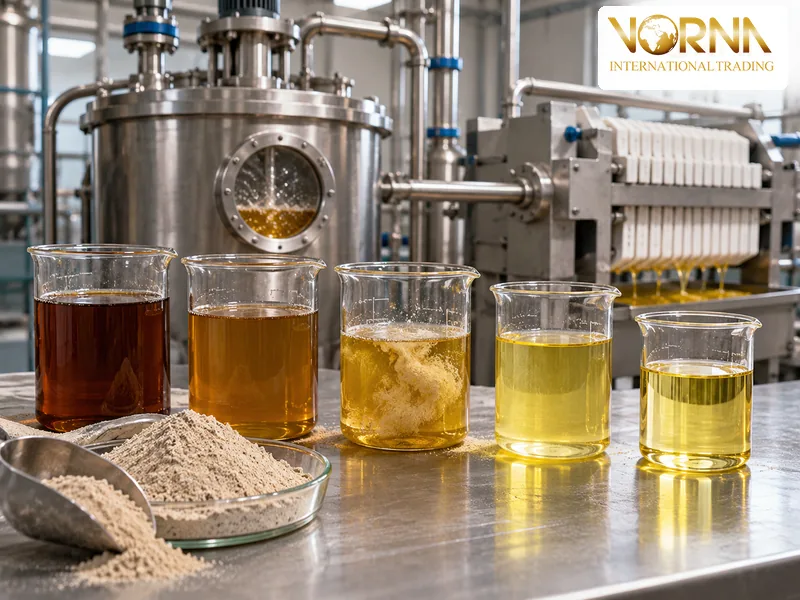
After treatment, the bleaching clay must be separated from the oil.
Filtration performance is a practical part of adsorbent selection because filter resistance, cake characteristics and residual fines can affect plant throughput.
Spent bleaching earth also retains oil. The amount varies with adsorbent characteristics, process conditions and filtration practices.
This matters financially because oil lost with the spent earth reduces the yield of saleable refined product.
Spent bleaching earth may also present a self-heating or fire risk when oil-containing filter cake is handled or stored improperly. Refineries should follow suitable safety procedures and applicable waste-management requirements.
A grade that achieves a slightly better color result but causes substantial oil retention or filtration problems may not be the most economical choice.
Grade Requirements for Edible Oil Applications
A supplier’s description of a material as “activated bentonite” does not establish that it is appropriate for food-processing use.
Refinery buyers should request documentation addressing the intended application, including:
- Mineral type, activation method and product identification
- Typical bleaching performance with relevant oil types
- Particle-size distribution and moisture specification
- Appropriate acidity and impurity test results
- Information relevant to potential contaminants and regulatory requirements
- Safety Data Sheet and handling instructions
- Representative samples and batch-specific quality records
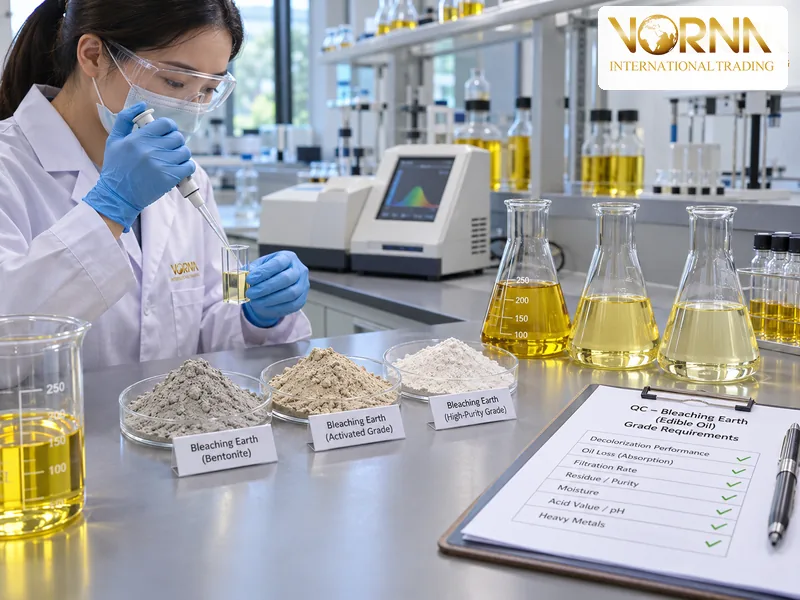
Food-processing suitability must be assessed against the regulations and quality requirements applicable to the refinery’s jurisdiction and finished product.
It is also important to distinguish a processing aid used during edible oil refining from bentonite sold for drilling, foundry, construction or other industrial purposes.
A product suitable for one of these industries should not be substituted into edible oil refining without application-specific qualification.
The distinction between industrial and food-related clay specifications is discussed further in our article on food-grade bentonite and its requirements. The terminology alone, however, does not establish suitability as a bleaching aid.
Choosing the Right Mineral Supply Option
For businesses evaluating raw materials for bleaching-earth production or industrial adsorption processes, the starting bentonite mineral and the finished bleaching product should be considered separately.
Vornaco supplies industrial bentonite grades and bulk sourcing options, including information about calcium, sodium and activated bentonite.
Buyers seeking material for edible oil refining should specify whether they need raw bentonite for a controlled activation process or finished, qualified bleaching earth. They should request application-specific test data and verify availability before treating any offered grade as suitable for refinery use.
Other adsorbents, including specialized silica-based materials, can play complementary roles in selected refining operations. However, ordinary industrial silica is not automatically interchangeable with food-processing silica adsorbents. The distinction matters when assessing silica materials and specifications for industrial supply.
A technical inquiry should identify the oil type, target impurities, existing process conditions, required documentation and planned order volume.
Conclusion
Bentonite contributes to edible oil refining through adsorption and related surface interactions that help remove pigments and selected residual impurities.
Its value as bleaching earth depends on mineral composition, activation, pore structure, surface chemistry and practical process behavior.
For refinery operators, the most useful measure of performance is not a single adsorption figure. It is the combination of treated-oil quality, acceptable contaminant levels, efficient filtration and controlled oil loss.
Selecting bleaching earth on that basis can help avoid unsuitable grades, reduce unnecessary adsorbent consumption and support more consistent refining operations.
Frequently Asked Questions
Is all bentonite suitable for edible oil refining?
No. Standard bentonite grades used in drilling, construction or foundry applications are not automatically suitable for edible oil bleaching. The material must meet application-specific performance, quality and regulatory requirements.
Why is acid-activated bentonite used for oil bleaching?
Controlled acid activation can increase accessible porosity and alter surface chemistry, improving the adsorption of pigments and certain impurities. The result depends on the original clay and activation conditions.
Does bleaching earth remove more than oil color?
Yes. Depending on the oil, adsorbent and operating conditions, bleaching can also reduce residual phospholipids, soaps, trace metals and certain oxidation-related compounds.
Is calcium bentonite better than sodium bentonite for bleaching?
Suitable calcium-rich bentonite is commonly used as a starting material for acid-activated bleaching earth. However, the original cation type alone does not establish final bleaching performance.
How can a refinery compare bleaching earth grades?
Compare representative samples under identical testing conditions, measuring pigment removal, relevant oil-quality indicators, filtration performance, dosage and oil retention.
Can excessive bleaching clay damage oil quality?
Excessive dosage or unsuitable adsorbent acidity and process conditions may increase oil losses or promote undesirable reactions. Refiners should optimize the complete process rather than maximize clay usage.
What documents should buyers request?
Relevant technical specifications, a representative COA, SDS, bleaching performance results and documentation needed to assess the intended food-processing application and applicable regulations.
Is food-grade bentonite the same as edible oil bleaching earth?
Not necessarily. “Food-grade” is a broad description, while bleaching earth is a specific processing material that must be evaluated for its function, impurity profile and regulatory suitability.