Bentonite is widely used in cat litter because it absorbs moisture, swells when wet, and helps form solid clumps that are easy to remove. These properties make it a common raw material for clumping cat litter products.
When a cat urinates in a litter box, bentonite granules absorb the liquid and bind together. The wet material forms a clump that can be removed with a scoop, leaving much of the surrounding litter available for continued use.
However, not every bentonite clay performs in the same way. Mineral composition, particle size, processing methods, and dust content all affect how the finished cat litter works.
Understanding these differences is useful for cat owners, manufacturers, and businesses sourcing bentonite for cat litter production.
What Is Bentonite Cat Litter?
Bentonite cat litter is a mineral-based product made from processed bentonite clay. Bentonite is a natural material that forms mainly through the alteration of volcanic ash and contains clay minerals such as montmorillonite.
Montmorillonite has a layered mineral structure that allows it to interact with water. Depending on the type of bentonite, water can enter the spaces between these layers and cause the clay to expand.
This swelling behavior is particularly useful in cat litter production.
Sodium bentonite is commonly preferred for clumping formulations because it generally has a greater swelling capacity than calcium bentonite.
The finished product usually consists of carefully processed granules designed to absorb moisture while maintaining a suitable texture for cats.
For information about available grades, granule characteristics, and commercial supply, explore Vornaco’s Bentonite Cat Litter products.
Why Is Bentonite Used in Cat Litter?
Manufacturers select bentonite because its physical and mineral properties help address several common problems associated with litter box maintenance.
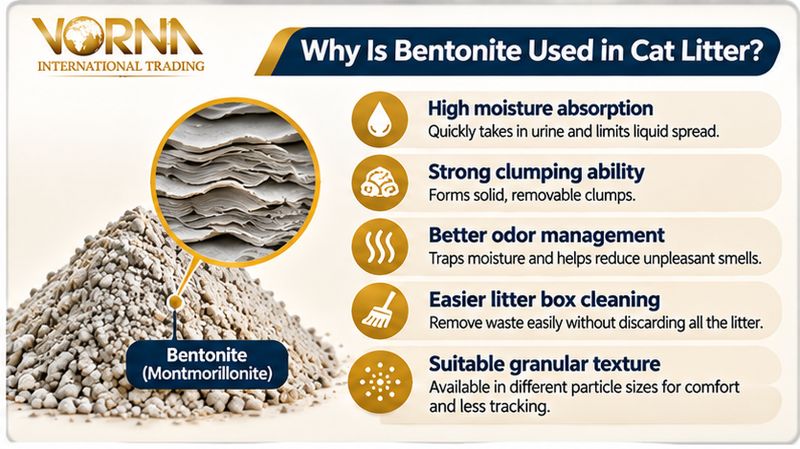
1. High Moisture Absorption
One of the main reasons bentonite is used in cat litter is its ability to absorb water.
When urine contacts the litter, moisture enters the spaces between particles and interacts with the clay minerals.
This helps limit the spread of liquid across the litter box.
Absorption performance depends on the mineral composition, granule structure, and processing quality.
A bentonite product with good absorption characteristics can help maintain a drier litter surface between cleaning sessions.
2. Strong Clumping Ability
Clumping is a major advantage of sodium bentonite cat litter.
As the clay absorbs liquid and expands, nearby particles come into contact and adhere to one another. The affected area gradually forms a removable mass.
A well-formed clump should remain intact when lifted with a litter scoop.
For example, if a cat urinates in one corner of the litter box, the wet granules can form a localized clump. The owner can remove that clump without emptying the entire box.
Clump strength varies between products. Some formulations produce firm clumps, while others break apart during cleaning.
3. Better Odor Management
Cat litter needs to manage moisture as well as unpleasant odors.
Bentonite helps by absorbing urine and concentrating wet material into removable clumps. Some odor-producing substances may also interact with mineral surfaces.
However, bentonite does not eliminate every odor-causing compound.
Urine breakdown, bacterial activity, litter box hygiene, and the frequency of waste removal all influence odor levels.
Products may include additional odor-control ingredients, but their effectiveness depends on the formulation.
4. Easier Litter Box Cleaning
Clumping bentonite allows owners to remove urine-soaked material during routine cleaning.
This reduces the need to discard all the unused litter after every urination.
Regular scooping also makes it easier to identify wet areas and maintain a suitable litter level.
The remaining litter still needs to be checked, replenished, and replaced when necessary.
5. Suitable Granular Texture
Bentonite can be processed into different particle sizes, including fine and medium granules.
Granule size affects how the litter feels under a cat’s paws, how easily it forms clumps, and how much material may scatter outside the box.
Fine granules provide a relatively smooth texture but can increase tracking or dust if poorly processed.
Coarser particles may reduce tracking in some formulations, although they can behave differently during liquid absorption.
Manufacturers must balance these characteristics according to the intended product.
How Does Bentonite Cat Litter Work?
The mechanism behind bentonite cat litter depends mainly on water absorption, swelling, and particle interaction.
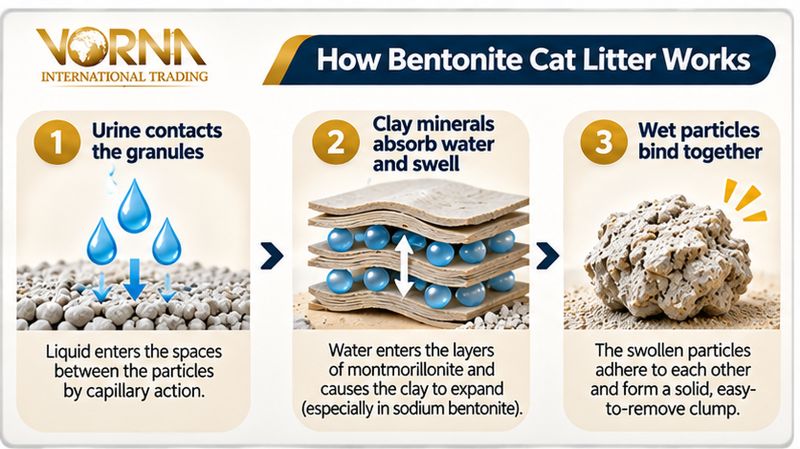
Step 1: Urine Contacts the Bentonite Granules
When urine reaches the litter surface, liquid begins entering the spaces between the granules.
Capillary forces and the absorbent structure of the material help draw moisture into the surrounding particles.
The amount of liquid absorbed depends on the bentonite grade and the properties of the finished litter.
Step 2: Clay Minerals Absorb Water and Swell
Bentonite commonly contains montmorillonite, a layered clay mineral.
In swelling bentonite, water molecules enter the spaces between mineral layers and interact with exchangeable ions.
This increases the separation between some layers, causing the clay to expand.
Sodium bentonite is especially useful because its mineral structure and exchangeable sodium ions often support substantial swelling.
The extent of expansion depends on mineral composition and the chemistry of the liquid.
Step 3: Wet Particles Bind Together
As the particles absorb moisture, they swell and interact with neighboring granules.
The hydrated clay develops cohesive properties that help the affected particles form a clump.
A successful clumping formulation balances swelling behavior with sufficient mechanical strength.
If the clump is too weak, it may break apart when removed.
Step 4: The Clump Is Removed
After the clump has formed, it can be removed with a suitable scoop.
Unused litter remains in the box, provided it is still clean and suitable for continued use.
The clumping process makes daily maintenance more convenient and allows more targeted removal of contaminated material.
Why Is Sodium Bentonite Preferred Over Calcium Bentonite?
Bentonite is commonly classified according to its dominant exchangeable cations, particularly sodium and calcium.
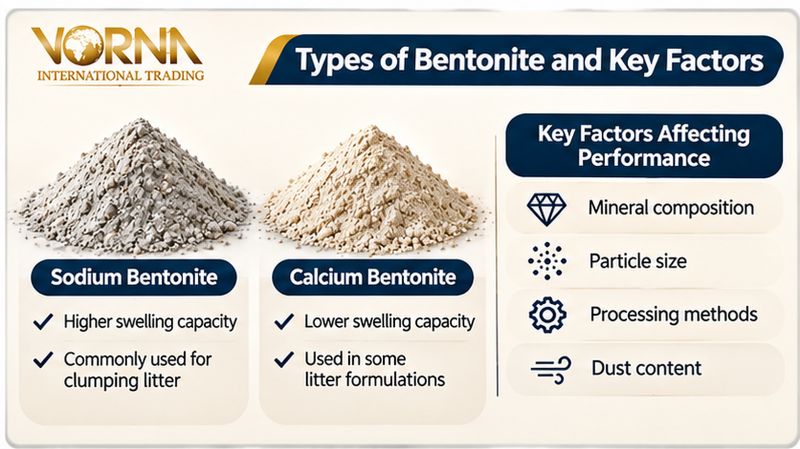
Both forms can absorb moisture, but their swelling behavior differs.
| Property | Sodium Bentonite | Calcium Bentonite |
|---|---|---|
| Swelling capacity | Generally higher | Generally lower |
| Water absorption | High, depending on grade | Variable, depending on grade |
| Clumping potential | Commonly suitable for strong clumping formulations | Often requires additional processing or formulation adjustments |
| Typical cat litter application | Clumping cat litter | Absorbent litter and selected formulations |
| Performance factors | Mineral purity, particle size, processing | Mineral purity, particle size, processing |
Sodium bentonite is often preferred when a manufacturer wants a product that forms cohesive clumps after contact with moisture.
Calcium bentonite can still be useful in absorbent products, and some materials undergo sodium activation to modify their swelling properties.
For a detailed explanation of mineral composition, swelling behavior, and industrial applications, read Sodium Bentonite vs Calcium Bentonite: Differences and Uses.
What Affects the Quality of Bentonite Cat Litter?
Even when two products contain sodium bentonite, their performance can differ noticeably.
Several material and manufacturing characteristics influence the finished product.
Montmorillonite Content
Montmorillonite is the main swelling clay mineral associated with bentonite.
Its proportion and mineral characteristics influence the material’s ability to interact with water.
However, a higher montmorillonite content alone does not guarantee better finished litter performance.
Particle Size Distribution
Granule size affects moisture distribution, dust generation, and clump formation.
Manufacturers use crushing, granulation, and screening processes to obtain the required particle-size range.
A controlled distribution helps improve product consistency.
Initial Moisture Content
Moisture content influences storage stability, granule strength, and the amount of additional liquid the product can absorb.
Excessive moisture before packaging may reduce the remaining absorption capacity.
Very dry or mechanically weak granules may generate more dust during handling.
Dust Content
Dust is an important quality consideration for both consumers and wholesale buyers.
Fine particles can become airborne when litter is poured, moved, or scooped.
Screening, granule strength, and manufacturing controls help reduce dust generation.
A product described as low-dust should still be evaluated through actual testing.
Clump Strength
Strong clumps make waste removal easier.
Clump integrity depends on the mineral properties, particle size, moisture absorption behavior, and any ingredients added during manufacturing.
For commercial buyers, sample testing provides useful evidence of how a product performs during normal use.
Application-Specific Bentonite Grades
Bentonite is used in several industries, but different applications require different performance characteristics.
For example, Drilling Bentonite is selected for properties such as viscosity development, filtration behavior, and drilling-fluid performance. Cat litter manufacturers focus more directly on moisture absorption, clump strength, granule size, and dust content.
A bentonite grade that performs well in drilling fluids is not automatically suitable for cat litter production.
Manufacturers should therefore verify application-specific test results before selecting raw materials.
Is Bentonite Cat Litter Safe for Cats?
Bentonite-based cat litter is widely used in household pet care, and commercial clay litter is generally considered suitable when used as intended.
Still, product quality and the individual cat’s needs matter.
Dust exposure: Some clay litters release fine particles during pouring or scooping. Low-dust products may be preferable for cats or owners sensitive to airborne dust.
Accidental ingestion: Small amounts of litter can be swallowed during grooming. Persistent litter eating or ingestion of large amounts needs veterinary attention.
Young kittens: Kittens may investigate litter by putting it in their mouths. Non-clumping alternatives are often recommended for very young kittens until they are older and less likely to ingest litter.
Litter box maintenance: Used litter may contain microorganisms and waste-related contaminants. Regular cleaning and proper hygiene remain necessary regardless of the mineral used.
According to the European Bentonite Association’s FAQ on the safety of clay-based pet litter, clay-based pet litter is considered safe under normal conditions of use.
Does Bentonite Cat Litter Have Any Disadvantages?
Bentonite offers useful performance characteristics, but it also has limitations.
Dust Generation
Some products generate dust during transport, pouring, or scooping.
The amount depends on processing conditions and the physical strength of the granules.
Heavy Weight
Mineral-based litter can be heavier than some plant-based alternatives.
Weight affects handling, packaging, shipping costs, and storage requirements.
This is particularly relevant for international importers purchasing large quantities.
Disposal Restrictions
Bentonite cat litter should generally be placed in the appropriate household waste stream according to local disposal rules.
Because swelling clay can expand in contact with water, it should not be flushed down toilets.
Environmental Considerations
Bentonite is a mined mineral resource, and its extraction and processing have environmental impacts.
Conventional bentonite litter is not generally considered biodegradable.
Consumers interested in alternative materials can compare the characteristics of plant-based and mineral-based litter.
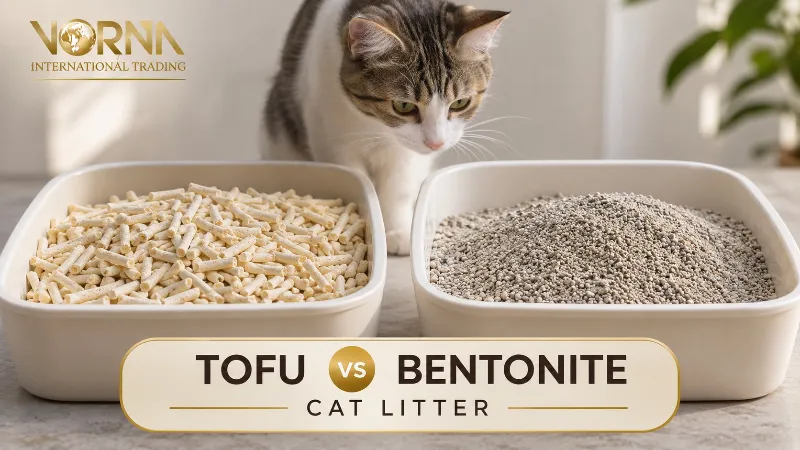
For a closer comparison of their absorbency, clumping behavior, dust levels, and disposal characteristics, read Tofu Cat Litter vs. Bentonite Cat Litter.
Bentonite Cat Litter vs. Non-Clumping Cat Litter
Clumping and non-clumping litters manage moisture differently.
Bentonite-based clumping litter forms removable masses when exposed to urine. Non-clumping litter absorbs liquid but does not necessarily bind the affected particles into solid clumps.
This changes how the litter box is maintained.
With clumping litter, owners can remove localized wet material during daily cleaning. Non-clumping products may require a different replacement schedule as moisture accumulates.
Neither type guarantees complete odor elimination or a dust-free environment.
Material quality, cleaning frequency, and the cat’s preferences influence the overall experience.
Choosing between these products depends on the cat’s preferences, the desired cleaning routine, and the performance characteristics of the litter.
Why Bentonite Quality Matters for Cat Litter Manufacturers
For manufacturers and wholesale distributors, bentonite is more than a basic mineral ingredient.
Its characteristics affect product consistency, packaging performance, consumer satisfaction, and production costs.
A suitable raw material should meet the requirements of the intended litter formulation.
Buyers commonly evaluate absorption behavior, swelling capacity, particle-size distribution, dust content, and clump integrity.
Commercial factors also matter. These include supply consistency, packaging options, delivery requirements, and technical documentation.
For example, a distributor sourcing bentonite cat litter for several markets may need a specific granule size and packaging format. These requirements should be confirmed before ordering commercial quantities.
Businesses that need raw bentonite for manufacturing can review Vornaco’s Bentonite Supplier & Exporter page for available grades, technical information, and bulk supply requirements.
The appropriate material should be selected according to the intended cat litter formulation and supported by relevant testing.
Bentonite Cat Litter Supply from Vornaco
Vornaco supplies bentonite and bentonite-based cat litter for international buyers, including importers, wholesalers, distributors, and pet product businesses.
The company supports commercial inquiries involving product grades, technical specifications, packaging requirements, and export arrangements.
Businesses evaluating bentonite cat litter can review Vornaco’s available products and request information relevant to their purchasing requirements.
For bulk sourcing inquiries, buyers can contact Vornaco with their required product specifications, estimated order quantities, preferred packaging, and destination country.
Providing this information helps identify suitable supply options and supports more accurate commercial quotations.
Frequently Asked Questions About Bentonite Cat Litter
What makes bentonite suitable for cat litter production?
Bentonite absorbs moisture and, in suitable formulations, forms removable clumps. These properties help manage wet litter and simplify cleaning. Sodium bentonite is commonly selected because of its swelling characteristics.
How does sodium bentonite form clumps?
When sodium bentonite contacts liquid, its clay minerals absorb water and swell. The hydrated particles interact with neighboring granules, forming cohesive masses that can be removed from the litter box.
Does bentonite cat litter eliminate urine odor completely?
No. Bentonite can help manage urine-related odors by absorbing moisture and allowing contaminated litter to be removed. Odor control still depends on the product formulation, waste removal frequency, and litter box hygiene.
Why do some bentonite cat litters produce more dust than others?
Dust generation depends on particle size, processing methods, granule strength, and the amount of fine material remaining in the finished product. Screening and suitable production controls can help reduce dust.
Can bentonite cat litter be flushed down the toilet?
No. Conventional bentonite cat litter should not be flushed. Its swelling properties may contribute to blocked plumbing, and disposal must follow applicable local waste-management rules.
Is all bentonite suitable for making clumping cat litter?
No. Bentonite deposits differ in mineral composition and swelling behavior. Suitable raw materials must meet the technical requirements of the intended cat litter formulation.
What should wholesale buyers check before purchasing bentonite cat litter?
Buyers should evaluate moisture absorption, clump strength, granule size, dust content, product consistency, packaging specifications, and available quality documentation. Sample testing is useful before committing to large orders.