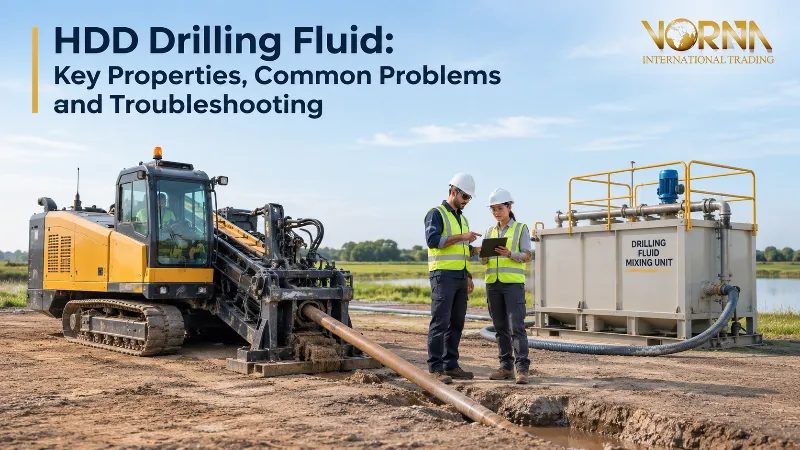
Horizontal Directional Drilling (HDD) relies on drilling fluids to transport cuttings, lubricate drilling equipment, stabilize the borehole, and control fluid losses during underground installation. However, successful HDD operations depend on more than simply increasing drilling-fluid viscosity. Water chemistry, rheological behavior, filtration properties, annular pressure, and drilling conditions must work together.
A properly designed HDD drilling fluid should provide sufficient cuttings transport while maintaining manageable pumping pressure and minimizing the risk of borehole instability, fluid loss, and inadvertent returns (frac-out).
This guide explains the main properties of HDD drilling fluids, how to test them, why common performance problems occur, and what operators should investigate before adjusting the fluid formulation.
1. What Is HDD Drilling Fluid?
HDD drilling fluid, also known as HDD drilling mud, is a circulating fluid used during horizontal directional drilling operations. It is commonly formulated using water, bentonite, and selected additives designed to achieve the required rheological and filtration properties.
Unlike conventional excavation methods, HDD creates an underground borehole through which the drilling assembly and, eventually, the product pipe are installed. The drilling fluid performs several functions throughout this process.
Its main functions include:
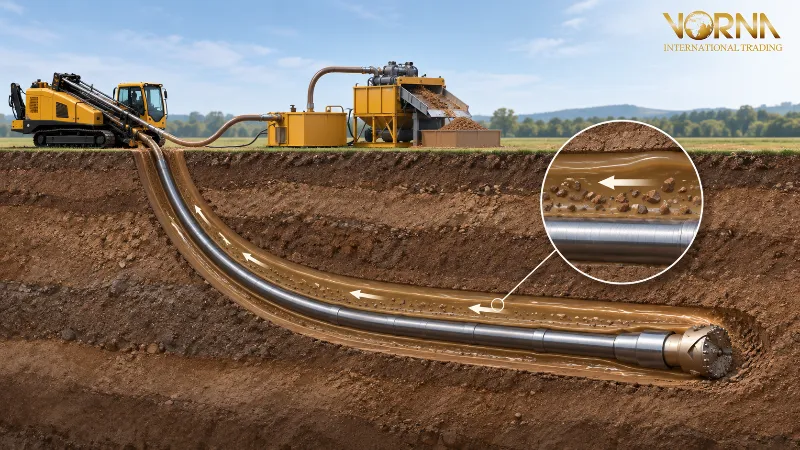
- Cuttings Transport: Carries soil and rock fragments from the borehole to the surface through the annular space.
- Borehole Stabilization: Helps maintain borehole integrity and reduces the risk of collapse in suitable ground conditions.
- Lubrication: Reduces friction between the drill string, drilling tools, and surrounding formation.
- Cooling: Helps dissipate heat generated during drilling.
- Fluid Loss Control: Forms a filter cake on permeable borehole walls, helping limit fluid invasion into the surrounding formation.
- Hydraulic Power Transmission: In applicable HDD systems, drilling fluid provides hydraulic power to downhole motors and drilling tools.
These functions are interconnected. For example, increasing viscosity may improve the suspension of drilled cuttings, but it can also increase pumping pressure. Therefore, the objective is to develop a fluid that performs effectively under the actual geological and operational conditions.
2. Key Properties of HDD Drilling Fluid
The performance of an HDD drilling fluid is determined by several measurable properties. Evaluating these parameters together provides a more reliable understanding of fluid behavior than relying on a single viscosity reading.
2.1. Viscosity
Viscosity describes a fluid’s resistance to flow. In HDD operations, it influences the ability of drilling fluid to transport drilled cuttings through the annular space.
If viscosity is too low, solid particles may settle and accumulate along the lower section of a horizontal borehole. This can lead to poor hole cleaning, increased torque, and difficulties during reaming or pipe installation.
On the other hand, excessively high viscosity can increase pumping pressure, reduce circulation efficiency, and contribute to hydraulic problems.
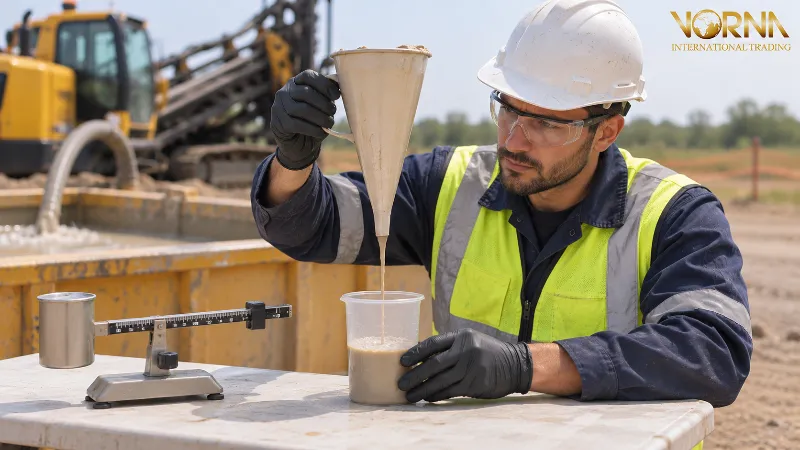
Viscosity is commonly checked in the field using a Marsh Funnel Viscometer. The result is reported as the time required for a specified volume of fluid to pass through the funnel.
However, Marsh Funnel viscosity is a practical screening measurement rather than a complete description of fluid rheology.
The important consideration: The target viscosity should be selected according to the drilling fluid formulation, formation characteristics, borehole geometry, and required circulation rate. There is no single viscosity value suitable for every HDD project.
2.2. Rheology and Gel Strength
Drilling fluids generally exhibit non-Newtonian behavior. Many bentonite-based HDD fluids are shear-thinning and thixotropic.
This means their apparent viscosity changes with applied shear, while their internal structure can develop when the fluid remains at rest.
These characteristics are useful during HDD operations:
- Lower apparent viscosity under higher shear can help reduce resistance during pumping.
- Suitable low-shear viscosity supports cuttings transport in the annular space.
- Gel strength helps suspend particles when circulation stops.
- Controlled rheological behavior helps balance hole cleaning and pumping requirements.
Gel strength is particularly important during temporary circulation interruptions. If the fluid cannot suspend the drilled solids adequately, particles may settle and form a cuttings bed.
However, excessive gel strength can create high startup pressure when circulation resumes.
HDD fluid design should therefore consider low-shear rheological behavior rather than relying exclusively on conventional high-speed rotational viscometer readings.
Research presented at the 18th European Conference on Soil Mechanics and Geotechnical Engineering highlights the importance of low-shear rheology in HDD and explains why conventional Bingham-model assumptions based on 300 and 600 rpm readings may not adequately represent flow behavior inside HDD bores.
2.3. Fluid Loss and Filter Cake Formation
Fluid loss refers to the movement of liquid from the drilling fluid into permeable formations.
During HDD operations, bentonite particles can accumulate against the borehole wall and form a thin filter cake.
A suitable filter cake helps:
- Reduce excessive fluid invasion into the formation.
- Support borehole integrity.
- Limit uncontrolled fluid losses.
- Improve the performance of the circulating drilling-fluid system.
However, minimizing fluid loss without considering other properties is not sufficient.
The filter cake should provide effective filtration control without becoming excessively thick or contributing to increased friction and restricted circulation.
Fluid loss performance depends on several factors, including:
- Bentonite grade and mineral characteristics.
- Degree of hydration and dispersion.
- Water chemistry.
- Additive compatibility.
- Formation permeability.
- Solids concentration and particle-size distribution.
A fluid that develops acceptable viscosity does not necessarily provide adequate filtration control. Both properties should be evaluated independently.
2.4. Fluid Density
Fluid density, also called mud weight, is another important parameter in HDD operations.
It influences the hydrostatic pressure of the fluid column and contributes to the pressure conditions within the borehole.
An appropriate fluid density helps maintain the required hydraulic conditions, but increasing density without considering formation strength can create additional risks.
Excessive annular pressure may contribute to inadvertent drilling-fluid returns, commonly known as frac-out, particularly when the formation has limited pressure tolerance.
Density should therefore be evaluated together with flow rate, borehole geometry, fluid rheology, and the geotechnical characteristics of the formation.
2.5. Sand Content and Suspended Solids
Sand content is an important indicator of the amount of abrasive solids present in a drilling-fluid system.
During HDD, drilled materials enter the circulating fluid and must be separated through an appropriate solids-control and recycling process.
Excessive sand and suspended solids can cause:
- Increased equipment wear.
- Changes in fluid density and rheology.
- Reduced efficiency of drilling-fluid treatment.
- Accumulation of solids in the circulation system.
- Difficulties maintaining consistent fluid properties.
Regular monitoring of sand content and effective separation of drilled solids are important for maintaining fluid performance.
2.6. pH, Water Hardness and Chloride Content
The chemical composition of make-up water can significantly influence bentonite hydration.
Three parameters deserve particular attention:
pH
The pH of the mixing water affects the hydration and dispersion behavior of bentonite and other drilling-fluid additives.
Strongly acidic conditions may interfere with the development of the desired fluid properties.
Calcium Hardness
Dissolved calcium ions can interfere with bentonite hydration and influence particle interactions.
High calcium hardness may result in poor viscosity development, water separation, and uncontrolled filtration behavior.
Chloride Content
Chlorides, commonly associated with saline water, can inhibit bentonite hydration and reduce the development of the required fluid properties.
This is particularly important when using groundwater, seawater, or water from industrial sources.
For a more detailed explanation of these mechanisms, read our guide:
How Water Salinity Affects Bentonite Hydration and Performance
3. Important HDD Drilling Fluid Tests
A reliable HDD fluid management program should include regular field testing and evaluation of the fluid throughout the drilling operation.
The following table summarizes the main parameters and their practical importance.
| Test Parameter | Testing Method | Why It Matters |
|---|---|---|
| Funnel Viscosity | Marsh Funnel Viscometer | Evaluates flow resistance and provides a rapid field indicator |
| Rheology | Rotational Viscometer / Rheometer | Evaluates flow behavior under different shear conditions |
| Gel Strength | Rotational Viscometer | Evaluates the ability to suspend particles during static periods |
| Fluid Density | Mud Balance | Monitors mud weight and hydrostatic conditions |
| Fluid Loss | Filter Press | Evaluates filtration behavior |
| Sand Content | Sand Content Kit | Measures abrasive solid contamination |
| pH | pH Meter or Test Strips | Evaluates water and fluid alkalinity |
| Calcium Hardness | Hardness Test | Identifies water-quality problems affecting hydration |
| Chloride Content | Chloride Test | Identifies saline contamination |
API RP 13B-1 provides standardized field-testing procedures for water-based drilling fluids, including viscosity, gel strength, density, filtration, sand content, pH, chloride content, and total hardness.
For HDD applications, the applicable project specification and fluid management plan should determine which tests are required and how frequently they are performed.
Why Regular Testing Matters
A drilling-fluid system can change significantly during a project.
For example, the fluid may initially perform well when prepared with suitable water, but its properties can deteriorate after exposure to saline groundwater or calcium-rich formations.
Similarly, the accumulation of drilled solids can gradually change the fluid density, viscosity, and filtration behavior.
Testing should therefore be performed at defined intervals and whenever significant changes occur in:
- Formation geology.
- Make-up water quality.
- Drilling-fluid circulation.
- Drilled-solids loading.
- Fluid returns.
- Pumping pressure.
Testing only the freshly prepared fluid is not sufficient to establish how it will perform throughout the HDD operation.
4. Common HDD Drilling Fluid Problems and Their Causes
Many HDD fluid problems are initially treated by adding more bentonite or increasing viscosity. However, this approach may not address the actual cause.
The following troubleshooting guide provides a more systematic starting point.
4.1. Low Viscosity and Poor Viscosity Development
Possible causes:
- Insufficient bentonite hydration.
- High calcium hardness in make-up water.
- High chloride concentration.
- Unsuitable bentonite grade.
- Inadequate mixing and dispersion.
- Excessive dilution.
- Contamination by drilling solids or incompatible materials.
Recommended checks:
- Test the quality of the make-up water.
- Measure pH, calcium hardness, and chloride content.
- Check the bentonite grade and its laboratory specifications.
- Review powder addition rate and mixing conditions.
- Allow sufficient hydration time according to the product and fluid formulation.
- Recheck viscosity and filtration properties before making further adjustments.
Adding more bentonite without investigating water chemistry or hydration conditions may increase material consumption without solving the problem.
4.2. Excessively High Viscosity
High viscosity can make an HDD fluid difficult to pump and circulate.
Common causes include:
- Excessive bentonite concentration.
- Accumulation of drilled solids.
- Insufficient solids separation.
- Inappropriate additive concentration.
- Changes in water chemistry and particle interactions.
Recommended checks:
- Measure fluid density and sand content.
- Compare current viscosity with previous measurements.
- Inspect the solids-control and recycling system.
- Review the bentonite and additive concentrations.
- Evaluate pumping pressure and circulation performance.
Dilution may be appropriate in some situations, but it should only be considered after identifying the source of the increased viscosity.
4.3. Poor Cuttings Transport
Poor hole cleaning is a significant operational concern in horizontal directional drilling.
When the drilling fluid cannot carry the drilled materials effectively, cuttings may accumulate along the lower part of the borehole.
This can result in:
- Increased drilling torque.
- Higher pullback resistance.
- Restricted annular circulation.
- Increased pressure.
- Borehole blockage.
Possible contributing factors include inadequate circulation rate, unsuitable fluid rheology, excessive penetration rate, unfavorable annular geometry, and high solids loading.
Recommended checks:
- Evaluate the actual flow rate.
- Inspect the volume and condition of returning drilling fluid.
- Review the relationship between borehole diameter and drill-string diameter.
- Evaluate cuttings size and the formation being drilled.
- Check low-shear rheological behavior.
- Review drilling progress against the fluid circulation capacity.
Increasing Marsh Funnel viscosity alone is not necessarily the correct solution. Higher viscosity may increase pumping pressure without resolving an inadequate cuttings transport strategy.
4.4. Excessive Fluid Loss
Excessive fluid loss occurs when drilling fluid enters permeable formations faster than the fluid system can maintain adequate circulation and filtration control.
Possible causes include:
- Highly permeable soil or fractured formations.
- Inadequate filter cake development.
- Poorly hydrated bentonite.
- Unsuitable bentonite grade.
- Saline or hard make-up water.
- Inappropriate fluid formulation.
Recommended checks:
- Perform the relevant filtration test.
- Examine the quality of the filter cake.
- Review water chemistry.
- Evaluate the bentonite grade and additive compatibility.
- Monitor the difference between pumped and returned fluid volumes.
A suitable fluid formulation should be selected according to the formation and project requirements rather than relying on a universal fluid-loss target.

4.5. Pressure Increase and Inadvertent Drilling Fluid Returns (Frac-Out)
Frac-out is one of the most important risks in HDD operations.
It occurs when drilling-fluid pressure exceeds the ability of the surrounding formation to contain the fluid, resulting in unintended fluid migration toward the ground surface or another pathway.
Potential contributing factors include:
- Excessive annular pressure.
- Restricted annular circulation.
- Accumulation of cuttings.
- High pumping rates relative to the available return path.
- Inappropriate fluid rheology.
- Weak or fractured formations.
Recommended checks:
- Monitor annular pressure where appropriate.
- Compare actual pressure with the project-specific allowable pressure limits.
- Monitor drilling-fluid returns and changes in fluid volume.
- Investigate sudden pressure increases or unexplained fluid losses.
- Evaluate possible cuttings accumulation and borehole restrictions.
If abnormal pressure or loss of returns occurs, the operation should follow the approved HDD contingency procedure. Continuing to increase pumping pressure without investigating the cause can make the situation worse.
5. How to Prepare and Maintain HDD Drilling Fluid
Proper preparation is essential for developing consistent drilling-fluid properties.
The following sequence provides a practical framework.
Step 1: Evaluate Make-Up Water
Before adding bentonite, examine the chemical quality of the water.
Check:
- pH.
- Calcium hardness.
- Chloride content.
- General water quality.
Water that interferes with bentonite hydration should be evaluated before it is used for fluid preparation.
Step 2: Select the Appropriate Bentonite Grade
Not every bentonite grade provides the same hydration, viscosity, and filtration characteristics.
The material should be selected according to:
- Required rheological properties.
- Swelling behavior.
- Filtration requirements.
- Water chemistry.
- HDD application and formation conditions.
API-grade bentonite may be appropriate where the project requires compliance with the relevant API specification, but API compliance alone does not establish suitability for every HDD project.
For more information, see:
Step 3: Add Bentonite Under Controlled Mixing Conditions
Bentonite should be introduced gradually into the circulating water under suitable mixing conditions.
Rapid addition or inadequate dispersion can lead to partially hydrated aggregates and uneven fluid properties.
The mixing process should provide sufficient circulation and dispersion to allow the bentonite particles to hydrate effectively.
Step 4: Allow Adequate Hydration
Hydration time depends on bentonite characteristics, water chemistry, temperature, and mixing conditions.
The fluid should be evaluated after the required hydration period rather than assuming that the initial viscosity represents its final performance.
Step 5: Test Before Application
Before introducing the fluid into the drilling operation, verify the required properties.
Depending on the project specification, these may include:
- Funnel viscosity.
- Rheology and gel strength.
- Density.
- Fluid loss.
- pH.
- Sand content.
Step 6: Monitor and Recondition During Drilling
During circulation, the fluid may accumulate drilled solids or encounter changes in water chemistry.
Regular testing, solids separation, and controlled reconditioning help maintain the required properties.
A fluid management plan should define the monitoring frequency, acceptable operating limits, and corrective actions.
6. How to Select Bentonite for HDD Applications
Selecting bentonite for HDD should begin with the required performance of the drilling-fluid system, not simply the product name or price.
Industrial buyers and drilling contractors should evaluate several characteristics before purchasing.
| Selection Factor | What to Evaluate |
|---|---|
| Mineral Composition | Montmorillonite content and relevant mineral characteristics |
| Swelling Behavior | Hydration and swelling under specified test conditions |
| Viscosity Development | Ability to develop the required rheological properties |
| Filtration Performance | Fluid loss and filter cake characteristics |
| Particle Size | Dispersion and hydration behavior |
| Moisture Content | Storage, handling, and delivered product quality |
| Chemical Compatibility | Response to the intended mixing water |
| Batch Consistency | Consistency between laboratory samples and delivered shipments |
Buyers should request a product-specific Technical Data Sheet (TDS) and Certificate of Analysis (COA).
These documents help establish whether the supplied material meets the required specifications.
Vornaco provides drilling bentonite products for industrial drilling applications. To review available grades and laboratory information, visit the Drilling Bentonite product page.
For additional information about the company’s bentonite grades and supply options, see Bentonite Supplier & Exporter.
7. Practical HDD Drilling Fluid Monitoring Checklist
A structured monitoring routine helps identify changes before they become major operational problems.
The following checklist can be used as a starting point for an HDD fluid management procedure.
Before drilling:
- Check make-up water quality.
- Confirm the selected bentonite grade.
- Verify the mixing and circulation equipment.
- Prepare the fluid according to the required formulation.
- Record initial fluid properties.
- Establish project-specific pressure and fluid-loss limits.
During drilling:
- Monitor Marsh Funnel viscosity.
- Evaluate rheology and gel strength at the required intervals.
- Check fluid density and solids content.
- Monitor drilling-fluid returns.
- Track changes in pumping and annular pressure.
- Inspect the recycling and solids-control system.
- Record significant changes in geology and water conditions.
After drilling or during reaming and pullback:
- Evaluate remaining fluid properties.
- Monitor returns and possible fluid losses.
- Maintain appropriate circulation conditions.
- Manage used drilling fluid and cuttings according to applicable environmental requirements.
The monitoring frequency should be established by the project’s drilling-fluid management plan. More frequent testing may be necessary following significant changes in geology, water chemistry, or fluid performance.
8. Frequently Asked Questions About HDD Drilling Fluid
What is the main purpose of drilling fluid in HDD?
HDD drilling fluid transports cuttings, lubricates and cools drilling equipment, helps stabilize the borehole, and controls fluid loss. Its effectiveness depends on fluid properties, formation conditions, and operating parameters.
What is the ideal viscosity for HDD drilling fluid?
There is no universal ideal viscosity for every HDD project. The required Marsh Funnel viscosity depends on soil conditions, borehole geometry, circulation rate, cuttings characteristics, and the fluid formulation.
Why does HDD drilling fluid lose viscosity?
Common causes include poor bentonite hydration, high calcium hardness, chloride contamination, unsuitable bentonite grade, and excessive dilution. Water chemistry and mixing conditions should be checked before increasing bentonite concentration.
What causes excessive fluid loss during HDD?
Excessive fluid loss may result from permeable or fractured formations, poor filter cake development, inadequate bentonite hydration, or unsuitable fluid formulation. Filtration tests and formation conditions should be evaluated together.
How does bentonite improve cuttings transport?
When properly hydrated, bentonite increases the flow resistance and suspension characteristics of water-based drilling fluids. These properties help carry drilled particles through the annular space toward the surface.
What is frac-out in horizontal directional drilling?
Frac-out is the unintended escape of drilling fluid into the surrounding ground or toward the surface when fluid pressure exceeds the formation’s containment capacity. Annular pressure monitoring, proper fluid design, and effective hole cleaning help manage this risk.
Is API-grade bentonite always suitable for HDD?
Not necessarily. API-grade bentonite is evaluated against the applicable API specification, but an HDD project may require additional performance considerations. Water chemistry, rheology, filtration behavior, and geological conditions should also be assessed.
Which tests are important for HDD drilling fluid?
Important tests include Marsh Funnel viscosity, rheology, gel strength, fluid density, fluid loss, sand content, pH, calcium hardness, and chloride content. The exact testing program should follow the project specification.
Conclusion
Successful horizontal directional drilling depends on maintaining a drilling-fluid system that balances cuttings transport, filtration control, borehole stability, and manageable pumping pressure.
Bentonite is an important component of many HDD fluids, but its performance depends on the quality of the mixing water, hydration conditions, product characteristics, and the complete fluid formulation.
Rather than focusing on viscosity alone, drilling contractors should monitor rheology, fluid density, filtration behavior, water chemistry, solids content, and annular pressure throughout the operation.
A systematic approach to fluid testing and troubleshooting can help reduce circulation problems, improve hole cleaning, and minimize the operational risks associated with HDD projects.
For technical information about drilling bentonite grades, laboratory documentation, and bulk supply options, visit Vornaco’s drilling bentonite product page.
Technical References
- Fluid Rheology and Its Implications for Flow and Cuttings Transport in HDD Bores – ISSMGE, ECSMGE 2024
- HDD Position Statement Note – AQUIND / WSP, 2020
- Drilling Fluid Properties and Testing – Cebo Holland, HDD Applications, 2025
- API RP 13B-1 – Recommended Practice for Field Testing Water-Based Drilling Fluids