How Water Salinity Affects Bentonite Hydration and Performance
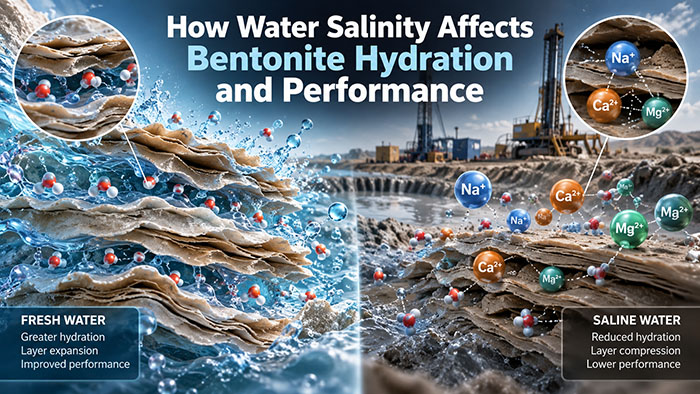
Water chemistry can change the behavior of bentonite long before the clay is exposed to mechanical loading or elevated temperatures. A bentonite that disperses readily in freshwater may behave quite differently when mixed with seawater, groundwater containing dissolved calcium, or concentrated industrial brine.
The difference begins at the mineral surface. Dissolved salts influence how water interacts with bentonite particles, how far the clay layers separate, and whether individual particles remain dispersed or form larger aggregates. These microscopic changes can alter viscosity, swelling, filtration behavior, and hydraulic conductivity.
For industrial applications, water salinity is therefore not simply a property of the mixing water. It is a factor that directly influences bentonite hydration and performance.
Why Is Bentonite Sensitive to Water Salinity?
Bentonite owes much of its water-responsive behavior to smectite minerals, particularly montmorillonite. These minerals consist of thin, layered particles with negatively charged surfaces balanced by exchangeable cations.
When bentonite contacts water, hydration occurs around these cations and on the mineral surfaces. Water can also enter the spaces between individual clay layers, producing interlayer expansion.
In suitable conditions, electrostatic repulsion between clay particles contributes to their separation and dispersion.
Dissolved salts modify this behavior by changing the ionic environment surrounding the clay.
Three processes are especially important:
- Electrostatic screening: Dissolved ions reduce the effective repulsion between charged clay surfaces.
- Cation exchange: Ions in the water can replace exchangeable cations associated with the clay.
- Particle aggregation: Reduced repulsion can allow clay particles to approach one another and form larger structures.
Together, these processes explain why bentonite often behaves differently in freshwater and saline solutions, even when the amount of bentonite remains unchanged.
The response of bentonite to dissolved salts is closely related to its mineral composition and exchangeable cations. These characteristics also help distinguish the industrial grades offered by a Bentonite Supplier for different applications.
How Does Salinity Affect Bentonite Hydration?
Bentonite hydration involves more than water absorption. It includes hydration of exchangeable cations, expansion of interlayer spaces, and interactions between clay particles suspended in water.
These mechanisms respond differently to the chemistry of the surrounding liquid.
Compression of the Diffuse Double Layer
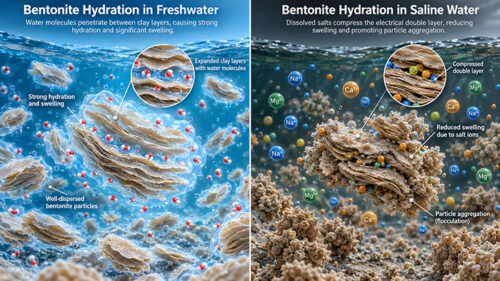
Montmorillonite surfaces carry a net negative charge. Counterions in the surrounding water help balance this charge and establish an electrical double layer around the clay particles.
In dilute electrolyte solutions, the diffuse portion of this layer can extend farther from the mineral surface. Electrostatic repulsion helps prevent particles from approaching each other closely.
As dissolved salt concentration increases, the diffuse double layer becomes compressed. The reduced range of repulsive interactions can promote particle association.
In a bentonite suspension, this may change dispersion, particle arrangement, and flow properties.
The effect is particularly relevant to sodium bentonite, whose swelling and dispersion behavior can be strongly influenced by the ionic environment.
Reduced Osmotic Swelling
Osmotic swelling occurs when water enters the spaces between clay layers and contributes to their separation.
The difference in ionic conditions between the interlayer region and surrounding solution helps drive this process.
When the external solution contains more dissolved electrolytes, the conditions supporting osmotic swelling become less favorable.
As a result, sodium bentonite generally develops less osmotic expansion in concentrated saline solutions than in dilute freshwater.
This distinction matters because the large volume increase associated with sodium bentonite cannot be assumed to occur under saline conditions.
Changes in Clay Particle Aggregation
Salt can also change the arrangement of clay particles outside their individual mineral layers.
When electrostatic repulsion is reduced, particles can associate into larger aggregates or flocculated structures.
This changes the way water moves between particles and how the suspension responds to shear.
Importantly, flocculation and hydration are not interchangeable concepts. A suspension can develop a more pronounced aggregated structure without achieving the same degree of interlayer swelling observed in freshwater.
Sodium Chloride vs Calcium and Magnesium Salts
Not all dissolved salts affect bentonite in the same way.
The identity and electrical charge of the dissolved cations influence the clay’s response.
Sodium ions carry one positive charge, while calcium and magnesium ions each carry two. Divalent ions can interact more strongly with negatively charged mineral surfaces and contribute to cation exchange.
Consequently, total salinity alone does not fully describe the chemical environment experienced by bentonite.
The effects of dissolved salts are also influenced by the exchangeable cations already present in the clay. Our guide to Sodium Bentonite vs Calcium Bentonite explains how these two bentonite types differ in swelling behavior, water interaction, and industrial applications.
Effect of Sodium Chloride (NaCl)
Sodium chloride is particularly relevant to seawater exposure, saline groundwater, and water-based drilling systems that encounter salt-bearing formations.
Increasing NaCl concentration generally compresses the diffuse double layer and suppresses osmotic swelling.
Laboratory research on bentonite-based drilling suspensions has also demonstrated reductions in apparent viscosity following the dissolution of sodium chloride.
However, the rheological response is not necessarily linear over every concentration range. At high electrolyte concentrations, changes in particle association can produce more complicated flow behavior.
Effect of Calcium Chloride (CaCl₂)
Calcium ions can replace exchangeable sodium ions associated with montmorillonite.
This exchange changes the hydration environment and the balance of forces between clay layers.
In sodium bentonite suspensions, calcium-rich water can substantially alter dispersion and the structure of the resulting filter cake.
For bentonite-based barriers, the accompanying changes in swelling and pore structure may also affect hydraulic conductivity.
Effect of Magnesium Chloride (MgCl₂)
Magnesium is another divalent ion commonly encountered in seawater and certain industrial waters.
Experimental work on magnesium-chloride-contaminated drilling fluids has reported decreases in viscosity, yield point, and gel strength as magnesium chloride concentration increased within the systems examined.
In those experiments, increasing magnesium contamination also increased fluid loss.
These results illustrate how dissolved magnesium salts can influence both flow behavior and filtration performance.
Comparison of Common Dissolved Salts
| Dissolved salt | Relevant ion | Main interaction with bentonite | Industrial significance |
|---|---|---|---|
| Sodium chloride (NaCl) | Na⁺ | Electrostatic screening and suppression of osmotic swelling | Saline drilling fluids and brine exposure |
| Calcium chloride (CaCl₂) | Ca²⁺ | Cation exchange, double-layer compression and changes in particle association | Filtration and hydraulic-barrier behavior |
| Magnesium chloride (MgCl₂) | Mg²⁺ | Changes in dispersion, rheology and particle interactions | Drilling-fluid stability and filtration |
These effects depend on salt concentration, the initial exchangeable cations in the bentonite, and the physical conditions of the system.
How Salinity Changes Bentonite Viscosity and Rheology
In water-based suspensions, bentonite affects viscosity through the interaction of hydrated mineral surfaces and clay particle structures.
A well-dispersed bentonite suspension can develop useful flow resistance and suspension characteristics. These properties are particularly important in drilling fluids.
Introducing electrolytes modifies the particle interactions responsible for that behavior.
Apparent Viscosity
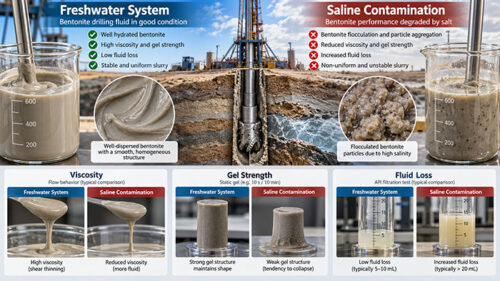
Apparent viscosity describes the resistance of a fluid to flow under a specified shear condition.
Salt-induced changes in hydration and dispersion can reduce apparent viscosity, as observed in experimental bentonite–NaCl systems.
A reduction in viscosity can affect the ability of a fluid to transport and suspend solid particles.
However, apparent viscosity alone does not describe the complete rheological behavior of a bentonite suspension.
Yield Point and Gel Strength
Yield point and gel strength are relevant to drilling-fluid performance because they describe different aspects of the resistance to flow and the development of structure.
The presence of dissolved salts can modify these properties by changing the interactions between clay particles.
Magnesium chloride contamination, for example, has been associated with declining yield point and gel strength in studied water-based mud formulations.
The practical consequence is that a bentonite suspension prepared under one water chemistry may not retain the same rheological characteristics after exposure to a different ionic environment.
Why Salt Contamination Does Not Always Produce One Simple Response
It is tempting to describe salt contamination as a uniform reduction in bentonite viscosity.
That description is incomplete.
Electrolytes influence both particle separation and aggregation. Depending on concentration and suspension conditions, these mechanisms can compete.
A clay suspension may become less dispersed while developing more pronounced particle associations. Its response can also depend on shear history, solid concentration, and hydration state.
For this reason, changes in viscosity, yield point, and gel strength should be understood as related but distinct responses to water chemistry.
Effect of Salinity on Bentonite Filtration and Hydraulic Conductivity
The influence of dissolved salts extends beyond swelling and viscosity.
In applications where bentonite is used to restrict water movement, the arrangement of hydrated clay particles is critical.
Filtration Behavior in Drilling Fluids
Bentonite contributes to the formation of filter cakes in water-based drilling fluids.
A filter cake consists of solid particles deposited as liquid passes into a permeable formation under a pressure difference.
Its structure influences the amount of filtrate entering the formation.
Salt-induced changes in bentonite hydration, dispersion, and aggregation can modify the packing and permeability of this deposited layer.
Research involving calcium-rich brines has demonstrated that cation chemistry can strongly influence bentonite filtration behavior.
In practical terms, changes in fluid loss cannot be explained solely by the viscosity of the original suspension. The resulting filter-cake structure also matters.
Hydraulic Conductivity in Bentonite-Based Barriers
Hydraulic conductivity describes the ability of a porous material to transmit liquid.
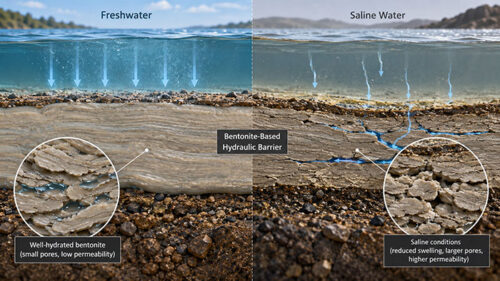
In compacted bentonite and geosynthetic clay liners, swelling helps occupy pore spaces and restrict liquid movement.
High concentrations of dissolved electrolytes can suppress swelling, alter particle arrangements, and modify the hydraulic pathways through the material.
For conventional sodium-bentonite barriers, saline exposure can increase hydraulic conductivity under certain conditions.
However, the response is influenced by the type of permeating solution, clay composition, density, confining conditions, and the history of chemical exposure.
This is one reason the hydraulic performance of bentonite in freshwater cannot be treated as equivalent to its performance in concentrated brine.
Does Hydrating Bentonite in Freshwater Before Saltwater Exposure Make a Difference?
The order in which bentonite encounters different waters can influence its final structure.
If bentonite hydrates in freshwater before contact with saline water, some particle expansion and pore filling can occur before the clay is exposed to the higher electrolyte concentration.
By contrast, immediate exposure to concentrated saltwater can limit the development of osmotic swelling from the beginning.
This distinction is particularly relevant to bentonite-containing hydraulic barriers and the preparation of certain drilling-fluid systems.
Research on geosynthetic clay liners has identified prehydration as an important factor influencing chemical compatibility and hydraulic behavior.
Nevertheless, the outcome is not universal across all bentonite formulations. Studies of organically modified bentonite have documented responses that differ from those of conventional untreated materials.
The important distinction is that hydration history affects the structure that develops, while subsequent salt exposure can continue changing that structure.
Industrial Applications Affected by Saline Water
The consequences of water salinity depend on the function bentonite performs in each industrial system.
Because dissolved salts can change drilling fluid viscosity, gel strength, and filtration behavior, water chemistry is particularly important in selecting suitable Drilling Bentonite for water-based mud systems.
Water-Based Drilling Fluids
Bentonite is used in water-based drilling fluids to influence rheology and help control filtration.
When dissolved salts enter the system, changes in hydration and particle interactions can alter viscosity, yield point, gel strength, and fluid loss.
Exposure may occur when drilling through salt-bearing geological formations or when saline water is used in fluid preparation.
The chemistry of the continuous water phase therefore plays a direct role in the behavior of bentonite-based mud systems.
Geosynthetic Clay Liners and Sealing Barriers
Geosynthetic clay liners commonly rely on bentonite to develop low hydraulic conductivity.
Their performance is closely connected to the swelling and water-retention characteristics of the clay.
Saline liquids can alter these characteristics and change the pore structure within the barrier.
The influence is especially important where bentonite-containing systems contact chemically complex liquids, including some industrial leachates and saline groundwater.
Compacted Bentonite in Geotechnical Barriers
Compacted bentonite is used in engineered barriers because of its coupled swelling and low-permeability characteristics.
Exposure to electrolyte solutions can change swelling pressure, water retention, compressibility, and hydraulic conductivity.
Recent research on compacted bentonite also highlights that responses to water chemistry are ion-specific and influenced by the mineral’s existing structure.
Unlike a freely dispersed drilling-fluid suspension, compacted bentonite experiences confinement and restricted particle movement. Consequently, its behavior cannot be predicted directly from suspension viscosity or free-swell measurements.
Why Swelling Capacity Alone Cannot Predict Saline-Water Performance
Swelling capacity is a useful characteristic of bentonite, but it cannot describe every aspect of performance in saline environments.
Two bentonite materials may behave similarly in a freshwater swelling test yet develop different structures when exposed to calcium-rich or magnesium-rich solutions.
Likewise, a material that exhibits substantial swelling does not necessarily provide the same filtration behavior, rheological performance, or hydraulic conductivity in every application.
The reason is that these properties describe different physical responses:
| Property | What it describes | How salinity can influence it |
|---|---|---|
| Swelling capacity | Expansion of bentonite upon hydration | Alters interlayer and osmotic swelling |
| Dispersion stability | Separation and association of clay particles | Changes electrostatic repulsion and aggregation |
| Rheology | Flow and deformation of a suspension | Modifies viscosity and structure-dependent flow properties |
| Fluid loss | Liquid passing through a filter cake | Changes filter-cake structure and permeability |
| Hydraulic conductivity | Liquid transmission through a porous barrier | Changes swelling, pore geometry and transport pathways |
These differences are particularly important when comparing laboratory results from separate industrial applications.
A free-swell test provides information about expansion under specific conditions. It does not independently establish the suitability of a bentonite for a saline drilling fluid or an engineered hydraulic barrier.
The Role of Water Chemistry in Bentonite Performance
The influence of water salinity is best understood as an interaction between the clay mineral and the surrounding solution.
Three aspects of the water are especially significant:
Electrolyte concentration influences the thickness of the diffuse electrical double layer and the conditions for osmotic swelling.
Cation composition determines which exchangeable ions are available to interact with the mineral surfaces.
Hydration history influences the particle arrangement and pore structure established before subsequent chemical exposure.
Together, these factors help explain why a bentonite suspension or compacted barrier can change behavior when exposed to different waters.
They also show why the term saltwater is not, by itself, a complete description of the chemical conditions affecting bentonite.
Frequently Asked Questions
Does bentonite swell in saltwater?
Bentonite can hydrate and undergo swelling in saltwater, but high electrolyte concentrations generally suppress osmotic swelling compared with dilute freshwater conditions. The response depends on mineral composition and dissolved ions.
Why does salt reduce sodium bentonite swelling?
Dissolved electrolytes compress the diffuse electrical double layer and reduce the conditions supporting osmotic expansion between clay particles and layers.
How does calcium in water affect bentonite?
Calcium ions can participate in cation exchange and change the hydration and association of montmorillonite particles. These changes influence swelling, dispersion, and hydraulic behavior.
Does sodium chloride reduce bentonite viscosity?
Experimental studies of bentonite suspensions have reported reductions in apparent viscosity following sodium chloride addition. The overall rheological response depends on electrolyte concentration and suspension conditions.
Why is saline water important in bentonite drilling fluids?
Saline water can change bentonite hydration, particle dispersion, viscosity, yield point, gel strength, and filtration behavior, affecting the properties of water-based drilling fluids.
Can bentonite hydrated in freshwater behave differently after exposure to brine?
Yes. Hydration history can influence the structure developed before saline exposure, affecting subsequent swelling and hydraulic behavior.
Conclusion
Water salinity influences bentonite at the level of mineral surfaces, exchangeable cations, and clay particle interactions. These changes can extend from reduced osmotic swelling to altered rheology, filtration, and hydraulic conductivity.
The effects are not determined by salt concentration alone. Sodium, calcium, and magnesium ions interact differently with bentonite, while initial hydration conditions and physical confinement influence the final response.
Understanding these mechanisms provides a more accurate basis for interpreting bentonite behavior in drilling fluids, saline groundwater environments, and engineered sealing systems.