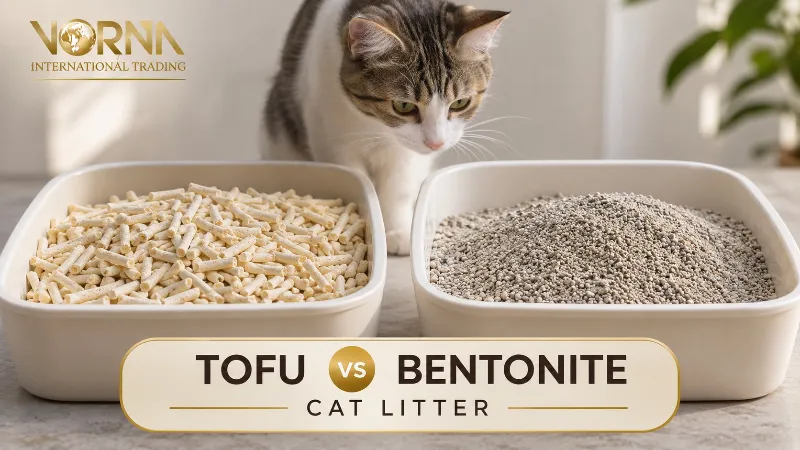
Choosing between tofu cat litter and bentonite cat litter involves more than comparing two materials on a package. Both can absorb moisture, form removable clumps, and help manage litter box odors. However, they differ in composition, granule texture, dust behavior, weight, waste disposal, and long-term cost.
Tofu litter is generally made from processed plant-based ingredients, while bentonite litter uses naturally occurring mineral clay. These differences affect how each product performs in a litter box and how comfortable it feels under a cat’s paws.
The short answer: Bentonite is often a practical choice for firm clumping, fine-granule texture, and affordability. Tofu litter can be attractive to owners who prefer lighter plant-based pellets, potentially lower tracking, and biodegradable materials. Neither option is automatically better at every task.
The most useful comparison is based on measurable product performance and your cat’s preferences rather than material claims alone.
1. What Is the Difference Between Tofu and Bentonite Cat Litter?
The main difference lies in their raw materials and the mechanisms they use to absorb moisture.
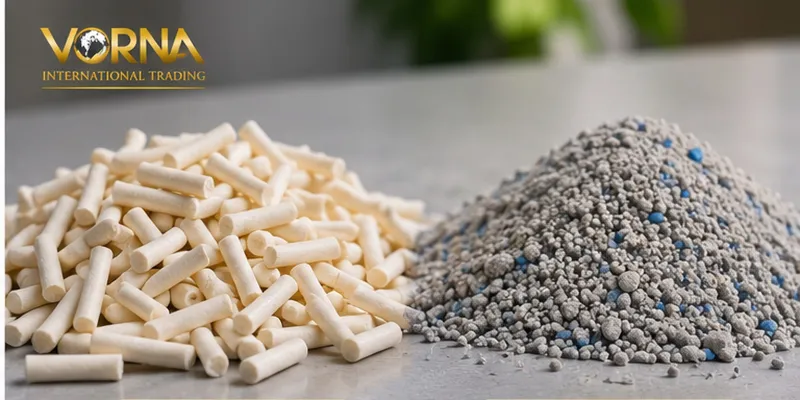
What Is Tofu Cat Litter Made Of?
Tofu cat litter is a plant-based product commonly manufactured using soybean residue, soy fiber, pea fiber, starch, or other agricultural ingredients.
Despite its name, not every tofu litter is made entirely from soybeans. Some manufacturers combine plant fibers with binding agents, deodorizing additives, or mineral ingredients.
The material is typically processed into lightweight pellets. When exposed to moisture, these pellets absorb liquid, soften, and may bind together to form removable clumps.
The performance depends on the ingredients and manufacturing process.
For example, two tofu litters may have different absorbency and clumping characteristics because one contains more starch-based binder while the other uses a different fiber mixture.
Some commercial tofu litters also contain bentonite. This means that a product labeled “tofu cat litter” is not necessarily 100% plant-based.
What Is Bentonite Cat Litter Made Of?
Bentonite cat litter is produced from naturally occurring clay containing smectite minerals, particularly montmorillonite.
Clumping formulations commonly use sodium bentonite because of its water absorption and swelling characteristics.
When urine contacts bentonite granules, the clay absorbs moisture and expands. Under suitable formulation conditions, the wet particles form a cohesive mass that can be removed using a litter scoop.
Bentonite litter is often available in fine or medium-sized granules, although particle-size distribution varies between products.
Its performance depends on several factors, including:
- Mineral composition and active clay content.
- Granule size and particle distribution.
- Moisture content.
- Dust-removal processing.
- Clump strength.
- Product formulation.
For information about the commercial material and its available characteristics, see Vornaco’s bentonite-based cat litter products.
2. Tofu vs. Bentonite Cat Litter: Quick Comparison
The following table summarizes the main differences between the two materials.
| Feature | Tofu Cat Litter | Bentonite Cat Litter |
|---|---|---|
| Main material | Plant fibers and binding ingredients | Natural mineral clay |
| Common appearance | Cylindrical or irregular pellets | Fine to medium granules |
| Absorbency | Can be high; formulation-dependent | High moisture absorption in suitable grades |
| Clumping | Forms clumps through hydrated plant-based binders | Forms clumps through swelling clay particles |
| Clump texture | Can be softer or more cohesive depending on formulation | Often firm and dense |
| Odor control | Depends on formulation, additives, and cleaning | Depends on clay characteristics, additives, and cleaning |
| Dust generation | Frequently marketed as low-dust; varies by brand | Can produce mineral dust; low-dust grades are available |
| Tracking | Larger pellets may reduce tracking | Fine granules may be carried outside the tray |
| Weight | Often relatively lightweight | Generally heavier for a comparable volume |
| Biodegradability | Plant-based components may biodegrade | Mineral clay is not biodegradable |
| Disposal | Follow local waste rules; do not assume flushability | Dispose of as solid waste; do not flush |
| Purchase price | Often higher per kilogram | Often more economical per kilogram |
| Paw feel | Pellet texture may feel unfamiliar | Fine-granule texture may feel more familiar |
These are typical material characteristics, not performance guarantees. A high-quality bentonite litter may produce less dust than a poorly processed tofu litter, and a well-formulated tofu product may form stronger clumps than a weak mineral formulation.
For buyers comparing finished products, sample testing is more reliable than assuming the raw material determines every performance characteristic.
3. Which Cat Litter Has Better Absorbency?
Absorbency is one of the main reasons cat owners compare tofu and bentonite litter.
However, higher absorbency does not automatically mean better litter box performance.
A product should absorb urine without allowing excessive liquid to spread across the tray or reach the bottom.
How Tofu Cat Litter Absorbs Moisture
Tofu litter absorbs moisture through its plant-based fibers and other absorbent ingredients.
As the pellets contact urine, they soften and absorb liquid. Depending on the formulation, the hydrated material can form a clump that is lifted from the tray.
Some tofu formulations absorb moisture rapidly, while others allow liquid to travel farther before forming a stable clump.
Pellet dimensions, fiber composition, binder concentration, and product density all influence the outcome.
How Bentonite Cat Litter Absorbs Moisture
Bentonite absorbs moisture through interactions between water and its clay mineral structure.
Sodium bentonite can swell considerably under suitable conditions. This swelling contributes to the formation of removable clumps when wet particles interact.
However, the actual absorption capacity of a finished bentonite litter also depends on granulation, mineral characteristics, and processing.
A product containing bentonite is not automatically guaranteed to absorb more liquid than a plant-based litter.
How to Compare Absorbency Correctly
If comparing two products, use consistent conditions.
For example, a practical comparative test could involve:
- Preparing equal volumes of unused litter in identical trays.
- Adding the same measured volume of test liquid to each sample.
- Observing how quickly the liquid is absorbed.
- Checking whether liquid reaches the bottom of the tray.
- Recording the size of the wet area and the resulting clump.
- Repeating the test to identify variation between samples.
This is a practical product-comparison method, not a recognized standardized laboratory procedure.
For commercial comparisons, distinguish absorbency per gram from absorbency per unit volume. Lightweight products may perform differently when evaluated by weight rather than the amount of litter occupying a tray.
Practical takeaway: Choose the litter that absorbs moisture effectively without excessive spreading or wet residue. The material category alone cannot determine the winner.
4. Clumping Performance: Which One Forms Stronger Clumps?
Clumping quality directly affects daily cleaning and litter consumption.
A good clump should remain sufficiently intact during scooping and should not leave significant amounts of wet material behind.
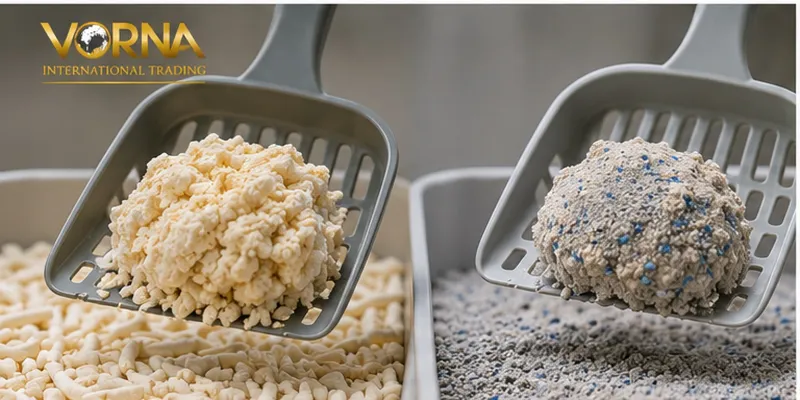
Bentonite Clumping Performance
Sodium bentonite is commonly used in clumping litter because its swelling behavior allows hydrated granules to bind together.
Well-processed bentonite litter can form compact, dense clumps.
This can make removal straightforward, particularly when the clump has sufficient time to develop strength.
However, not every bentonite product performs identically.
Excessive fines, unsuitable granule distribution, low-quality mineral material, or inconsistent processing can result in fragile clumps that break during scooping.
Tofu Cat Litter Clumping Performance
Tofu litter typically relies on the interaction between plant fibers and hydrated binding ingredients.
Depending on the formulation, the resulting clumps may be soft, cohesive, sticky, or relatively firm.
Some products form clumps that are easy to remove. Others may produce clumps that break apart, stick to the bottom of the tray, or contain incompletely absorbed material.
The manufacturing process and ingredient ratio are therefore important.
What Matters More Than Clumping Speed?
Clumping speed is useful, but speed alone does not determine cleaning performance.
A product that forms an immediate but fragile clump may leave more residue than one that forms a stable clump slightly later.
When comparing tofu and bentonite, evaluate:
- Time required for clump formation.
- Clump integrity during scooping.
- Amount of material left behind.
- Adhesion to the tray bottom.
- Quantity of clean litter removed with the clump.
The better litter is the one that forms removable, stable clumps under your normal cleaning conditions.
Both tofu and bentonite can be clumping products. If you want to understand the separate difference between clumping and non-clumping formulations, read Vornaco’s guide to clumping and non-clumping cat litter.
5. Odor Control: Tofu or Bentonite?
Cat litter odor control depends on several factors, not just the material used.
Urine accumulation, bacterial activity, ammonia formation, ventilation, litter replacement, and product additives all influence odor development.
Odor Control in Bentonite Litter
Bentonite helps manage odor partly by absorbing moisture and allowing urine-soaked material to be removed through scooping.
Some commercial bentonite formulations contain additional deodorizing ingredients, such as activated carbon or fragrance components.
The effectiveness depends on product design and maintenance.
Sodium bentonite itself should not be treated as a guarantee of complete ammonia removal.
Odor Control in Tofu Litter
Tofu-based products can manage odors through moisture absorption and the removal of urine-soaked clumps.
Some formulations contain activated carbon, plant-based deodorizing ingredients, or fragrances.
Their performance varies according to the ingredients and how the litter is used.
A pleasant initial scent does not necessarily indicate effective long-term odor control.
Which Performs Better in a Multi-Cat Home?
For multiple cats, the most important factors are:
- Regular removal of urine clumps and feces.
- Sufficient litter boxes.
- Effective moisture absorption.
- Appropriate litter depth.
- Good ventilation.
- A product your cats willingly use.
Even a product with strong odor-control claims can perform poorly if waste accumulates in the tray.
Recommendation: Compare odor-control performance over several days of normal use rather than relying on fragrance or a single fresh-litter test.
6. Dust Levels: Is Tofu Litter Better Than Bentonite?
Dust is a common concern when choosing cat litter.
Fine airborne particles may be released during pouring, digging, scooping, or cleaning.
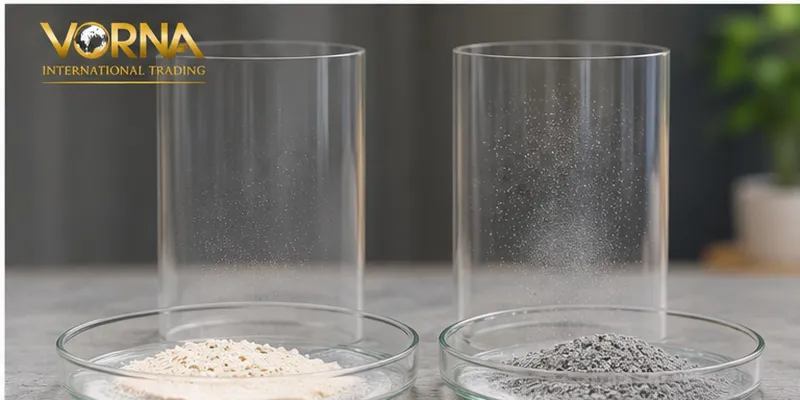
Dust in Bentonite Cat Litter
Bentonite is a mineral material, and dust can be generated during mining, crushing, drying, granulation, transportation, and handling.
Fine particles may remain in the finished product if processing and dust-removal controls are insufficient.
However, dust levels vary considerably.
Well-processed bentonite litter can be manufactured with reduced dust content through particle-size control and dust-removal processes.
Therefore, describing all bentonite litter as excessively dusty would be misleading.
Dust in Tofu Cat Litter
Tofu products are often sold as low-dust alternatives.
Larger pellets and the absence of large amounts of loose mineral fines can help limit dust generation in some formulations.
Nevertheless, plant-based litter is not automatically dust-free.
Pellets can break during packaging, transportation, storage, and handling. Broken particles and fine powders may accumulate at the bottom of the bag.
How to Choose a Low-Dust Cat Litter
When evaluating either material:
- Look for reliable dust-performance information.
- Observe dust during normal pouring and scooping.
- Check whether the bag contains excessive loose powder.
- Evaluate whether pellets or granules break during handling.
- Avoid assuming that claims such as “99% dust-free” are meaningful without an identified test method.
For cats with asthma or other respiratory conditions, ask a veterinarian about an appropriate low-dust option.
7. Tracking and Paw Comfort
Tracking occurs when litter particles attach to a cat’s paws or fur and are carried outside the tray.
Both litter materials can track, although their physical forms are different.
Tofu Litter and Tracking
Tofu litter is often manufactured as relatively large cylindrical pellets.
These pellets may be less likely to become trapped between paws than very fine granules.
However, broken pellets and fine particles can still be tracked around the home.
Some cats may also dislike the feel of larger pellets.
Bentonite Litter and Tracking
Bentonite litter frequently has a fine, sand-like texture.
This can feel familiar to cats that naturally prefer soft material for digging and covering waste.
However, smaller particles can attach to paws and spread outside the tray.
The actual result depends on granule size, paw characteristics, tray design, and the cat’s digging behavior.
Which Texture Do Cats Prefer?
Many cats prefer soft, fine-grained litter, but individual preferences vary.
A cat accustomed to bentonite may hesitate to use a box filled with larger tofu pellets.
Likewise, a cat already comfortable with tofu litter may show no reason to switch.
The best way to evaluate preference is to observe the cat’s behavior when both materials are offered appropriately.
Signs of discomfort may include hesitation before entering the box, avoiding digging, balancing on the tray edge, or eliminating outside the tray.
These behaviors can also indicate health or environmental problems. Sudden litter box avoidance should be discussed with a veterinarian.
8. Environmental Impact: Is Tofu Cat Litter More Sustainable?
Tofu and bentonite litter differ substantially in their raw materials.
However, environmental performance involves more than whether a material is labeled natural or biodegradable.
Bentonite Cat Litter and the Environment
Bentonite is a naturally occurring mineral extracted through mining.
Its environmental footprint can involve:
- Land disturbance during extraction.
- Energy consumption during drying and processing.
- Dust generation.
- Transportation.
- Disposal of mineral waste.
Bentonite clay is not biodegradable in the way organic plant fibers are.
When discarded, mineral litter remains part of the solid waste stream.
Tofu Cat Litter and the Environment
Tofu litter is made primarily from plant-derived materials, which may include agricultural residues.
Using recovered plant fibers can provide a productive use for suitable agricultural byproducts.
Plant-based components may biodegrade under appropriate conditions.
However, environmental benefits depend on:
- Raw material sourcing.
- Ingredient composition.
- Manufacturing energy requirements.
- Drying processes.
- Packaging.
- Transportation.
- Waste management.
A product described as biodegradable is not automatically carbon-neutral or environmentally harmless.
Blended tofu-and-bentonite formulations also require separate consideration because they contain both plant-based and mineral ingredients.
Can Tofu Cat Litter Be Flushed?
The safest general recommendation is not to flush cat litter, including tofu litter.
Although some manufacturers label tofu litter as flushable, the material’s ability to disperse in water does not establish compatibility with household plumbing, sewer infrastructure, or wastewater treatment systems.
Cat waste can also contain pathogens.
Follow local wastewater rules and dispose of used litter through the approved solid waste system.
Can Tofu Cat Litter Be Composted?
Plant-based ingredients may be biodegradable, but used cat litter can contain fecal pathogens and other contaminants.
Do not place used cat litter into ordinary household or food-garden compost simply because the product is plant-based.
Follow local waste-management requirements. In many locations, used cat litter belongs in residual household waste rather than municipal organic waste.
Practical takeaway: Tofu litter generally has an advantage in terms of plant-based, potentially biodegradable raw materials. The environmental impact of either product still depends on its full lifecycle and disposal method.
9. Which Cat Litter Is More Cost-Effective?
Bentonite is frequently more affordable per kilogram than tofu litter, although prices vary by market, brand, packaging, and formulation.
Tofu products may have higher purchase prices because of their manufacturing process, ingredients, and commercial positioning.
However, purchase price alone does not determine the true cost of daily use.
A lighter product may require fewer kilograms to fill the same tray volume.
Clumping quality also affects consumption. If clumps break apart or remove large amounts of unused litter, more material may be required over time.
How to Compare the Monthly Cost
A useful calculation is:
Monthly litter cost = Quantity of litter consumed per month × Price per kilogram
For example, consider two hypothetical products:
| Factor | Tofu Litter | Bentonite Litter |
|---|---|---|
| Price per kg | $2.50 | $1.20 |
| Monthly consumption | 4 kg | 7 kg |
| Estimated monthly cost | $10.00 | $8.40 |
These numbers are illustrative, not current market prices or laboratory consumption results.
The example demonstrates why comparing only the price of one bag can be misleading.
For an accurate comparison, measure actual consumption over a normal cleaning period while maintaining appropriate litter depth and hygiene.
10. Which One Is Better for Different Cats and Households?
There is no universal winner. The most appropriate litter depends on the cat, its environment, and the owner’s priorities.
| Situation | What to Consider |
|---|---|
| Cat prefers fine sand-like texture | Fine-granule bentonite may be more acceptable |
| Owner wants larger plant-based pellets | Tofu may be worth testing |
| Main concern is clump integrity | Compare actual clump strength in both products |
| Main concern is mineral dust | Evaluate a verified low-dust product; tofu may be an option |
| Multi-cat household | Prioritize odor control, scoopability, and sufficient litter boxes |
| Budget is important | Compare monthly consumption, not only bag price |
| Cat has respiratory problems | Consult a veterinarian and select a suitable low-dust formulation |
| Young kitten | Seek an age-appropriate non-clumping option |
| Cat dislikes changing litter | Introduce alternatives gradually |
How to Switch from Bentonite to Tofu Cat Litter
If your cat is comfortable with its current litter, there may be no need to change.
If you want to try tofu litter, avoid abruptly replacing the entire contents of the box.
A practical approach is to:
- Keep the existing litter box available.
- Introduce a small quantity of the new litter gradually, or offer it in a separate box.
- Observe whether the cat digs, covers waste, and uses the tray normally.
- Increase the new litter gradually if the cat accepts it.
- Stop the transition if the cat repeatedly avoids the new material.
Do not change the litter type, tray location, and tray design simultaneously. This makes it difficult to identify why the cat is uncomfortable.
11. How Can Commercial Buyers Compare Tofu and Bentonite Litter Quality?
For distributors, importers, private-label brands, and manufacturers, evaluating cat litter requires more than comparing consumer-facing claims.
The important question is whether the finished product meets consistent performance specifications.
Important Quality Parameters
| Quality Parameter | Why It Matters |
|---|---|
| Liquid absorption | Determines the product’s ability to absorb moisture |
| Clump formation time | Indicates how quickly removable clumps develop |
| Clump integrity | Determines how well clumps survive scooping |
| Dust generation | Influences cleanliness and product handling |
| Particle-size distribution | Affects texture, tracking, and uniformity |
| Bulk density | Influences packaging volume and transportation |
| Moisture content | Affects storage stability and handling |
| Odor-control performance | Indicates how effectively the formulation manages odors |
| Packaging integrity | Protects the product during storage and shipment |
| Batch consistency | Helps maintain predictable performance across orders |
Buyers should specify the intended test method, sample size, evaluation conditions, and acceptable limits.
A supplier’s raw material analysis may provide useful information, but it cannot replace testing of the finished litter product.
What Should Buyers Request Before a Bulk Order?
For a meaningful comparison, buyers should request representative finished-product samples and relevant technical documentation.
If the product is bentonite-based, the mineral source, granule characteristics, and processing method may also be relevant.
For importers evaluating mineral raw materials for cat litter manufacturing, Vornaco’s sodium bentonite supply information provides background on available bentonite grades and technical documentation.
The intended application should be stated clearly. A bentonite grade suitable for drilling or civil engineering should not automatically be assumed suitable for cat litter manufacturing.
For clumping cat litter, the relationship between sodium bentonite’s swelling properties and finished-product behavior is also important. Our article on sodium and calcium bentonite differences explains the mineral characteristics behind these distinctions.
12. Frequently Asked Questions About Tofu vs Bentonite Cat Litter
Is tofu cat litter better than bentonite cat litter?
Neither material is universally better. Tofu litter may appeal to buyers seeking plant-based pellets and potentially lower tracking, while bentonite is often selected for firm clumping, fine texture, and affordability. Actual performance depends on the product formulation.
Does tofu cat litter clump as well as bentonite?
Some tofu products form strong, removable clumps, but results vary by formulation. Bentonite often produces dense mineral clumps, while tofu relies on plant fibers and binders. Compare clump integrity and scooping performance rather than assuming one material always performs better.
Which cat litter is better for odor control?
Both can provide effective odor management when properly formulated and maintained. Moisture absorption, prompt waste removal, ventilation, and deodorizing ingredients influence the results.
Is tofu litter less dusty than bentonite?
Tofu litter is frequently marketed as low-dust and can generate less dust in some formulations. However, dust levels vary. Properly processed bentonite litter may also have low dust content.
Can tofu cat litter be flushed down the toilet?
Flushing cat litter is generally discouraged, even when the packaging claims that tofu litter is flushable. Plumbing restrictions, wastewater regulations, and potential pathogens in cat waste should be considered. Use approved local waste-disposal methods.
Is bentonite cat litter biodegradable?
No. Bentonite is a naturally occurring mineral clay, but it is not biodegradable like plant-based organic materials. Tofu litter may contain biodegradable ingredients, depending on its formulation.
Which litter is better for cats with sensitive paws?
Some cats prefer the fine, sand-like texture of bentonite. Others may accept tofu pellets. A cat’s individual preference, mobility, and health should guide the decision.
Is tofu cat litter more expensive than bentonite?
Tofu litter often has a higher price per kilogram. However, monthly cost depends on consumption, bulk density, clumping efficiency, and the q