What is Bentonite Clay Food Grade?
Bentonite clay food grade is a naturally occurring clay that has undergone purification to meet strict safety standards for use in food products. This kind of bentonite differs from industrial versions as it is free from toxins, heavy metals, and unwanted chemicals. It is prized for its absorbent and binding properties which make it effective for clarifying liquids and detoxifying the body when ingested. The natural structure of bentonite enables it to swell significantly when wet, attracting and holding various substances. Food-grade bentonite is mainly used in food and beverage industries and dietary supplements, where safety and purity are paramount. Its processing includes testing and refinement to ensure it complies with food safety regulations worldwide.
For those seeking reliable sources, exploring our range of Bentonite products is essential. Trusted Bentonite suppliers offer high-quality clay suitable for various industrial and commercial applications. Discover premium options to meet your specific needs.

Food Grade Bentonite vs Industrial Bentonite
| Feature | Food Grade Bentonite | Industrial Bentonite |
|---|---|---|
| Main Purpose | Used in food-related applications, beverage clarification, animal feed and approved industrial processes | Used in drilling, construction, foundry and other industrial applications |
| Purity Requirements | Requires higher quality control and stricter limits for impurities and contaminants | Based mainly on technical performance requirements |
| Quality Documentation | Usually requires detailed documentation such as COA, TDS and quality analysis | Standard technical documents based on application requirements |
| Main Evaluation Factors | Purity, heavy metal content, microbiological parameters, particle size and mineral composition | Swelling capacity, viscosity, binding properties and sealing performance |
| Typical Buyers | Food manufacturers, beverage producers, feed companies and specialized industries | Drilling companies, construction companies, foundries and industrial manufacturers |
Bentonite Clay Food Grade
Bentonite clay food grade is a natural, purified clay safe for consumption and widely used in food and health industries. It undergoes strict purification processes to remove harmful contaminants such as heavy metals and chemicals, ensuring its safety. This clay is highly absorbent, capable of binding toxins and impurities, which makes it useful as a clarifying agent in beverages and a detoxifying supplement for internal cleansing. Packed with beneficial minerals like calcium, magnesium, and iron, it also supports overall health when ingested in moderation. Unlike industrial grades, bentonite clay food grade contains no additives or harmful substances, making it ideal for direct or indirect use in food products.
Key Properties of Bentonite Clay Food Grade
The high cation exchange capacity (CEC) of food-grade bentonite allows it to absorb and trap positively charged ions such as minerals and toxins, making it effective in cleansing and filtration applications. Its pH buffering capability helps maintain equilibrium in food products, which is crucial to prevent spoilage and maintain flavor and texture. Food-grade bentonite also exhibits excellent swelling properties, enhancing its ability to bind impurities and stabilize products. Unlike other bentonite grades, it contains no additives, artificially introduced chemicals, or contaminants. These properties make food-grade bentonite uniquely useful across food processing, supplement formulation, and detoxification therapies.
Important Quality Parameters for Food Grade Bentonite
| Quality Parameter | Importance for Buyers |
|---|---|
| Purity Level | Determines suitability for food-related and sensitive applications |
| Heavy Metal Content | Important for meeting safety and quality requirements |
| Microbiological Parameters | Helps verify product suitability for intended applications |
| Moisture Content | Affects storage stability and processing performance |
| Particle Size Distribution | Influences handling, dispersion and application performance |
| Mineral Composition | Determines consistency and functional properties |
| Adsorption Capacity | Important for applications requiring absorption characteristics |
| Swelling Index | Indicates bentonite performance characteristics |
Common Uses of Bentonite Clay Food Grade in Food Industry
In food processing, bentonite clay food grade serves primarily as a clarifying agent for liquids including juices, wines, and edible oils. These liquids often contain proteins, sediments, and other haze-forming substances; bentonite binds to these impurities and settles them out of the solution, improving the clarity and shelf life of the final product. Besides beverages, bentonite is utilized in meat and dairy processing to remove fats and proteins from wastewater, helping recycling processes and reducing environmental impact by recovering valuable resources. Its toxin-binding properties are harnessed in health supplements, where it aids digestion and promotes toxin elimination. In animal nutrition, bentonite food grade is added to feed to improve quality and reduce contamination risks by binding mycotoxins and heavy metals.
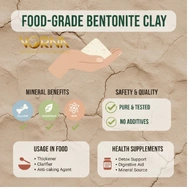
Food Grade Bentonite Applications
| Industry | Application of Food Grade Bentonite |
|---|---|
| Beverage Industry | Used in clarification processes to remove unwanted particles and improve product quality |
| Animal Feed Industry | Used as a binder and adsorbent in animal nutrition applications |
| Food Processing | Used in specific industrial processes where approved mineral properties are required |
| Edible Oil Industry | Applied in clarification and purification processes depending on processing requirements |
| Industrial Applications | Used in applications requiring controlled mineral properties and high-quality specifications |
Benefits of Using Bentonite Clay Food Grade
The detoxification benefits of food-grade bentonite are noteworthy, as it adsorbs toxins and harmful substances in the gastrointestinal tract, supporting natural cleansing processes. This function helps improve digestion, reduce bloating, and maintain gut health. Bentonite supplies essential minerals such as calcium, magnesium, and iron, potentially adding nutritional value when consumed as part of supplements. Its ability to stabilize pH levels helps preserve the freshness and consistency of food products, reducing spoilage and waste. Being all-natural, free from chemicals and additives, it makes a safe and sustainable choice for both manufacturers and consumers who prefer clean-label products.
How to Identify High-Quality Bentonite Clay Food Grade
Quality assurance is critical when sourcing bentonite clay food grade. Authentic products must be accompanied by certificates of analysis (COAs) confirming compliance with local and international standards on heavy metals and microbiological purity. Consistency in particle size and texture indicates professional processing, ensuring the clay performs reliably in applications. Potential buyers should verify that the bentonite is labeled explicitly as food grade and sourced from reputable suppliers who follow GMP (Good Manufacturing Practices). Avoid products lacking detailed testing or with ambiguous grading claims, as impurities or contaminants at low levels can pose health risks.
Safety and Regulatory Standards for Bentonite Clay Food Grade
International safety standards administered by organizations such as the FDA and EFSA impose strict limits on contaminants and specify testing protocols for food-grade bentonite. Producers must demonstrate that their products are free from excessive heavy metals such as lead, arsenic, and mercury and meet microbiological safety thresholds. The manufacturing process involves purification, drying under controlled conditions, and packaging in food-safe materials. These procedures minimize contamination and guarantee the clay’s safety for direct or indirect food use. Compliance with these standards is often a prerequisite for market access and consumer acceptance, especially in regulated regions.
When it comes to efficient drilling operations, Bentonite clay drilling mud plays a critical role. Our drilling Bentonite products enhance lubrication and stability in boreholes, ensuring smooth and safe drilling processes. Learn more about our specialized Bentonite clay drilling mud solutions.

Difference Between Bentonite Clay Food Grade and Other Grades
Compared to food-grade bentonite, industrial and cosmetic bentonites have different purity levels and intended uses. Industrial grades may contain chemicals or residues acceptable only in drilling, construction, or waste treatment but unsuitable for ingestion. Cosmetic bentonite is purified for skin compatibility but might not meet all food safety criteria, such as heavy metal thresholds. Particle size distribution and mineralogical composition vary too, influencing functional properties like absorption and swelling. Understanding these distinctions is key for end-users to select the appropriate bentonite type, ensuring safety and functional efficacy in food, beverage, or health applications.
Extended Applications of Bentonite Clay in Food Industry
Bentonite food grade sees extensive applications beyond simple clarification. In the dairy industry, it removes fats and proteins from wastewater during cheese and milk processing, helping meet environmental regulations while recovering valuable nutrients for reuse in animal feed. Its high affinity for organic compounds helps in processing and treating waste streams from meat and vegetable processing plants. Moreover, bentonite is experimented with as a nanofiller in biodegradable food packaging to enhance barrier properties and extend shelf life. This expanding utility highlights bentonite clay food grade as a multifunctional ingredient in modern food production and sustainability efforts.
To fully understand the benefits and applications of Bentonite clay, reading the comprehensive guide in “What is Bentonite Clay?” is highly recommended. This article covers the composition, types, and uses of Bentonite clay, helping you make informed decisions.

Frequently Asked Questions
What is food grade bentonite used for?
Answer:
Food grade bentonite is used in food-related applications such as beverage clarification, food processing, animal feed applications and other approved industrial uses where purity and quality control are required.
How is food grade bentonite different from industrial bentonite?
Answer:
Food grade bentonite requires stricter quality control and documentation compared with industrial grades. The main differences include purity requirements, contaminant limits and intended applications.
What documents should I request before buying food grade bentonite?
Answer:
Buyers should request documents such as COA, TDS, MSDS and product specifications to verify quality and suitability for their application.
Can food grade bentonite be customized for industrial requirements?
Answer:
Yes. Depending on the application, specifications such as particle size, moisture content and other technical parameters may be adjusted according to buyer requirements.
Where can I buy bulk food grade bentonite?
Answer:
Bulk food grade bentonite can be purchased from specialized mineral suppliers that provide technical documentation, consistent quality and export support.