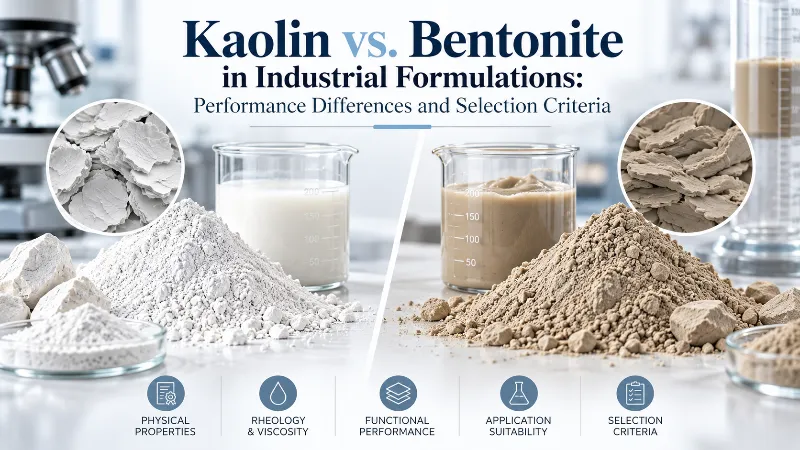
Kaolin vs. Bentonite in Industrial Formulations: Performance Differences and Selection Criteria
Kaolin and bentonite are both industrial clay materials, but choosing between them is rarely as simple as comparing chemical compositions or prices per tonne. In a water-based formulation, a relatively small amount of the wrong clay can change viscosity, settling behavior, mixing time, pumpability, and the stability of the finished system.
The most important distinction is how each material interacts with water and with other ingredients.
Kaolin, which is primarily associated with the mineral kaolinite, is generally a low-swelling clay. Bentonite, commonly rich in smectite minerals such as montmorillonite, can develop substantial swelling and structure in water, particularly when the exchangeable-cation composition favors hydration.
For formulators, these differences affect whether a clay behaves mainly as a mineral filler, contributes to the solids content, or is used to modify suspension rheology and particle interactions.
This guide compares kaolin and bentonite from a formulation perspective: what changes when they enter a liquid system, where substitution becomes problematic, which applications require different performance characteristics, and how to evaluate candidate materials before committing to bulk supply.
Kaolin vs. Bentonite: The Key Differences at a Glance
| Selection criterion | Kaolin | Bentonite |
|---|---|---|
| Predominant clay mineral | Kaolinite | Commonly montmorillonite and other smectites |
| Layer structure | 1:1 layer silicate | 2:1 layer silicate |
| Behavior in water | Generally low swelling | Can swell significantly, depending on composition and conditions |
| Rheological contribution | Strongly influenced by solids loading, particle size, dispersion, and surface chemistry | Can develop viscosity and yield stress at relatively low additions |
| Typical formulation role | Mineral filler, ceramic raw material, pigment/extender, or functional particulate component | Rheology modifier, suspension stabilizer, binder, or sealing component |
| Sensitivity to solution chemistry | Particle interactions change with pH, electrolytes, and dispersants | Hydration and particle interactions can be particularly sensitive to exchangeable ions and dissolved electrolytes |
| Main substitution concern | May not provide the desired low-dose viscosity or gel structure | May increase viscosity, water demand, or processing difficulty beyond acceptable limits |
| Primary evaluation approach | Test particle size, mineralogy, purity, dispersion, and application-specific performance | Test mineralogy, swelling or hydration behavior, rheology, moisture, and application-specific performance |
These are typical tendencies, not universal specifications. Natural kaolin and bentonite deposits vary in mineral composition, impurities, processing history, and particle characteristics. The behavior of a particular commercial grade must be verified in the intended formulation.
1. Why Clay Structure Changes Formulation Performance
Kaolin and bentonite are often described simply as clay minerals. That label hides an important structural difference.
Kaolin: A relatively stable, low-swelling layered mineral
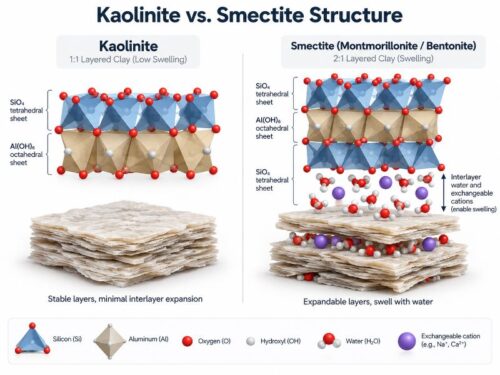
Kaolinite has a 1:1 structure, with one silica tetrahedral sheet associated with one alumina octahedral sheet. Its layers are held together in a way that generally limits significant expansion when exposed to water.
In industrial suspensions, kaolin particles may disperse, flocculate, or form structures depending on pH, ionic conditions, dispersants, and solids concentration. However, ordinary kaolinite does not exhibit the extensive interlayer swelling characteristic of sodium-rich smectites.
That makes kaolin attractive in formulations where the mineral must provide solids, particle-based functionality, or other grade-specific properties without introducing pronounced swelling.
Bentonite: A clay capable of developing an expanded particle network
Bentonite commonly contains montmorillonite, a member of the smectite group. Smectites have a 2:1 structure in which an octahedral sheet is positioned between two tetrahedral sheets.
Water and exchangeable ions can interact with spaces between these layers. Under suitable conditions, hydration causes expansion and can promote separation of particle units into finer structures.
This behavior is important in systems that require yield stress, gel development, suspension stability, or controlled flow.
However, sodium bentonite and calcium bentonite cannot be assumed to behave identically. The dominant exchangeable cations, the mineral composition, and the surrounding liquid chemistry influence the extent and rate of hydration.
Formulation implication: If the main objective is to introduce a particulate mineral without substantial swelling, a suitable kaolin grade may be easier to integrate. If the objective is to develop low-dose rheological structure, bentonite may be the more relevant starting candidate.
Neither conclusion replaces a formulation trial.
2. How Kaolin and Bentonite Affect Viscosity and Yield Stress
Viscosity and yield stress are related, but they describe different aspects of suspension behavior.
Viscosity describes resistance to flow under specified measurement conditions. Yield stress refers to the stress required to initiate significant flow in a material that exhibits yield-stress behavior.
This distinction matters when a formulation must remain stable during storage but still flow during pumping, pouring, spraying, or mixing.
Kaolin in concentrated suspensions
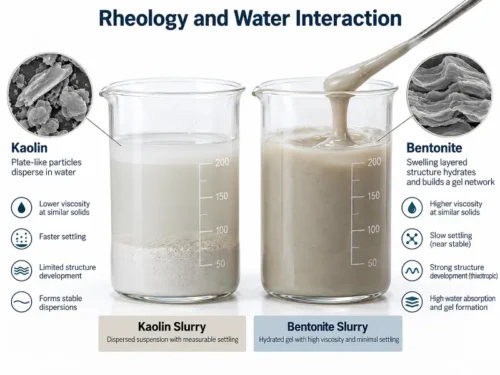
Kaolin can contribute to substantial viscosity and yield stress, particularly at higher solids concentrations or when particles form flocculated structures.
The response depends on particle-size distribution, shape, solids concentration, pH, electrolyte composition, and dispersant selection.
It would therefore be incorrect to describe kaolin as a material that never thickens liquids. The more accurate distinction is that its rheological behavior does not generally depend on the extensive interlayer swelling associated with smectites.
In ceramic slips and other concentrated mineral suspensions, dispersion control is often central to achieving useful solids loading without excessive viscosity.
Bentonite in structured suspensions
Hydrating bentonite can increase apparent viscosity and develop a measurable yield stress at comparatively low solids additions.
That can be beneficial when particles need to remain suspended or a system requires a particular low-shear structure.
It can also create problems.
Too much bentonite, unsuitable hydration conditions, or incompatibility with the liquid phase may produce excessive viscosity, inconsistent processing, or difficulties during pumping and application.
A clay that improves stability in one formulation may impair flow in another.
Why the same dosage does not mean equivalent performance
Replacing 2% kaolin with 2% bentonite does not necessarily preserve rheological behavior. The two materials can contribute very different particle interactions and water demands.
Research on mixed kaolin–bentonite slurries has shown that bentonite content can influence yield-stress magnitude, while kaolin properties and pH conditions affect the rheological response.
For practical formulation work, compare candidate grades at defined solids content, pH, temperature, mixing conditions, and measurement history rather than at equal dosage alone.
3. Water Demand, Hydration, and Mixing Behavior
The way a clay is introduced into a formulation can affect the final result as much as the raw material selection.
Kaolin: Focus on dispersion and solids loading
With kaolin, the mixing objective is often to distribute particles consistently and control agglomeration.
Depending on the formulation, a suitable dispersant and appropriate mixing energy may help obtain workable flow properties at the required solids concentration.
The actual response should be measured because dispersant effectiveness depends on the kaolin grade and the chemistry of the system.
Bentonite: Allow for hydration and structure development
For bentonite, hydration history can strongly influence rheological measurements.
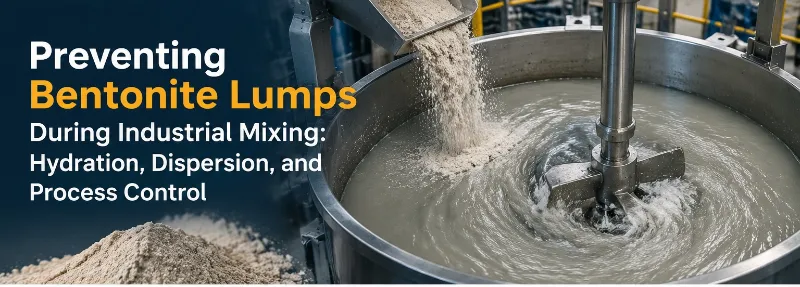
Particle addition rate, available mixing energy, residence time, water quality, and the order of ingredient addition may all affect the development of the final structure.
When evaluating bentonite, compare samples after consistent mixing and hydration intervals. Otherwise, two materials may appear different simply because their preparation histories were not equivalent.
Because bentonite performance depends on mineral composition, hydration behavior, and processing conditions, selecting a suitable grade requires more than comparing general product descriptions. Buyers sourcing industrial quantities should discuss their formulation requirements with a bentonite supplier before evaluating samples and confirming material specifications.
The overlooked problem: Testing with laboratory water only
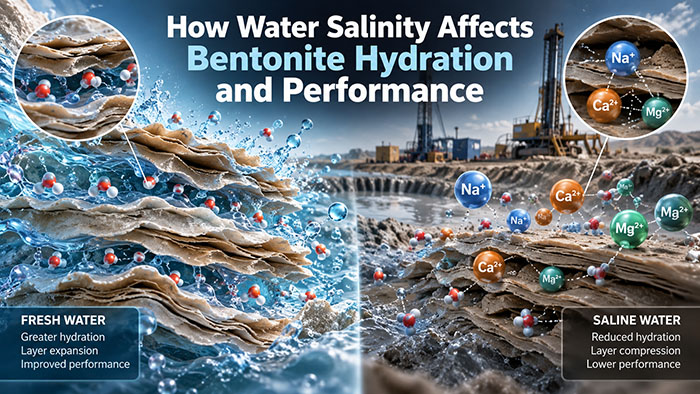
A sample that performs well in deionized water may behave differently in production water containing dissolved salts or hardness ions.
Both kaolin and bentonite dispersions are affected by solution chemistry, though the mechanisms and magnitudes differ.
For a meaningful qualification test, use the intended process water or a representative laboratory equivalent.
The objective is not to find a universally superior clay, but to establish whether its performance is repeatable under actual operating conditions.
4. Choosing Between Kaolin and Bentonite by Formulation Function
A useful selection process begins with the function required from the mineral rather than with the mineral name.
When a mineral filler is the main requirement
If the formulation requires a particulate solid to contribute to properties such as solids loading, optical behavior, surface characteristics, or processing performance, an application-specific kaolin grade may be a sensible candidate.
In coatings, for example, properties such as particle size, brightness, morphology, and compatibility with the binder system may be more important than swelling capacity.
The exact role of kaolin depends on the coating chemistry and grade. It should not be assumed that any kaolin can replace an existing filler without affecting the finished product.
When suspension structure is the priority
If the formulation requires yield stress, controlled settling, or gel-like behavior, bentonite may be evaluated as a functional additive.
Its contribution should be assessed at the relevant shear rates and over the required storage or processing period.
A high viscosity result at one measurement point is not sufficient evidence that a material will provide the desired performance throughout the process.
When binding behavior matters
Both materials can participate in systems where green strength or binding behavior is relevant, but they do not contribute through identical mechanisms.
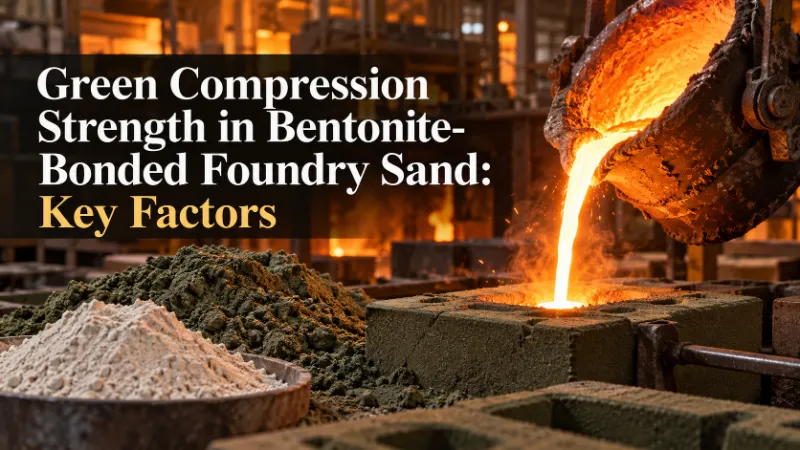
In mineral agglomeration and foundry applications, bentonite may provide important bonding functionality through clay–water–particle interactions.
In ceramic processing, kaolin can contribute to forming and firing behavior as part of a broader raw-material composition.
The final performance depends on the complete recipe and process rather than the clay alone.
When thermal processing is involved
For ceramic bodies and other fired formulations, the distinction extends beyond room-temperature rheology.
Kaolin undergoes thermal transformations that influence ceramic processing and fired properties. Bentonite-containing formulations can introduce different fluxing components, impurities, and processing characteristics.
Material selection in these applications requires thermal and compositional evaluation, not just a wet-slurry viscosity comparison.
5. Can Kaolin and Bentonite Replace Each Other?
Sometimes one material can be used to adjust a formulation originally containing the other. However, direct substitution on a one-to-one mass basis is rarely a reliable starting assumption.
Consider three typical scenarios.
Scenario A: Replacing kaolin with bentonite in a low-viscosity slurry
The formulation already flows adequately and requires a mineral component without substantial viscosity development.
Adding bentonite may increase low-shear structure, change water demand, or affect the dispersion of other particles.
Before proceeding, measure the full flow response, not just the apparent viscosity at a single speed.
Scenario B: Replacing bentonite with kaolin in a suspension-stabilizing system
The existing formulation relies on a small bentonite addition to help maintain particles in suspension.
Replacing that addition with the same weight of kaolin may reduce the yield-stress contribution and allow different settling behavior.
A higher kaolin dosage is not necessarily a satisfactory solution because it may increase total solids or alter other formulation properties.
Scenario C: Combining kaolin and bentonite
A blended system may offer a way to adjust solids loading and rheological structure.
However, the interaction is not necessarily linear. The result depends on both mineral grades, the proportions used, pH, exchangeable ions, and preparation conditions.
A controlled experiment comparing each clay alone and several blend ratios is more informative than assuming their effects are additive.
Practical rule: Define the required physical performance first. Then test whether a substitution or blend achieves that performance without creating a new processing problem.
6. Application-Based Selection: Ceramics, Coatings, and Industrial Slurries
| Industrial system | Main selection question | Kaolin consideration | Bentonite consideration |
|---|---|---|---|
| Ceramic slip or body | How will the clay affect solids loading, casting behavior, forming, and firing? | Evaluate mineral composition, particle size, plasticity, and thermal behavior | Evaluate any rheological benefit alongside added water demand, impurities, and firing effects |
| Water-based coatings | What particle and flow properties does the formulation need? | Assess filler/extender functionality, brightness, size distribution, and dispersion | Consider only when a suitable grade provides the required rheological behavior and formulation compatibility |
| Mineral suspensions | How can particles remain adequately dispersed or suspended? | May serve as a mineral particulate component; behavior depends on concentration and chemistry | May help develop suspension structure, depending on the formulation |
| Industrial binders or agglomeration systems | What produces the required strength and processability? | Evaluate only where the application calls for its particular mineral properties | May be relevant where swelling-clay bonding behavior is required |
| Mixed-clay formulations | Can one mineral modify the performance of the other? | Can affect solids loading and particle interactions | Can modify yield stress and structure, subject to compatibility tests |
These examples are intended as formulation-selection guidance. They do not establish that every kaolin or bentonite grade is qualified for every listed industry.
Kaolin performance can vary considerably between commercial grades, particularly in terms of particle size, mineral composition, and processing characteristics. For a closer look at how these differences influence material selection, explore our guide to kaolin grades and their industrial applications.
7. Which Technical Parameters Should You Compare Before Purchasing?
A supplier’s product name or general mineral description is not enough to establish suitability.
A useful specification should address the properties most likely to affect the intended formulation.
Mineral composition
Confirm the dominant clay minerals and important associated phases.
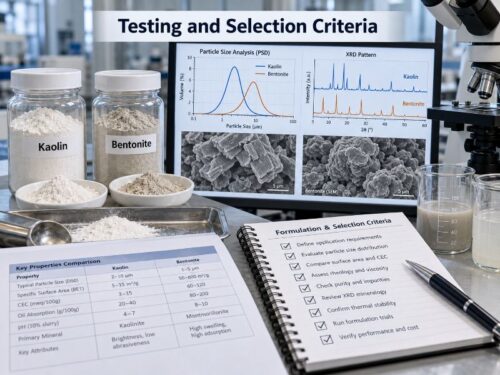
X-ray diffraction (XRD) can help identify crystalline mineral phases, while chemical analysis provides complementary information about elemental or oxide composition.
The relevance of impurities depends on the application. For some products, color-related constituents are important; for others, mineral phases affecting processing or thermal behavior may be more consequential.
Particle-size distribution
Particle size affects dispersion, surface area, settling behavior, processing, and finished-product properties.
Compare distributions using the same measurement method and preparation conditions. A nominal mesh description does not provide the same information as a complete particle-size distribution.
Moisture content
Moisture affects shipping weight, storage, and the actual dry-solids dosage entering a process.
When comparing materials, ensure that trial formulations use consistent dry-solids calculations.
Rheological performance
Measure viscosity under relevant shear conditions, along with yield stress and time-dependent behavior when appropriate.
Record test temperature, solids content, pH, mixing procedure, hydration time, and instrument conditions.
Results without comparable test methods can be misleading.
Water chemistry and dispersant compatibility
Evaluate the clay in the actual liquid phase, especially when the formulation contains dissolved electrolytes, dispersants, binders, or other additives.
If changing the water source or ingredient order alters performance, include those variables in the qualification protocol.
Application-specific properties
Depending on the intended use, further testing may involve brightness, chemical composition, ceramic firing characteristics, sedimentation stability, green strength, or other functional measurements.
Avoid using a generic specification table as a substitute for application-relevant acceptance criteria.
For commercial sourcing, Vornaco provides separate product information for Kaolin and Bentonite. Buyers should match the grade and available batch documentation to the intended technical requirements.
When selecting kaolin for an industrial formulation, buyers should evaluate mineral composition, particle size, and application-specific performance before placing a bulk order. Working with an experienced kaolin supplier helps establish the material specifications and commercial requirements needed for consistent sourcing.
8. A Practical Qualification Procedure for Industrial Formulators
The following workflow can help reduce uncertainty before changing a clay grade or selecting a new supplier.
Step 1: Define the material’s function
Write down what the clay is expected to do.
Possible objectives include controlling rheology, contributing mineral solids, supporting suspension stability, meeting optical specifications, or providing a specific processing response.
Separate essential requirements from desirable improvements.
Step 2: Establish a reference formulation
Use the current material or an established control sample.
Document the ingredient quantities on a consistent dry-solids basis and record the process-water composition, mixing conditions, temperature, and test schedule.
Step 3: Compare candidate grades under identical conditions
Prepare a controlled set of samples rather than adjusting multiple variables at once.
If the goal is substitution, compare equal dry mass initially for reference, then optimize dosage according to the measured functional response.
Step 4: Evaluate performance over time
For liquid formulations, record rheology at relevant intervals and examine settling, redispersion, or structural changes where applicable.
A formulation may appear acceptable immediately after mixing but behave differently after storage.
Step 5: Test the actual production process
Laboratory mixing and production-scale mixing may differ in energy input, residence time, equipment geometry, and ingredient-addition sequence.
A candidate grade should not be approved solely because a small laboratory sample performed well.
Step 6: Establish acceptance criteria for future deliveries
After selecting a suitable grade, define the critical parameters and their agreed test methods.
These may include mineral composition, particle-size distribution, moisture, and application-specific performance tests.
The objective is to qualify not just one successful sample but a material specification that can be evaluated consistently across future deliveries.
9. Common Selection Mistakes That Create Formulation Problems
Choosing based only on the mineral name
Two materials sold as bentonite can differ significantly in exchangeable cations, mineral composition, and rheological response. Kaolin grades can also differ in particle characteristics and purity.
Use product-specific information rather than relying on the category name alone.
Comparing viscosity measurements from different methods
A viscosity value without a stated test method, solids concentration, and preparation procedure may be unsuitable for comparing suppliers.
Request comparable results or perform controlled internal testing.
Assuming more swelling is always better
High swelling potential can be useful for some functions and undesirable for others.
The correct target is the amount and type of structure needed by the formulation, not the maximum swelling achievable.
Ignoring interactions with other additives
A clay may alter the effectiveness of dispersants, electrolytes, binders, or other formulation components.
Testing the mineral alone in water cannot establish its behavior in a chemically complex product.
Approving raw material quality without evaluating finished-product performance
A material may meet its agreed mineral specification yet still require adjustments to processing or formulation.
Raw-material inspection and functional qualification are related but distinct decisions.
Frequently Asked Questions
What is the main difference between kaolin and bentonite in industrial formulations?
Kaolin is generally a low-swelling clay commonly used for mineral and application-specific particle functionality. Bentonite often contains swelling smectite minerals and may contribute substantial viscosity or yield stress in water-based systems. Actual performance depends on the grade and formulation conditions.
Is bentonite always a better thickener than kaolin?
No. Bentonite can develop strong rheological effects at comparatively low additions, but the suitability of either clay depends on solids concentration, liquid chemistry, target viscosity, shear conditions, and the other ingredients. Kaolin suspensions can also develop high viscosity under certain conditions.
Can kaolin and bentonite be used together?
Yes, they can be evaluated in mixed-clay formulations. Their combined rheological behavior depends on the proportions, mineral characteristics, pH, electrolytes, and mixing procedure. Controlled testing is needed because their effects are not necessarily additive.
Can bentonite replace kaolin in ceramic formulations?
Not automatically. Bentonite may alter water demand, plasticity, slurry rheology, and the mineral composition entering the firing process. Any substitution should be assessed through formulation trials and application-specific ceramic testing.
Which is more sensitive to water chemistry, kaolin or bentonite?
Both are influenced by pH and dissolved ions. Bentonite hydration and smectite particle interactions can be especially sensitive to exchangeable cations and electrolyte conditions, while kaolin dispersion and flocculation also vary with water chemistry. The practical effect must be tested for the specific grades.
What tests help select kaolin or bentonite for industrial use?
Useful tests may include mineral identification by XRD, chemical analysis, particle-size distribution, moisture content, and relevant rheological measurements. Additional tests should be selected according to the intended application, such as ceramic firing behavior, brightness, or suspension stability.
Is kaolin cheaper to use than bentonite?
A lower purchase price does not necessarily mean a lower formulation cost. The required dosage, processing demands, water usage, product performance, and rejection risk all affect the total cost. Materials should be compared on the basis of the required functional result.
Conclusion: Choose the Clay by Function, Not by Name
Kaolin and bentonite are not interchangeable simply because both are fine-grained industrial clays.
Kaolin is often considered where the formulation needs a suitable mineral particulate component with limited swelling. Bentonite may be relevant where hydration-dependent structure, suspension behavior, or bonding functionality is required.
The deciding factors are the specific grades, formulation chemistry, operating conditions, and measurable performance targets.
Start with the function the material must deliver, evaluate the relevant mineral and rheological properties, and qualify candidate grades under realistic production conditions.
For bulk industrial mineral sourcing, review Vornaco’s kaolin and bentonite product information and discuss the intended application, required specifications, and order requirements before selecting a grade.
For manufacturers sourcing raw materials for industrial applications, Vornaco operates as a bulk industrial minerals supplier, offering information on kaolin, bentonite, and other mineral products. Buyers can explore the available materials and discuss their technical specifications and bulk purchasing requirements.
References and Further Reading
- The Relation Between Composition and Swelling in Clays.
- Kaolinite-Group Minerals — X-Ray Powder Diffraction Manual.
- Smectite Group — X-Ray Powder Diffraction Manual.
- Rheological and Zeta Potential Behaviour of Kaolin and Bentonite Composite Slurries.
- Rheology Modifying Reagents for Clay-Rich Mineral Suspensions: A Review.