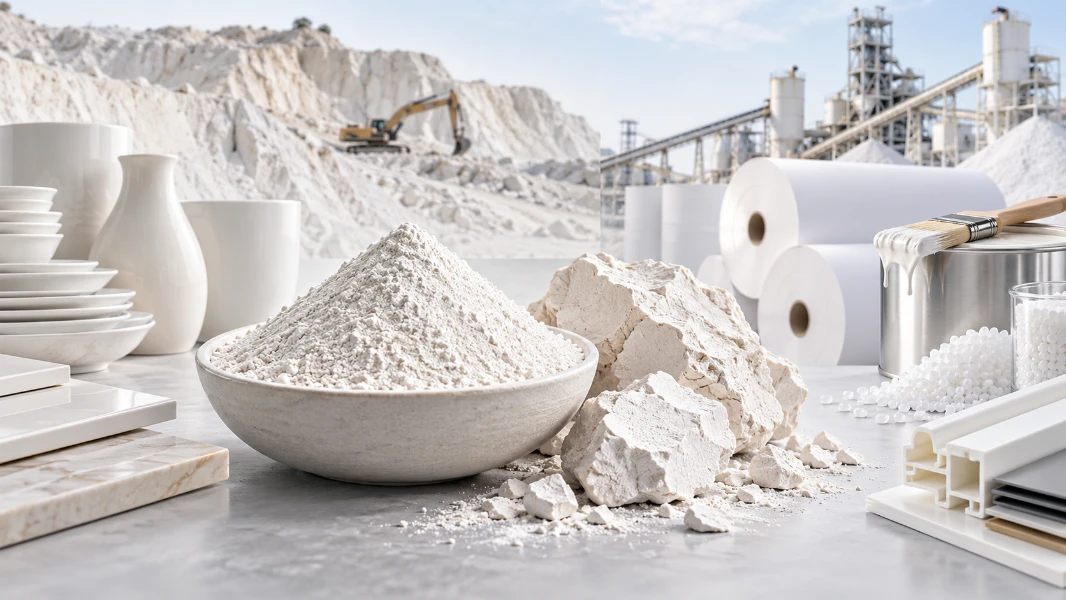
Introduction: Why Understanding Kaolin Grades Matters for Industrial Buyers
Kaolin is not a single standardized material with identical characteristics. Depending on its mineral composition, processing method, particle size distribution, brightness, and chemical purity, kaolin can be classified into different grades designed for specific industrial applications.
For manufacturers, choosing the correct kaolin grade is not only a technical decision but also a cost and performance factor. A ceramic manufacturer, paper producer, paint company, or polymer manufacturer may require completely different kaolin specifications.
For example, a high-whiteness kaolin suitable for premium ceramics may not necessarily be the most economical choice for construction applications. Similarly, a kaolin grade optimized for paper coating requires different particle size and brightness characteristics compared with kaolin used as a filler in plastics.
This guide explains the main kaolin grades, their properties, industrial applications, and the key parameters buyers should evaluate when sourcing bulk kaolin from suppliers and exporters.
Kaolin is supplied in different grades depending on industrial requirements, including ceramics, coatings, plastics, and other applications. Choosing the right kaolin supplier is essential for ensuring consistent quality and reliable bulk supply.
What Is Kaolin?
Kaolin is a naturally occurring industrial clay mainly composed of the mineral kaolinite, a hydrated aluminum silicate.
Also known as kaolin clay, this industrial mineral has unique properties that make it suitable for applications such as ceramics, paper, coatings, and plastics.
The chemical formula:
Al₂Si₂O₅(OH)₄
Kaolinite belongs to the 1:1 clay mineral group, meaning its structure consists of one silica tetrahedral sheet and one alumina octahedral sheet. Unlike swelling clays such as bentonite, kaolin has relatively low plasticity and limited expansion behavior.
The commercial value of kaolin comes from a combination of properties including:
- High whiteness
- Chemical stability
- Fine particle size
- Low abrasiveness
- Thermal resistance
- Good dispersion characteristics
Because of these properties, kaolin is widely used in ceramics, paper manufacturing, paints, coatings, plastics, rubber, construction materials, and specialty industrial applications.
Understanding Kaolin Grades
Kaolin grades are mainly determined by several technical factors:
| Quality Parameter | Why It Matters |
|---|---|
| Kaolinite content | Indicates mineral purity |
| Brightness | Important for white products such as paper and ceramics |
| Particle size distribution | Controls smoothness, opacity, and performance |
| Iron oxide content (Fe₂O₃) | Affects color and firing behavior |
| Titanium dioxide content (TiO₂) | Influences whiteness and ceramic properties |
| Moisture content | Important for transportation and processing |
| Residual minerals | Affect final product performance |
Industrial buyers usually evaluate kaolin through a combination of chemical analysis, physical properties, and application-specific requirements.
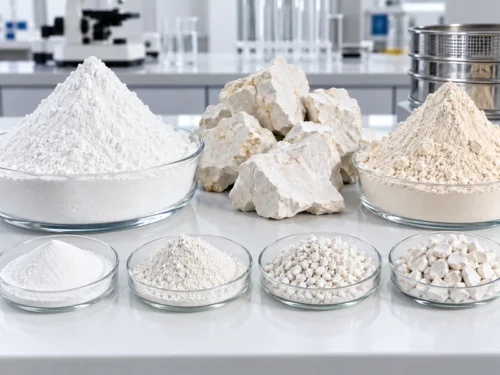
Main Types of Kaolin Grades
1. Ceramic Grade Kaolin
Ceramic grade kaolin is one of the most important commercial grades because kaolin has historically been associated with porcelain and ceramic production.
This grade requires:
- High kaolinite purity
- Low iron and titanium content
- Controlled particle size
- Good plasticity
- High firing whiteness
Common Applications:
- Porcelain
- Sanitary ceramics
- Ceramic tiles
- Tableware
- Refractory materials
Example:
A ceramic tile manufacturer usually prioritizes whiteness after firing and low impurity levels rather than only the chemical percentage of kaolin.
Two kaolin samples may have similar Al₂O₃ content, but the one with lower Fe₂O₃ may produce a noticeably whiter final ceramic product.
2. Paper Grade Kaolin
Paper-grade kaolin is engineered mainly for improving:
- Brightness
- Opacity
- Printability
- Surface smoothness
In paper manufacturing, kaolin is used both as a filler and coating material.
Important parameters include:
- Very fine particle size
- High brightness
- Low abrasive properties
- Controlled particle shape
A premium coating kaolin typically requires more advanced processing compared with general industrial grades.
3. Paint and Coating Grade Kaolin
Kaolin is widely used in paints as a functional extender pigment.
It helps improve:
- Opacity
- Durability
- Surface finish
- Rheological control
For coating manufacturers, the ideal kaolin grade depends on the formulation. Fine particle kaolin can improve smoothness, while specific grades can enhance hiding power and reduce production costs.
4. Plastic and Polymer Grade Kaolin
In plastics, kaolin is used as a functional filler rather than only a low-cost extender.
It can improve:
- Mechanical strength
- Dimensional stability
- Surface quality
- Barrier properties
Common applications include:
- PVC pipes
- Cable insulation
- Polymer composites
- Rubber products
For these industries, particle size distribution and surface treatment compatibility are often more important than maximum whiteness.
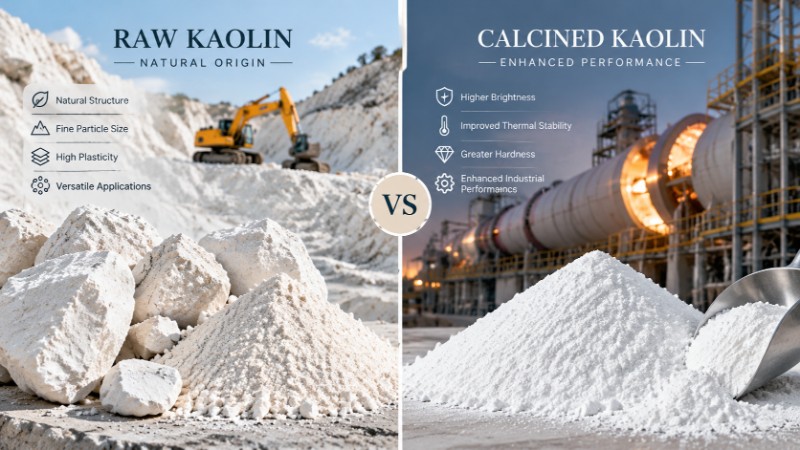
5. Calcined Kaolin Grade
Calcined kaolin is produced by heating raw kaolin at controlled temperatures to remove structural water and modify its properties.
This process creates:
- Higher brightness
- Improved opacity
- Increased hardness
- Enhanced performance as a functional filler
Calcined kaolin is commonly used in:
- High-performance coatings
- Plastics
- Rubber
- Specialty ceramics
Metakaolin, a calcined form of kaolinite, is also used as a reactive mineral addition in cement-based materials. Wikipedia
The differences between processed calcined kaolin and natural raw kaolin influence their performance in coatings, plastics, ceramics, and other industries. Learn more about calcined kaolin vs raw kaolin and their industrial applications.
Comparison of Common Kaolin Grades
| Kaolin Grade | Main Property Required | Major Applications |
|---|---|---|
| Ceramic Grade | Low impurities, firing whiteness | Tiles, porcelain, sanitary ware |
| Paper Grade | High brightness, fine particles | Paper coating and filling |
| Paint Grade | Dispersion and opacity | Paints and coatings |
| Plastic Grade | Compatibility and reinforcement | Polymer industries |
| Calcined Kaolin | High opacity and performance | Advanced fillers |
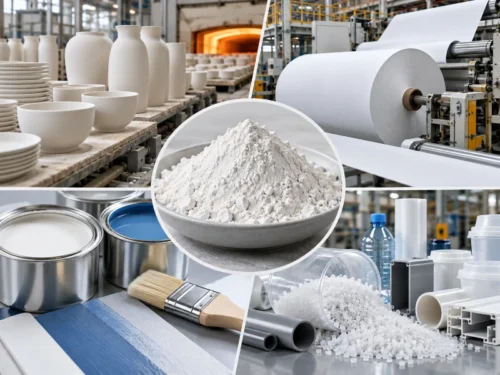
How Buyers Select the Right Kaolin Grade
When purchasing kaolin in bulk quantities, buyers should not evaluate only the product name. Selecting a suitable grade is only one part of the purchasing process. International buyers should also evaluate supplier reliability, technical documentation, consistency of supply, and export capabilities. Our guide explains how to choose a reliable kaolin exporter.
A professional supplier should provide:
Chemical Specifications
Including:
- SiO₂ percentage
- Al₂O₃ percentage
- Fe₂O₃ percentage
- TiO₂ percentage
- Loss on ignition (LOI)
Physical Specifications
Including:
- Brightness
- Particle size (micron distribution)
- Moisture
- Specific surface area
Application Testing
For industrial users, laboratory testing with their own formulation is often the final confirmation step.
For example:
A paint manufacturer may require a different kaolin grade compared with a ceramic factory, even if both purchase the same mineral.
Bulk Kaolin Supply and Export Considerations
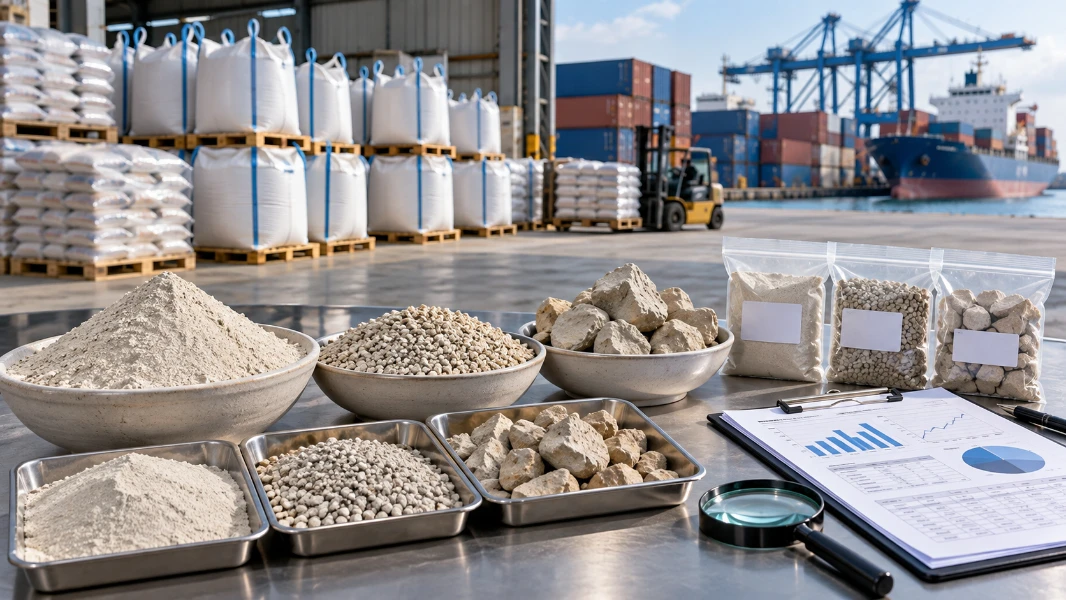
For international buyers, sourcing kaolin is not only about mineral quality. Reliable supply depends on:
- Consistent specifications
- Stable production capacity
- Proper packaging
- Export documentation
- Logistics capability
A professional kaolin supplier should be able to provide technical data sheets (TDS), certificates of analysis (COA), and customized specifications based on customer requirements.
Why Choose Vornaco as a Kaolin Supplier?
Vornaco supplies industrial minerals for international markets with a focus on reliable bulk supply and export-oriented solutions.
Our kaolin products are selected according to industrial requirements, including chemical composition, particle size, and application needs.
Whether you require kaolin for ceramics, coatings, plastics, or other industrial applications, our export team can support you with product specifications and supply solutions.
Looking for a reliable kaolin supplier for bulk industrial requirements?
Vornaco provides kaolin supply solutions for international buyers across ceramic, coating, plastic, and other industrial sectors. Contact our export team to discuss product specifications, required quantities, and customized supply options.
Frequently Asked Questions (FAQ)
What are the main grades of kaolin?
The main industrial kaolin grades include ceramic grade, paper grade, paint grade, plastic grade, and calcined kaolin.
Which kaolin grade is best for ceramics?
Ceramic manufacturers usually prefer kaolin with high kaolinite content, low iron impurities, and good firing whiteness.
Is calcined kaolin better than raw kaolin?
Not necessarily. Calcined kaolin offers different performance benefits, especially in opacity and reinforcement applications, while raw kaolin may be more suitable for other uses.
What should I check before buying bulk kaolin?
Buyers should review chemical analysis, brightness, particle size distribution, moisture content, and application suitability.
Conclusion
Choosing the correct kaolin grade is essential for achieving consistent industrial performance. Different industries require different combinations of purity, particle size, brightness, and mineral properties.
For companies searching for a reliable bulk kaolin supplier or kaolin exporter, understanding these differences helps reduce production risks and select the right raw material for each application.
- Mineralogical information on kaolinite structure and properties: Wikipedia
- Industrial mineral applications of kaolin: Wikipedia
- Calcined kaolin and metakaolin properties: Wikipedia