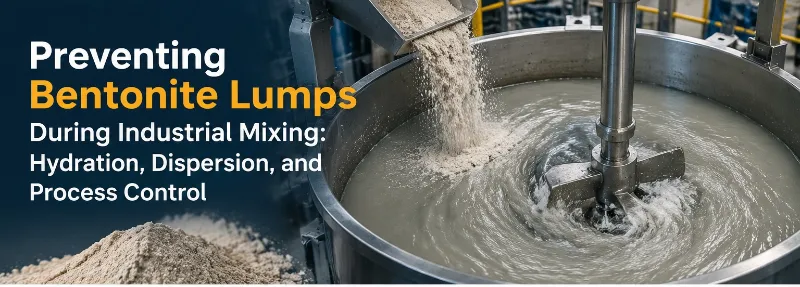
Preventing Bentonite Lumps During Industrial Mixing: Hydration, Dispersion, and Process Control
Bentonite lumps can create practical problems during industrial mixing, particularly when the clay is dispersed in water to prepare a slurry or suspension. Instead of forming a uniform mixture, portions of the powder may develop wet outer layers while retaining dry material inside. These partially hydrated aggregates can take longer to disperse and may lead to inconsistent slurry properties.
The problem is not always caused by poor-quality bentonite. Powder addition rate, mixing conditions, water chemistry, equipment design, and the hydration characteristics of the clay can all influence dispersion.
For manufacturers using bentonite in drilling fluids, mineral processing, foundry applications, and other industrial systems, understanding how lumps form is an important step toward improving mixing consistency.
This guide explains the main causes of bentonite lump formation and the practical process controls that can help reduce it.
Why Does Bentonite Form Lumps During Mixing?
Bentonite contains clay minerals, particularly smectites such as montmorillonite, that interact with water. Depending on the material’s characteristics, contact with water can cause hydration, swelling, and changes in the behavior of the clay particles.
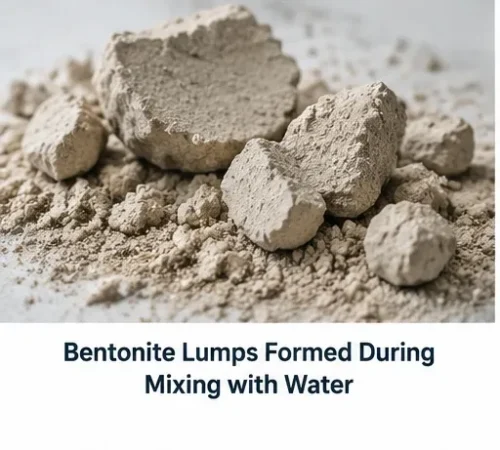
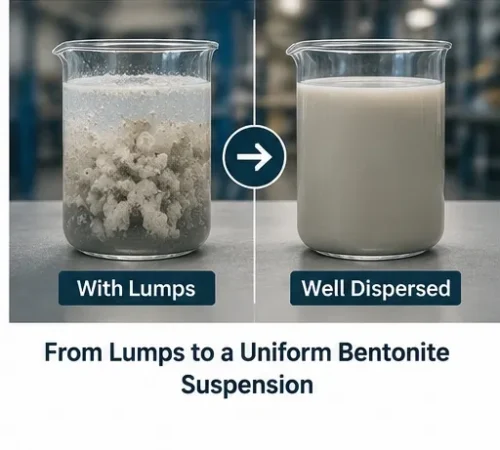
When dry bentonite powder contacts water too quickly or is not dispersed effectively, the outside of a particle cluster can become wet before the water penetrates the entire cluster. The resulting aggregate may contain a hydrated outer layer surrounding dry or incompletely hydrated powder.
This creates a dispersion problem: the material appears wet, but its interior may not be fully incorporated into the liquid.
Several operating conditions can contribute to this behavior:
- Adding powder faster than the mixing system can disperse it.
- Allowing a large quantity of powder to enter the liquid at one location.
- Inadequate circulation or poor mixing-zone design.
- Introducing powder into a region with limited liquid movement.
- Using water whose chemical composition affects the hydration behavior of the clay.
- Allowing insufficient time for the particular bentonite grade to hydrate.
These factors can interact. For example, rapid powder addition may cause problems in a mixing system that performs adequately when the same material is introduced more gradually.
1. Control the Rate of Powder Addition
The rate at which bentonite enters the mixing vessel is one of the first variables to examine when lumps appear.
If powder enters faster than the liquid and mixing equipment can disperse it, local concentrations of bentonite may become too high. Particles can accumulate, become wetted unevenly, and form aggregates before the mixture becomes uniform.
Why gradual addition can help
Introducing powder at a controlled rate gives the mixing system more opportunity to distribute the material throughout the liquid. It also reduces the likelihood that a large mass of dry powder will become trapped within a partially hydrated outer layer.
However, gradual addition does not automatically solve every dispersion problem. The result still depends on the location of powder feeding, the movement of the liquid, the equipment configuration, and the characteristics of the bentonite.
Practical checks
When investigating lump formation, examine:
- Whether powder is being introduced continuously or in large batches.
- Whether the feeding point allows the powder to contact moving liquid.
- Whether powder accumulates on the surface or along the vessel walls.
- Whether the feed rate changes during operation.
- Whether lumps appear immediately after powder addition or develop later.
If the problem begins during feeding, changing the addition procedure may be more effective than simply extending the mixing time.
2. Ensure Effective Mixing and Liquid Circulation
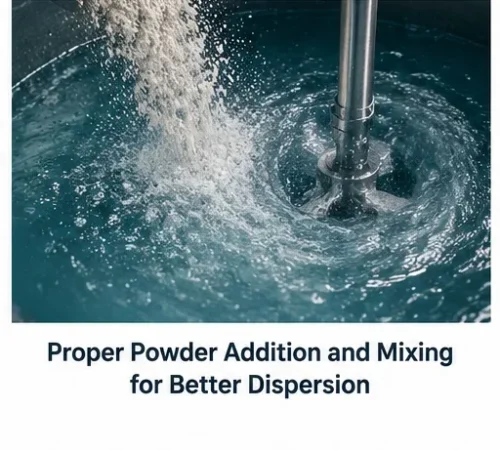
Mixing intensity and circulation influence how quickly bentonite particles become distributed throughout the liquid.
A mixer may be operating while still leaving poorly circulated regions in the vessel. Powder entering these areas may accumulate or remain insufficiently dispersed.
The relevant issue is not simply whether the mixer is running, but whether its design and operating conditions create effective contact between the powder and the liquid.
Mixing speed is not the only consideration
Increasing mixer speed may improve dispersion in some systems, but it is not a universal solution. The outcome depends on the impeller design, vessel geometry, liquid properties, powder-feeding arrangement, and the operating limits of the equipment.
Excessive agitation may also introduce unwanted air or create other operational difficulties in certain processes.
A more useful approach is to assess the overall mixing pattern and identify where the powder enters the liquid relative to the active circulation zone.
For industrial applications, changes to mixing speed, impeller configuration, or feeding position should be evaluated against the equipment design and the required slurry properties.
3. Allow Sufficient Time for Hydration
Dispersion and hydration are related, but they are not the same process.
Dispersion describes how effectively the powder is distributed throughout the liquid. Hydration describes the interaction between water and the clay material after contact occurs.
A bentonite powder may appear evenly distributed while some of its particles are still developing their hydrated properties. Conversely, extending hydration time may have limited benefit if large, poorly dispersed lumps remain in the mixture.
Why mixing time alone may not solve the problem
When lumps persist, operators sometimes respond by extending the mixing cycle. This may help if the material needs additional time to hydrate, but it may not resolve the underlying cause if powder addition or circulation is inadequate.
A more effective troubleshooting approach distinguishes between two situations:
- Poor initial dispersion: Lumps appear during powder addition and remain as visible aggregates.
- Incomplete hydration: The powder is distributed throughout the liquid, but the mixture has not yet developed its expected properties.
The appropriate mixing and hydration period depends on the bentonite grade, water conditions, equipment, and intended application. There is no single time that can be applied reliably to every industrial bentonite system.
4. Consider Bentonite Grade and Powder Characteristics
Not all bentonite materials behave identically during mixing.
Mineral composition, exchangeable cations, particle-size distribution, moisture condition, and processing history can influence how a particular powder interacts with water.
For this reason, two bentonite products introduced under similar mixing conditions may not develop identical dispersion or hydration behavior.
Why material consistency matters
Changes between batches can complicate process control. If the powder’s characteristics vary, a mixing procedure that previously produced a uniform suspension may become less effective.
When a recurring lumping problem appears after a change in supply, it can be useful to compare the available material information and batch records.
Relevant information may include:
- Bentonite type and mineral characteristics.
- Particle-size distribution, where specified.
- Moisture content.
- Relevant chemical properties.
- Any documented preparation or handling requirements.
These characteristics should be evaluated in the context of the intended application rather than treated as independent guarantees of mixing performance.
For information about Vornaco’s industrial bentonite offering, visit the Bentonite product page.
5. Evaluate Water Quality and Chemical Conditions
Water chemistry can affect the hydration and dispersion behavior of bentonite.
Dissolved ions, particularly calcium and magnesium, can influence the interactions between clay particles and water. Depending on their concentrations and the characteristics of the material, these effects may alter swelling, dispersion, and the properties of the resulting suspension.
This means that a mixing procedure that works with one water source may not produce identical results with another.
What to investigate
If the mixing procedure and bentonite supply remain unchanged but lump formation or slurry behavior changes, consider whether the water source or its chemical composition has changed.
Useful comparisons may include:
- Changes in the water supply.
- Relevant water-quality measurements.
- Differences in the resulting slurry properties.
- Changes in the bentonite batch or other formulation components.
Water chemistry should be considered alongside powder feeding and mixing conditions rather than assumed to be the sole cause of every lumping problem.
For a more detailed discussion of dissolved salts and clay behavior, see Vornaco’s article on how water salinity affects bentonite hydration and performance.
6. Prevent Powder Accumulation During Handling and Feeding
Bentonite handling conditions can influence how consistently the powder enters the mixing system.
Powder that has accumulated in storage, become compacted, or formed aggregates before feeding may be more difficult to disperse than material introduced in a consistent condition.
Storage and handling should therefore be considered when lump formation occurs even before the powder enters the liquid.
Practical checks include:
- Inspecting the powder for visible aggregates before feeding.
- Checking whether moisture exposure has occurred during storage.
- Reviewing how the material is transferred to the mixing equipment.
- Identifying restrictions or interruptions in the feeding system.
- Comparing the condition of different deliveries or batches.
Any handling or storage changes should be appropriate for the product and its documented requirements. The aim is to maintain consistent material condition before mixing begins.
7. Use a Structured Troubleshooting Approach
Changing several operating variables at once makes it difficult to identify why a mixing problem occurred. A structured investigation is generally more informative.
The following table links common observations to practical areas to examine.
| Observation | Possible contributing factor | What to examine |
|---|---|---|
| Lumps appear immediately after powder addition | Powder enters faster than it can disperse | Feed rate, feeding location, and liquid circulation |
| Dry material remains inside wet aggregates | Uneven wetting or inadequate initial dispersion | Powder addition method and mixing pattern |
| Slurry properties vary between batches | Changes in material, water, or preparation conditions | Batch records, water quality, and operating conditions |
| Lumps persist despite longer mixing | Poor initial dispersion or unsuitable mixing conditions | Feeding, equipment design, and material characteristics |
| Problems begin after changing the water source | Differences in water chemistry | Relevant water-quality measurements |
| Powder arrives with visible aggregates | Storage, handling, or material-condition issues | Packaging condition, moisture exposure, and batch consistency |
These observations help narrow the investigation, but they do not independently establish the root cause. More than one factor may be involved.
Change one variable at a time
When practical, compare controlled trials in which one operating variable is changed while the others remain consistent.
For example, a trial may compare two powder-feeding rates using the same bentonite batch, water source, vessel, and mixing configuration.
The comparison should use relevant observations or measurements, such as visible lump formation, dispersion consistency, and the properties required by the application.
This approach helps distinguish improvements caused by the process change from variations caused by other conditions.
8. Confirm That the Final Mixture Meets Application Requirements
A visually uniform mixture is useful, but appearance alone does not prove that the bentonite has reached the required state for its intended use.
Different applications require different properties. Bentonite prepared for drilling fluids, for example, may be evaluated using application-specific slurry properties, while other industrial systems may require different performance measurements.
Consequently, the final evaluation should be based on the requirements of the process rather than on a universal visual standard.
Depending on the application, relevant checks may include:
- Visual assessment of remaining aggregates.
- Consistency between batches.
- Appropriate slurry-property measurements.
- Hydration or dispersion tests relevant to the material.
- Verification against the process’s established acceptance criteria.
The appropriate test method and acceptance limits depend on the application and the material specification.
For drilling applications, Vornaco’s Drilling Bentonite product page provides a starting point for exploring the product category.
Common Mistakes When Trying to Prevent Bentonite Lumps
Several common responses can fail to address the underlying cause of lump formation.
Increasing mixing speed without checking circulation
Higher speed does not necessarily eliminate poorly mixed regions. The feeding point, vessel geometry, and mixing pattern also matter.
Extending mixing time without examining initial dispersion
Longer mixing may not resolve aggregates that formed during rapid powder addition or inadequate initial wetting.
Assuming all bentonite grades behave identically
Differences in material characteristics can influence hydration and dispersion. A procedure that works for one grade may require adjustment for another.
Changing several process variables simultaneously
Multiple simultaneous changes make it difficult to determine which adjustment improved the result.
Judging the result only by appearance
A visually uniform suspension may still require application-specific testing before it can be considered suitable for the intended process.
Conclusion
Preventing bentonite lumps during industrial mixing requires attention to how the powder contacts water, how effectively the liquid circulates, and how the material hydrates under the operating conditions.
Controlled powder addition, suitable mixing conditions, consistent material handling, and attention to water chemistry can all help reduce the likelihood of poorly dispersed aggregates.
However, lump formation rarely has one universal solution. The most effective approach is to identify when the problem occurs, investigate the relevant material and process variables, and evaluate changes against the requirements of the intended application.
For industrial buyers and process operators, understanding these factors also helps distinguish between a material-related issue and a problem arising from preparation or equipment conditions.
Looking for Bentonite for Your Industrial Application?
Consistent bentonite dispersion starts with understanding the material and the mixing conditions. Whether you are sourcing bentonite for drilling fluids or other industrial applications, selecting a suitable product is an important step toward reliable processing.
Explore Vornaco’s Bentonite products to learn more about its industrial mineral offering, or visit our Drilling Bentonite page for drilling-related supply inquiries.
Contact Vornaco to discuss your industrial bentonite requirements and bulk supply inquiries.
For a specification-matched quotation, a batch COA, or a technical discussion of your application, contact the team directly at Email or +98 912 293 9278.
Contact Us
Getting in touch with us is easy:
📞 Phone: +98 912 293 9278 or WhatsApp
📧 Email: info@vornaco.com
Frequently Asked Questions
Why does bentonite form lumps when mixed with water?
Bentonite can form lumps when the outside of a powder aggregate becomes wet before water penetrates its interior. Rapid powder addition, uneven circulation, and insufficient initial dispersion can contribute to this behavior.
How can bentonite lumps be reduced during industrial mixing?
Potential measures include controlling the powder-feeding rate, introducing the material into an effective mixing zone, maintaining suitable liquid circulation, and allowing sufficient hydration time. The appropriate approach depends on the material and equipment.
Does increasing mixing speed always prevent bentonite lumps?
No. Higher mixing speed does not necessarily correct poor circulation or unsuitable powder feeding. Mixing performance depends on the equipment design, vessel geometry, material properties, and operating conditions.
Can water quality affect bentonite dispersion?
Yes. Dissolved ions can influence the interaction between bentonite and water. Changes in water chemistry may affect hydration and slurry behavior, depending on the material and the concentrations of dissolved substances.
Does every bentonite grade require the same hydration time?
No. Hydration behavior depends on the bentonite’s characteristics, water conditions, mixing equipment, and intended application. A single hydration time should not be assumed suitable for every grade.
How can operators determine whether a bentonite mixing problem comes from the material or the process?
Compare material batches, water conditions, feeding procedures, and mixing parameters while keeping other variables consistent where practical. Relevant tests and process records can help identify the contributing factors.