The world mined about 20 million tons of bentonite in 2025, according to the U.S. Geological Survey. Six countries produced almost three-quarters of it. Market research firms value the trade at roughly $1.5 billion to $2.2 billion a year, and most expect growth of 2% to 5% a year into the early 2030s.
Those headline numbers hide a lot. Bentonite is a bulk mineral with a low price per ton, so freight, grade, and end use determine what a buyer pays. This guide covers market size, the main producers, demand by industry, trade flows, prices, and the Middle East market around Iran.
How Big Is the Bentonite Market?
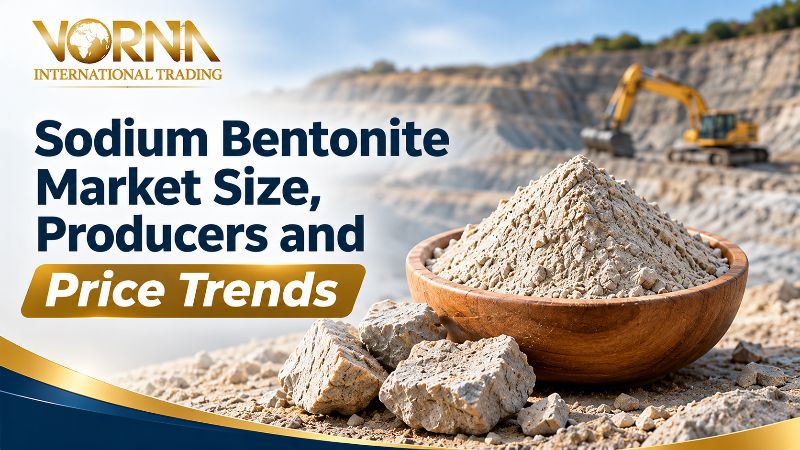
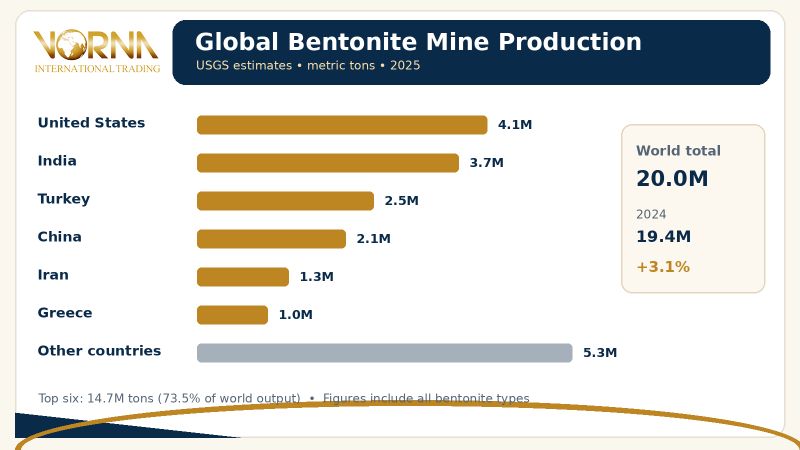
In volume, the answer is clear. The USGS puts world mine production at 19.4 million tons in 2024 and 20 million tons in 2025.
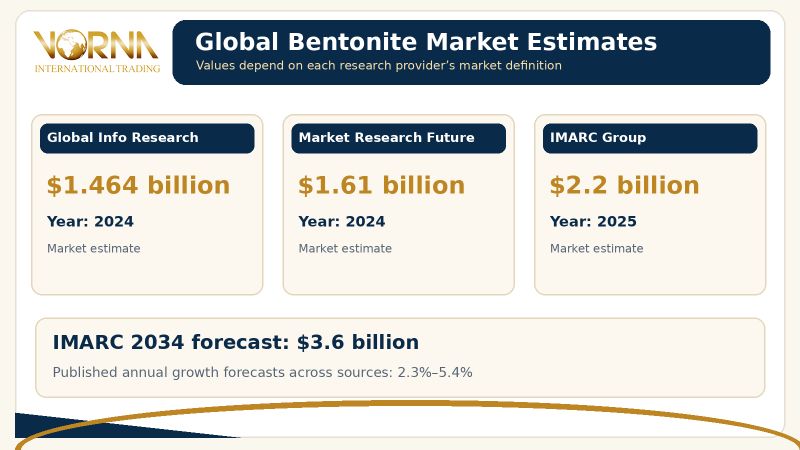
In value, the answer depends on the research provider. Global Info Research valued the market at $1,464 million in 2024. Market Research Future gives $1.61 billion for the same year. IMARC Group puts 2025 at $2.2 billion and forecasts $3.6 billion by 2034.
Why the gap? Each firm defines the market differently. Some count only raw and processed clay at the mine gate. Others may include organoclays, activated grades, and packaged products such as cat litter. A report that counts a retail bag of litter at its final selling price will show a larger market than one that counts only the mineral inside it.
Growth forecasts are closer together. Published estimates generally range from 2.3% to 5.4% a year, although actual growth will depend on industrial demand and market conditions.
Which Countries Produce the Most Bentonite?
The United States leads global production, followed by India, Turkey, and China. Iran is the fifth-largest producer, with an estimated 1.3 million tons in 2025. That represents about 6.5% of world production.
Major Bentonite Producers in 2025
| Country | Production (Million Tons) |
|---|---|
| United States | 4.1 |
| India | 3.7 |
| Turkey | 2.5 |
| China | 2.1 |
| Iran | 1.3 |
| Greece | 1.0 |
Source: U.S. Geological Survey, Mineral Commodity Summaries 2026. Estimates include all bentonite types.
Together, these six countries produced approximately 14.7 million tons, representing nearly 74% of estimated global production.
Turkey is particularly important for regional buyers. It is a major producer close to the Gulf and an important exporter to Middle Eastern markets.
Iran produces about half as much bentonite as Turkey and supplies domestic industries as well as international customers.
For buyers interested in Iranian mineral resources, Vornaco’s article on bentonite deposits in Iran explains the major geological regions and the characteristics of different deposits.
What Drives Bentonite Demand?
Bentonite swells in water, binds particles together, and absorbs liquids. These properties explain many of its industrial applications.
The United States provides relatively detailed statistics on bentonite consumption by application.
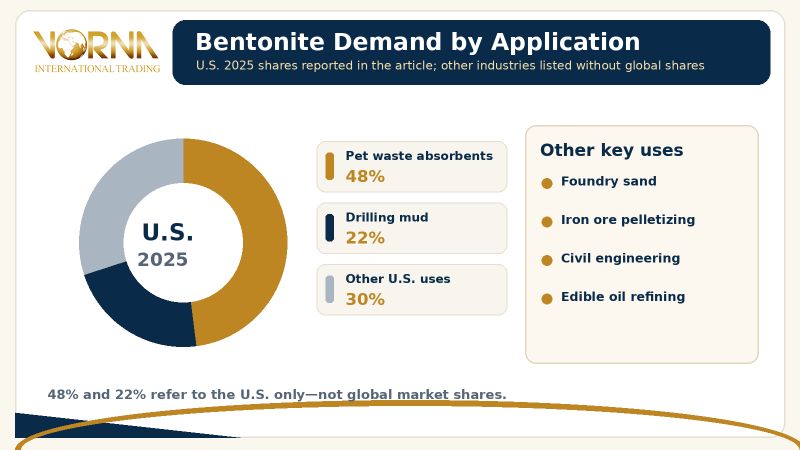
In 2025, pet waste absorbents accounted for approximately 48% of U.S. bentonite use, while drilling mud represented about 22%.
Other producing countries do not necessarily publish the same detailed breakdown, so these percentages should not be applied directly to global consumption.
Pet Litter Manufacturing
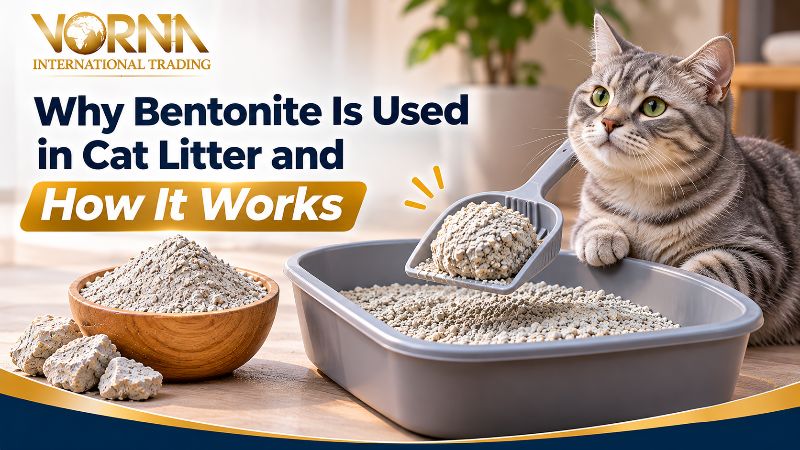
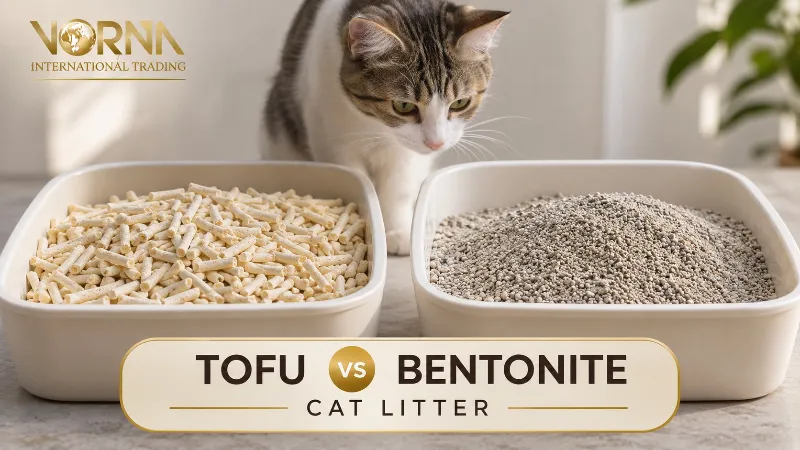
Sodium bentonite forms cohesive clumps when it absorbs moisture. This makes it a common raw material for clumping cat litter.
Manufacturers select different grades according to absorption capacity, particle size, dust content, and clump strength.
The pet care industry represents a significant source of demand, particularly in markets with high cat ownership and established commercial litter distribution.
Importers and pet product manufacturers can review Vornaco’s Bentonite Cat Litter for information about bulk supply and product characteristics.
Oil, Gas, and Water Well Drilling
Bentonite is used in water-based drilling fluids because suitable grades develop viscosity, help transport cuttings, and control fluid loss.
Demand depends on drilling activity, which can change with energy prices, infrastructure investment, and exploration projects.
For drilling contractors and industrial buyers, technical specifications are especially important.
Vornaco’s Drilling Bentonite product range provides information about grades used in drilling applications and their laboratory characteristics.
Foundry Manufacturing
Foundries use bentonite as a binder in sand molds for metal casting.
The clay helps maintain mold strength during handling and pouring.
Performance depends on the mineral grade, moisture content, and the composition of the molding sand.
Iron Ore Pelletizing
Steel producers add bentonite as a binder during iron ore pellet production.
Bentonite helps fine iron ore particles form pellets with suitable mechanical strength.
Even small changes in binder dosage can influence pellet quality and production performance.
Civil Engineering
Bentonite is used in diaphragm walls, tunneling operations, sealing systems, and landfill liners.
Its swelling behavior and low permeability make it useful in applications requiring water movement control.
Engineering performance depends on material quality, installation methods, and water chemistry.
Edible Oil Refining
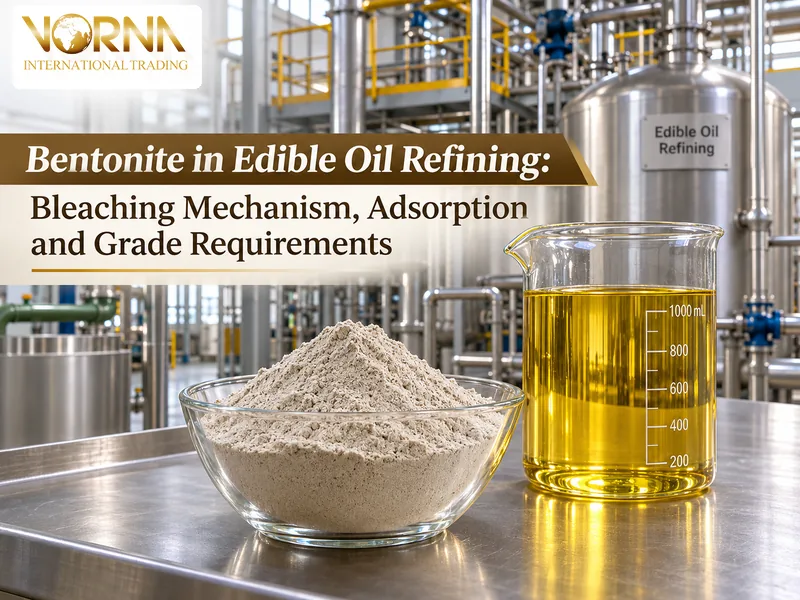
Processed and acid-activated clays are used as bleaching earth in edible oil refining.
These materials help remove selected pigments and impurities from oils during processing.
The required specifications differ from those of drilling-grade or absorbent bentonite.
Across the Middle East, drilling, construction, steel production, and industrial processing are important sources of demand. However, no consistent regional dataset provides an equivalent application-by-application breakdown.
How Does Bentonite Trade Work?
Most bentonite is consumed in the country where it is mined.
International exports represent a smaller portion of global production, and shipping costs strongly influence trade routes.
Because bentonite has a relatively low value per metric ton, freight can account for a substantial share of the final delivered price.
According to the Observatory of Economic Complexity, the largest bentonite exporters by value in 2022 included:
| Country | Export Value |
|---|---|
| United States | $201 million |
| China | $167 million |
| Turkey | $155 million |
| India | $101 million |
| Netherlands | $77 million |
The Netherlands is not among the world’s largest bentonite mining countries. Its trade value reflects processing, distribution, and re-export activity.
The largest importers in 2022 were Germany, Canada, the Netherlands, Indonesia, and Japan.
Import demand is particularly important where domestic deposits cannot supply the grades required by local industries.
Bentonite HS Code
Bentonite is generally classified under HS code 2508.10 in international customs statistics.
Buyers comparing import and export figures should verify that the data use the same customs classification.
Activated clay products and packaged cat litter may appear under other tariff headings, depending on their composition and classification.
The Middle East Bentonite Market
The Middle East is a significant production and trading region for bentonite.
Turkey and Iran represent two major sources of supply, serving industrial buyers within the region and international markets.
According to IndexBox estimates, the Middle East consumed approximately 2.5 million tons of bentonite in 2024, representing a market value of about $303 million.
Regional production was estimated at approximately 3.3 million tons.
Bentonite Consumption in Turkey and Iran
Turkey consumed approximately 1.3 million tons in 2024, while Iranian consumption reached an estimated 882,000 tons.
Production estimates for Iran vary between data providers.
IndexBox reported approximately 886,000 tons, while USGS estimated 1.3 million tons. Differences in methodology, reporting coverage, and the treatment of crude and processed clay can contribute to these variations.
Bentonite Imports into the Middle East
Regional imports reached an estimated 294,000 tons in 2024.
Oman accounted for approximately 42% of these imports, while the UAE represented about 16%.
Iraq and Qatar each accounted for roughly 7.9%.
Saudi Arabia, Kuwait, and Bahrain also imported bentonite, although at lower volumes.
These trade patterns reflect differences in domestic production, industrial requirements, and access to regional suppliers.
Turkey and Iran as Regional Supply Sources
Turkey is an important supplier to Iraq and neighboring countries.
In 2022, Iraq imported approximately $1.82 million worth of bentonite, with Turkey supplying about $1.55 million.
This represented approximately 85% of Iraqi bentonite imports by value.
For buyers in Basra, Dubai, or Muscat, the choice between Turkish and Iranian suppliers depends on material specifications, transportation routes, border procedures, and delivered prices.
Distance alone does not determine the most economical source.
A supplier with a lower mine-gate price may become more expensive after freight, handling, and import charges.
Bentonite Prices per Ton
Bentonite prices vary considerably according to mineral grade, processing requirements, origin, and delivery conditions.
There is no single worldwide bentonite price.
According to USGS estimates, the average United States bentonite value at the plant increased from approximately $100 per ton in 2021 to $110 per ton in 2025.
That represents an increase of about 10% over four years.
Middle East Bentonite Prices
According to the regional figures cited by IndexBox, the average Middle East bentonite import price was approximately $130 per ton in 2024.
This represented a decline of about 31% compared with the previous year.
The average regional export price was approximately $139 per ton.
Prices differed substantially between importing countries.
Reported country averages ranged from approximately $39 per ton for Oman to $377 per ton for Israel.
These figures represent average trade values for the reported products and periods. They should not be interpreted as current quotations for an identical bentonite grade.
Why Bentonite Prices Vary
Several factors determine the price buyers receive.
Mineral grade: Natural sodium bentonite, calcium bentonite, activated bentonite, and specialty grades have different performance characteristics.
Processing: Drying, crushing, milling, screening, and chemical activation affect manufacturing costs.
Industrial application: Drilling, foundry, pelletizing, sealing, and absorbent products require different specifications.
Transportation: Freight rates, loading arrangements, and destination ports influence the delivered price.
Order quantity: Larger purchases can reduce certain handling and packaging costs per ton.
A small difference in price becomes important for large orders.
For example, a $10 difference per ton on an annual order of 1,000 tons equals $10,000.
Suppose the cheaper supplier also charges $20 more per ton for delivery. The same order would then cost $10,000 more overall, despite the lower price at the mine.
For this reason, buyers should compare total delivered costs using the same technical specifications and delivery conditions.
What the Bentonite Market Means for Buyers in the Region
A market with several major producers provides opportunities to compare suppliers, grades, and commercial terms.
However, a low price does not automatically mean a good purchase.
The following factors are especially relevant.
Match the Grade to the Application
Drilling, foundry, pelletizing, civil engineering, and cat litter production require different performance characteristics.
A material that performs well in one application may not meet the requirements of another.
Selecting the correct grade can reduce processing problems and unnecessary expenses.
Request Laboratory Test Results
Buyers should review technical documentation and request appropriate test results.
Important characteristics may include swelling capacity, moisture content, particle size distribution, viscosity, and mineral composition.
One commonly used test for swelling clay is the Free Swell Index.
Vornaco’s guide to the bentonite free swell index test explains the test procedure and how results are interpreted.
Compare Delivered Costs
A supplier’s quoted price may exclude freight, insurance, customs charges, and inland transportation.
Requesting quotations to the same destination allows a more meaningful comparison.
Review Packaging and Loading Requirements
Bentonite is available in different packaging formats, including small bags, jumbo bags, and bulk shipments.
Packaging influences loading, storage, handling, and transportation costs.
The preferred format depends on order quantity and the buyer’s receiving facilities.
Evaluate Supplier Reliability
Reliable supply involves consistent specifications, suitable documentation, and clear delivery arrangements.
Buyers should confirm production capabilities, product availability, quality control procedures, and export experience before placing large orders.
Sourcing Bentonite from Iran
Iran is one of the world’s major bentonite-producing countries.
Its geographical position provides access to markets in the Persian Gulf, Iraq, Pakistan, and Central Asia.
Vornaco supplies bentonite products to industrial buyers, importers, and distributors seeking mineral materials from Iran.
Available grades and commercial arrangements depend on the intended application and order requirements.
Businesses looking for raw or processed mineral products can explore Vornaco’s Bentonite Supplier & Exporter page for product information and bulk purchasing options.
When requesting a quotation, buyers should provide their required grade, technical specifications, approximate monthly volume, packaging preference, and destination port.
This information helps suppliers prepare quotations that reflect the actual purchasing requirements.
Frequently Asked Questions
What is the global bentonite market worth?
Published estimates place the global market at approximately $1.5 billion to $2.2 billion annually. Global Info Research estimated $1.464 billion in 2024, while IMARC Group estimated $2.2 billion in 2025. Differences reflect variations in market definitions and product coverage.
How much bentonite is produced worldwide each year?
According to USGS estimates, global bentonite mine production reached approximately 20 million tons in 2025, compared with 19.4 million tons in 2024.
Which country is the largest bentonite producer?
The United States was the largest reported producer in 2025, with approximately 4.1 million tons. India, Turkey, and China followed.
Where does Iran rank among bentonite producers?
Iran ranked fifth among the reported producing countries in 2025, with approximately 1.3 million tons, representing about 6.5% of estimated global production.
What is bentonite mostly used for?
Major applications include cat litter, drilling fluids, foundry sand, iron ore pelletizing, civil engineering, and refining processes. In the United States, pet waste absorbents accounted for approximately 48% of bentonite consumption in 2025.
Which countries export the most bentonite?
According to 2022 trade data, the largest exporters by value included the United States, China, Turkey, India, and the Netherlands.
What HS code covers bentonite?
Bentonite is generally classified under HS code 2508.10. Activated clay products and packaged cat litter may fall under other classifications.
How much does bentonite cost per ton?
Prices depend on grade, processing, and delivery terms. The average United States plant value was approximately $110 per ton in 2025, while Middle East import prices averaged approximately $130 per ton in 2024.
Is the bentonite market growing?
Commercial research providers generally forecast annual growth between approximately 2.3% and 5.4% into the early 2030s. Growth depends on industrial production, construction, drilling, and absorbent product demand.
Which Middle Eastern countries import the most bentonite?
According to regional estimates for 2024, Oman accounted for approximately 42% of bentonite imports, followed by the UAE with around 16%. Iraq and Qatar each represented approximately 7.9%.
Why do bentonite market reports give different values?
Market research companies use different definitions and calculation methods. Some focus on mined and processed clay, while others include additional products, applications, or stages of the supply chain.
Is Turkish or Iranian bentonite better for drilling contractors in Iraq?
Neither origin is automatically better. Buyers should compare laboratory results, technical specifications, supplier reliability, and total delivered costs. The most suitable product is the one that meets the drilling requirements at an acceptable overall cost.
Does a fall in oil prices make cat litter bentonite cheaper?
Not necessarily. Lower oil prices may affect drilling activity and demand for drilling-grade bentonite, but cat litter prices also depend on processing costs, pet care demand, mineral quality, and transportation expenses.