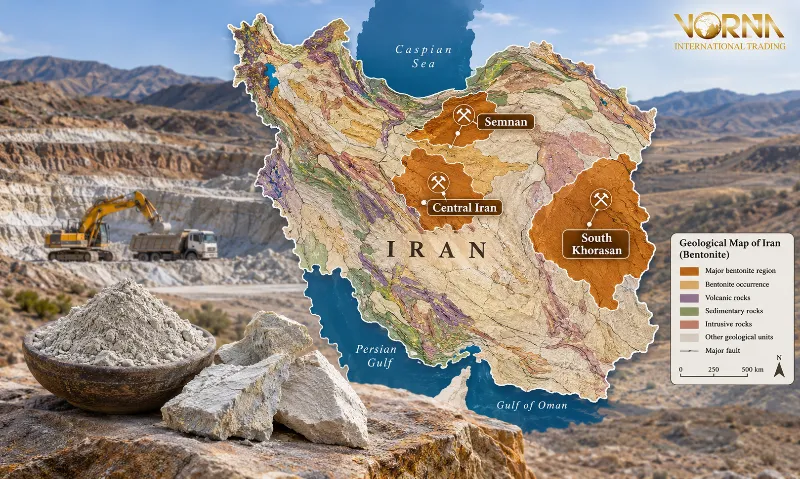
Iran is home to numerous bentonite deposits distributed across different geological regions, particularly in areas associated with ancient volcanic activity. These deposits vary in mineral composition, geological age, chemical characteristics, and industrial potential.
Among the most important documented bentonite-bearing areas are South Khorasan, Semnan–Toroud, and parts of Central Iran, including the Naein region of Isfahan Province. South Khorasan is particularly significant because of its extensive mining activity and documented reserves.
However, the presence of a bentonite deposit does not automatically indicate that it contains high-quality industrial material. Mineral composition, montmorillonite content, exchangeable cations, accessory minerals, and geological conditions all influence the characteristics of the extracted clay.
Understanding the distribution and geology of Iranian bentonite deposits is therefore important for mining companies, mineral processors, industrial manufacturers, and international buyers evaluating different sources of raw material.
1. Overview of Bentonite Resources in Iran
Bentonite deposits in Iran are associated with several geological structural zones, many of which experienced significant volcanic activity during the Cenozoic Era.
A nationwide geological study by Ghorbani and Tajbakhsh identified more than 100 bentonite deposits and occurrences across Iran. The study highlighted Central Iran, Eastern Iran, Alborz, and Azerbaijan as important areas of bentonite occurrence.
A later classification identified six principal bentonite-bearing geological zones:
- Semnan–Toroud Zone
- Alborz–Azerbaijan Zone
- Eastern Iran Zone
- Central Iran Zone
- Tafresh–Takab Zone
- Zagros Zone
These zones represent geological distribution patterns rather than a ranking of current production volumes. The number of documented occurrences, active mining operations, proven reserves, and annual extraction are different indicators and should not be treated as interchangeable.
Among these regions, South Khorasan has particularly strong evidence of large-scale mining activity, while several other areas are important for their documented geological and mineralogical characteristics.
2. Major Bentonite Mining and Deposit Regions in Iran
2.1. South Khorasan: One of Iran’s Most Important Bentonite-Producing Regions
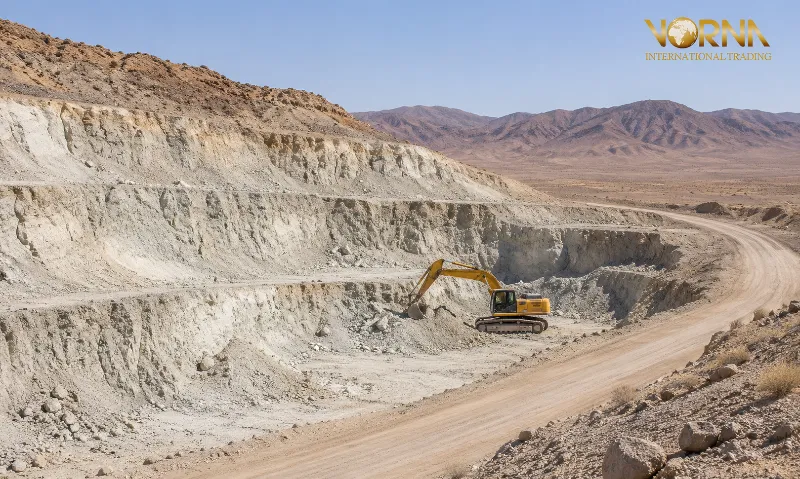
South Khorasan is one of the most significant bentonite-producing regions in Iran. The province contains numerous bentonite mines, particularly around Sarayan, Ferdows, Qaen, Birjand, and surrounding areas.
Its geological importance is supported by both mining records and academic research on the mineralogical characteristics of local deposits.
According to a report published on January 18, 2025, quoting the Deputy for Mining Affairs of the South Khorasan Industry, Mine and Trade Organization, the province had 143 reported bentonite mines.
The reported distribution was as follows:
| District | Number of Bentonite Mines |
|---|---|
| Sarayan | 66 |
| Ferdows | 23 |
| Qaen | 18 |
| Tabas | 13 |
| Birjand | 9 |
| Khosf | 6 |
| Sarbisheh | 4 |
| Boshruyeh | 3 |
| Darmian | 1 |
| Total | 143 |
The same report documented the following figures:
| Mining Indicator | Reported Value |
|---|---|
| Proven bentonite reserves | 55,899,252 tonnes |
| Nominal annual extraction capacity | 1,954,612 tonnes |
| Extraction from the beginning of the reported Iranian year | 992,184 tonnes |
| Employment generated | 627 people |
These figures reflect the provincial report published on January 18, 2025, and should not be interpreted as a current 2026 production audit.
Sarayan stands out among these districts, with 66 reported mines. The Kal Shend Ab mine in Sarayan was also identified as the largest contributor to extraction during the period covered by the report, with 203,900 tonnes extracted.
The concentration of mining activity in South Khorasan makes the province an important part of Iran’s bentonite industry.
2.2. Ferdows and Sarayan: Important Areas for Bentonite Mineralogical Research
Beyond mining statistics, Ferdows and Sarayan have received considerable attention in geological research.
A study published in Applied Clay Science in 2019 investigated seven bentonite deposits in these two counties:
Deposits around Ferdows:
- Gholeh-Gelia
- Kharman-Sar
- Khal-Kooh
Deposits around Sarayan:
- Chah-Taleb
- Chah-Keshmir
- Chah-Golestan
- Chah-Pirouz
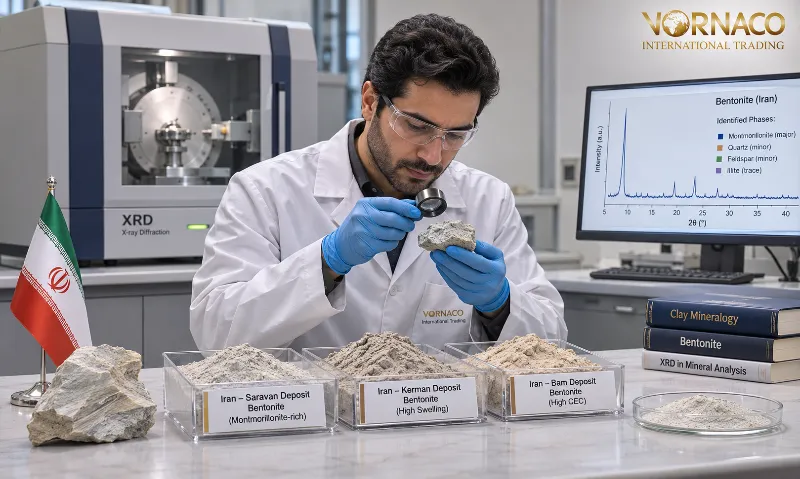
Researchers examined the mineralogical and geochemical properties of bentonite samples and their possible parent rocks using methods including X-ray diffraction (XRD), X-ray fluorescence (XRF), and inductively coupled plasma mass spectrometry (ICP-MS).
The results showed that the studied deposits were mainly composed of sodium montmorillonite and opaline silica, with smaller quantities of:
- Quartz
- Feldspars
- Carbonates
- Halite
- Zeolites
- Illite
The study also identified differences between deposits associated with the Ferdows and Sarayan areas, particularly in their volcanic source materials and geological development.
These findings demonstrate that bentonite deposits within the same broad geographical region can still have different mineralogical characteristics.
2.3. Momen Abad and Sarbisheh: Bentonite with Industrial Research Potential
Momen Abad is another important bentonite-bearing area in South Khorasan, located northeast of Sarbisheh and southeast of Birjand.
The deposit belongs to the Eastern Iranian Bentonite Zone and has been investigated for its mineralogical characteristics and potential applications in iron ore pelletizing.
A study published in the Journal of Advanced Applied Geology in 2020 examined bentonite samples from Momen Abad and several other mines in Eastern Iran.
The researchers used X-ray diffraction, scanning electron microscopy (SEM), and energy-dispersive X-ray spectroscopy (EDS/EDX) to investigate the samples.
The findings identified sodium-bearing smectite as an important mineral component, together with cristobalite and other accessory phases, including feldspar, zeolite, mica-illite, amorphous silica, and calcite.
One particularly useful observation was the variation in water absorption between samples collected from different depths.
In the study, selected deeper samples showed water absorption values of approximately 600–800%, whereas surface samples had lower absorption values.
These results demonstrate why evaluating a deposit based on a single surface sample may not provide a reliable picture of its overall industrial potential.
The Momen Abad research also highlights the importance of evaluating mineralogical properties alongside actual performance tests.
2.4. Semnan–Toroud: Bentonite Deposits Associated with Volcanic Rocks
The Semnan–Toroud geological zone is another recognized bentonite-bearing region in Iran.
One documented example is the Kuh-e-Arshe deposit, located approximately 50 kilometers east of Semnan.
A geological and mineralogical study of this area identified bentonite deposits associated with volcanic and pyroclastic rocks, particularly materials related to rhyodacitic and dacitic volcanic ash.
The researchers identified several mineral phases in the studied deposits, including:
- Smectite
- Dolomite
- Calcite
- Quartz
- Opal-CT
- Plagioclase
- Clinoptilolite
- Mordenite
- Minor illite
The study also reported differences between sodium-rich and calcium-rich smectites.
For example, the measured basal spacing of dioctahedral smectites was approximately 12.5–12.6 Å for sodium smectite and 15–15.5 Å for calcium smectite.
These differences are relevant to mineral identification and demonstrate how the chemical environment during deposit formation can influence the characteristics of the resulting clay.
The Kuh-e-Arshe deposit is a useful geological example of bentonite formation in the Semnan–Toroud region, although its published mineralogical description should not be interpreted as a current production assessment for the entire region.
2.5. Central Iran: Mollaahmad Pass Bentonite Deposit in Isfahan
Central Iran also contains documented bentonite occurrences, including the Mollaahmad Pass area in Naein, Isfahan Province.
A detailed study published in Acta Geodynamica et Geomaterialia in 2020 investigated the mineralogy, geochemistry, and geological origin of this deposit.
The Mollaahmad Pass bentonite deposit extends across an area of approximately 10 square kilometers and is associated with Oligocene–Miocene geological formations.
The bentonite occurs in both lenticular and layered forms within tuff, conglomerates, and sandstones containing volcanic fragments.
X-ray diffraction analyses identified several mineral phases, including:
- Montmorillonite
- Montmorillonite–illite
- Nontronite
- Albite
- Anorthite
- Quartz
- Clinoptilolite
- Heulandite
- Sanidine
- Orthoclase
- Calcite
- Microcline
- Actinolite
The study also examined the geochemical behavior of major and trace elements during the alteration of the parent rocks.
The presence of different smectite minerals and accessory phases indicates that the mineralogical characteristics of this deposit differ from those reported in some Eastern Iranian bentonite deposits.
This example demonstrates why bentonite from different geological regions should be evaluated individually rather than assumed to have identical industrial properties.
2.6. Other Bentonite-Bearing Geological Zones
In addition to the regions discussed above, bentonite occurrences have been documented in the Alborz–Azerbaijan, Tafresh–Takab, and Zagros geological zones.
These areas form part of the broader geological distribution of bentonite in Iran.
However, the availability of detailed deposit-level mineralogical studies and recent production statistics varies between regions.
For this reason, geological occurrence should be distinguished from verified commercial production. Identifying a bentonite-bearing formation does not necessarily confirm that it is currently being mined or that its material is suitable for a particular industrial application.
3. Geological Origin of Bentonite Deposits in Iran
Understanding the geological origin of Iranian bentonite deposits helps explain their distribution and mineralogical differences.
Many Iranian bentonite deposits are associated with volcanic activity during the Cenozoic Era, particularly the Eocene and Oligocene–Miocene periods.
The formation of bentonite commonly involves the alteration of volcanic ash, volcanic glass, and other pyroclastic materials.
Three general processes can contribute to bentonite formation:
1. Diagenetic Alteration
Volcanic ash and glass undergo chemical alteration after deposition, often in shallow-water environments such as lagoons or lake basins.
Over time, the alteration of volcanic materials can produce smectite-rich clay deposits.
2. Hydrothermal Alteration
Hot fluids and chemically active solutions interact with volcanic rocks, modifying their original mineral composition and potentially producing smectite-rich alteration zones.
3. Alteration in Sedimentary Environments
Volcanic materials deposited in suitable sedimentary environments may undergo chemical and mineralogical changes influenced by water chemistry, pH, temperature, and the availability of dissolved ions.
Research on Eastern Iranian bentonites suggests that many deposits in Ferdows and Sarayan formed through diagenetic processes in lagoon environments.
The geological evidence includes the stratigraphic relationship between bentonite layers, volcanic precursor materials, and associated gypsum beds.
This interpretation is important because the geological environment of formation influences the mineral phases and chemical characteristics of the resulting bentonite.
4. Mineralogical Characteristics of Iranian Bentonite Deposits
Although montmorillonite is the principal clay mineral associated with many Iranian bentonite deposits, the complete mineralogical composition varies between locations.
The presence of accessory minerals and differences in exchangeable cations can significantly affect the behavior of the extracted material.
4.1. Montmorillonite as the Main Clay Mineral
Montmorillonite belongs to the smectite group and is responsible for many of the characteristic properties associated with bentonite.
Its layered structure allows water and certain exchangeable cations to interact with the interlayer spaces.
This behavior contributes to:
- Water absorption
- Swelling capacity
- Plasticity
- Cation exchange capacity
- Gel formation
- Rheological behavior
The proportion and structural characteristics of montmorillonite are therefore important when evaluating bentonite deposits for industrial applications.
However, montmorillonite content alone cannot determine the final performance of a bentonite product.
4.2. Accessory Minerals and Their Influence
Other mineral phases may occur alongside montmorillonite in Iranian deposits.
| Mineral | General Significance |
|---|---|
| Quartz | Non-clay mineral that contributes to the inert fraction and affects overall purity |
| Cristobalite | Silica polymorph that may influence mineral purity and certain industrial suitability requirements |
| Calcite | Carbonate mineral that can influence chemical behavior and processing |
| Feldspar | Common accessory mineral associated with volcanic parent materials |
| Zeolites | Secondary aluminosilicate minerals found in some altered volcanic deposits |
| Illite | Non-expanding clay mineral that may influence the overall behavior of the clay mixture |
| Gypsum | Sulfate mineral occurring in some sedimentary and evaporitic associations |
| Halite | Sodium chloride mineral that can influence the soluble salt content of the material |
The type and quantity of these minerals vary between deposits.
For example, the Eastern Iranian deposits studied in 2019 contained significant opaline silica alongside sodium montmorillonite, whereas the Mollaahmad Pass deposit showed a different assemblage of smectites, feldspars, zeolites, and other mineral phases.
This mineralogical variability is one reason why the geological origin of a bentonite sample should be considered when evaluating its suitability for industrial use.
4.3. Sodium and Calcium Characteristics
The exchangeable cations associated with montmorillonite are another important factor in bentonite characterization.
Sodium-dominant and calcium-dominant bentonites may exhibit different hydration, swelling, and rheological behavior.
In general:
- Sodium-dominant bentonite tends to exhibit greater swelling and water absorption.
- Calcium-dominant bentonite generally exhibits lower swelling and different adsorption and binding characteristics.
- Mixed sodium-calcium bentonites may show intermediate or more complex behavior depending on their mineralogy and chemical composition.
These differences are relevant when comparing bentonite samples from different Iranian deposits.
For a more detailed comparison, see our guide:
Sodium Bentonite vs Calcium Bentonite: Differences and Uses
5. How Geological Characteristics Influence Industrial Performance
The geological origin of bentonite is not simply a matter of geographical identification. It can influence the properties that determine whether a particular deposit is suitable for industrial applications.
Several factors are particularly important.
5.1. Montmorillonite Content and Swelling Behavior
A higher proportion of suitable swelling smectite can contribute to improved water absorption and swelling behavior.
However, swelling performance also depends on the type of exchangeable cations, water chemistry, and the presence of non-clay minerals.
Therefore, two deposits with similar montmorillonite contents may not necessarily produce identical results.
5.2. Accessory Mineral Content
Quartz, cristobalite, feldspar, and other accessory minerals contribute to the non-clay mineral fraction.
Depending on their type and concentration, these phases may influence:
- Overall mineral purity
- Swelling behavior
- Adsorption characteristics
- Chemical composition
- Processing requirements
The significance of each mineral depends on the intended application.
For example, the presence of certain silica phases may be particularly important when evaluating bentonite for applications with strict mineral purity requirements.
5.3. Exchangeable Cations and Chemical Composition
The relative proportions of sodium, calcium, magnesium, and other cations influence the hydration and surface properties of smectite minerals.
These characteristics affect how bentonite behaves when mixed with water or incorporated into industrial formulations.
Chemical analysis and mineralogical identification should therefore be considered together.
5.4. Deposit Heterogeneity
A single geological deposit may contain variations in mineral composition, moisture, color, particle characteristics, and industrial performance.
These variations can occur between different layers, mining faces, and sampling depths.
The Momen Abad research provides a useful example: samples collected from different depths showed different water absorption results.
Consequently, evaluating a deposit based on one isolated sample may lead to incorrect conclusions about the overall quality of its reserves.
6. How to Evaluate the Quality of Bentonite from Iranian Deposits
Identifying a promising mining region is only the first step in evaluating bentonite.
Before selecting a material for industrial use, representative sampling and laboratory testing are necessary.
The following analytical methods provide useful information.
6.1. X-Ray Diffraction (XRD)
XRD is used to identify the crystalline mineral phases present in bentonite.
It helps determine the presence of:
- Montmorillonite
- Illite
- Quartz
- Cristobalite
- Feldspar
- Calcite
- Zeolite minerals
XRD is particularly useful for comparing mineralogical differences between samples from different deposits.
6.2. X-Ray Fluorescence (XRF)
XRF provides information about the major chemical oxides present in a sample.
Commonly evaluated components include:
- SiO₂
- Al₂O₃
- Fe₂O₃
- CaO
- MgO
- Na₂O
- K₂O
Chemical composition can help identify differences between samples and support the evaluation of their potential industrial suitability.
However, XRF results alone do not establish the exact mineral phases or exchangeable cation composition.
6.3. Cation Exchange Capacity (CEC)
CEC measures the ability of clay minerals to exchange positively charged ions.
It is an important characterization parameter for smectite-rich materials.
CEC can provide additional information about the active clay fraction and its chemical behavior, although it should be interpreted alongside mineralogical and other performance tests.
6.4. Swelling and Water Absorption Tests
These tests help evaluate how bentonite interacts with water.
Depending on the intended application, relevant measurements may include:
- Free Swell Index
- Water Absorption
- Swelling Capacity
- Hydration Behavior
The test method, preparation procedure, and reporting units must be specified when comparing results from different laboratories.
6.5. Physical and Chemical Quality Parameters
Other useful parameters include:
| Parameter | Evaluation Purpose |
|---|---|
| Moisture Content | Evaluates water content and storage condition |
| Particle Size Distribution | Determines fineness and size consistency |
| Sand Content | Identifies coarse non-clay impurities |
| pH | Evaluates suspension chemistry |
| Loss on Ignition | Helps assess volatile components and thermal mass loss |
| Iron Oxide Content | Important for certain color-sensitive applications |
| Soluble Salts | Helps evaluate chemical compatibility |
For industrial buyers, the most appropriate test program depends on the intended application.
A drilling-grade bentonite, for example, requires performance evaluation relevant to drilling fluids, while foundry and pelletizing applications require their own application-specific tests.
7. From Bentonite Deposit to Industrial Raw Material
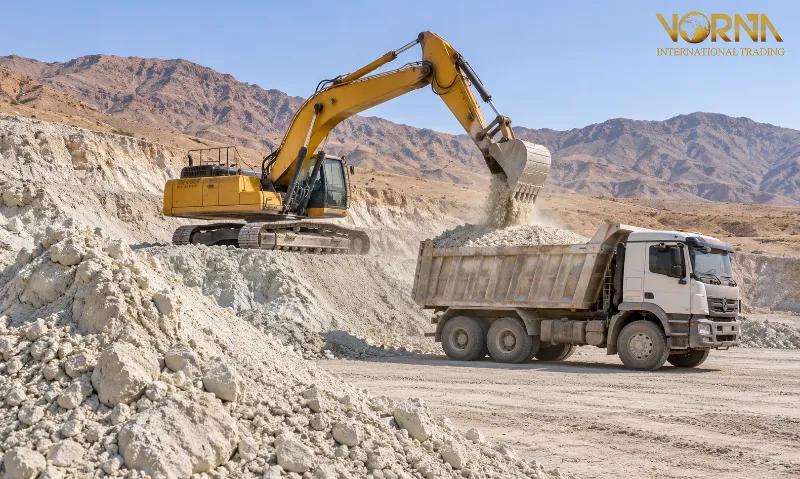
Natural bentonite extracted from a deposit is not necessarily ready for direct industrial use.
Depending on the deposit and the intended application, the material may require several processing operations.
These can include:
- Selective mining and raw material classification.
- Drying to achieve the required moisture level.
- Crushing and grinding to the target particle size.
- Screening and classification to control particle-size distribution.
- Activation or other treatment where required.
- Laboratory quality control and batch evaluation.
The processing requirements depend on the mineralogical characteristics of the deposit and the final product specification.
For example, a deposit containing suitable sodium montmorillonite may be considered for drilling or sealing applications, while other materials may require processing or activation before being used in specific industrial formulations.
The distinction between geological quality and processed-product quality is important: a promising deposit does not automatically guarantee that every processed batch will meet the same technical specification.
8. Industrial Applications of Iranian Bentonite
Iranian bentonite deposits have potential applications across several industrial sectors, depending on their mineralogical and physical characteristics.
Some important application areas include:
Drilling Fluids
Suitable bentonite grades are used in water-based drilling fluids to support borehole stability, control fluid loss, and improve cuttings suspension.
For product-specific information, see Vornaco’s Drilling Bentonite page.
Iron Ore Pelletizing
Sodium bentonite can act as a binder in iron ore pelletizing. Its water absorption and binding characteristics influence green pellet formation and strength.
The suitability of each deposit must be established through application-specific tests.
For more information, read:
Bentonite in Iron Ore Pelletizing: Binder Performance and Key Factors
Foundry Applications
Bentonite is used as a bonding material in green sand molding systems. Its performance depends on active clay content, water interaction, and the properties of the molding sand mixture.
Civil Engineering and Environmental Applications
Selected bentonite grades are used in geotechnical sealing, pond construction, landfill barriers, and other applications where low permeability and swelling behavior are important.
Paper and Industrial Formulations
Certain bentonite grades are used in papermaking and other industrial formulations, depending on their adsorption, particle-size, and chemical properties.
The geological source provides useful background, but the final selection should always be based on the technical requirements of the intended application.
9. What Should Buyers Consider When Evaluating Iranian Bentonite?
For international industrial buyers, the origin of bentonite is useful information, but it should not be the only basis for purchasing decisions.
A reliable technical evaluation should include:
- Mining Origin: Identify the documented source region and, where possible, the specific deposit or mining area.
- Mineralogical Composition: Review XRD results to understand the montmorillonite and accessory mineral content.
- Chemical Composition: Evaluate XRF results and relevant chemical specifications.
- Application-Specific Performance: Review swelling, viscosity, water absorption, adsorption, or binding tests according to the intended use.
- Batch Consistency: Compare representative samples and shipment documentation.
- Technical Documentation: Request a batch-specific Certificate of Analysis (COA) and Technical Data Sheet (TDS).
A deposit’s reputation or geographical location cannot replace laboratory verification.
For an overview of Vornaco’s bentonite grades and product information, visit the Bentonite Supplier & Exporter page.
10. Frequently Asked Questions About Bentonite Deposits in Iran
Where are the major bentonite deposits located in Iran?
Important bentonite-bearing areas include South Khorasan, particularly Sarayan and Ferdows, the Semnan–Toroud geological zone, and Central Iran, including the Mollaahmad Pass area in Isfahan. Additional occurrences are documented in Alborz–Azerbaijan, Tafresh–Takab, and Zagros.
Which province is particularly important for bentonite mining in Iran?
South Khorasan is one of Iran’s most important bentonite-producing provinces. A report published in January 2025 documented 143 bentonite mines and approximately 55.9 million tonnes of proven reserves in the province.
What is the main mineral found in Iranian bentonite deposits?
Montmorillonite, a member of the smectite group, is the principal clay mineral in many Iranian bentonite deposits. Other minerals, including quartz, cristobalite, calcite, feldspar, zeolites, and illite, may also occur.
Are all Iranian bentonite deposits sodium bentonite?
No. Iranian deposits can differ in their exchangeable cation composition and mineralogical characteristics. Sodium-dominant, calcium-dominant, and mixed sodium-calcium bentonites may occur in different geological settings.
Why is South Khorasan important for bentonite production?
South Khorasan contains numerous documented bentonite mines, particularly around Sarayan, Ferdows, Qaen, and other districts. Its substantial reported reserves and established mining and processing activities make it an important part of Iran’s bentonite industry.
What is the geological origin of bentonite deposits in Iran?
Many Iranian bentonite deposits are associated with the alteration of volcanic ash and pyroclastic materials. Research indicates that diagenetic alteration in shallow-water and lagoon environments played an important role in the formation of several Eastern Iranian deposits.
How can the quality of bentonite from different Iranian mines be compared?
Samples should be evaluated using mineralogical and chemical analyses, including XRD and XRF, together with relevant tests such as CEC, swelling, water absorption, moisture, and particle-size distribution. The selected tests depend on the intended industrial application.
Does the location of a bentonite mine determine its industrial quality?
No. Geological location provides useful information about the likely mineralogical characteristics of a deposit, but actual quality must be established through representative sampling and laboratory testing. Significant variations may exist within the same mining area.
Conclusion
Iran has a diverse distribution of bentonite deposits associated with several geological structural zones and different episodes of volcanic activity.
South Khorasan stands out because of its extensive documented mining activity, particularly around Sarayan and Ferdows. Other important geological examples include the Kuh-e-Arshe deposit in the Semnan–Toroud region and the Mollaahmad Pass deposit in Central Iran.
Mineralogical studies demonstrate that Iranian bentonite deposits are not uniform. Differences in montmorillonite content, exchangeable cations, accessory minerals, and geological formation conditions can influence their industrial characteristics.
For this reason, identifying the mining region is only the starting point. Reliable material evaluation requires representative sampling, mineralogical identification, chemical analysis, and application-specific performance testing.
Understanding these differences helps industrial manufacturers and mineral buyers make more informed decisions when evaluating bentonite from Iran.
References and Further Reading
- Modabberi, S. et al. (2019). Genesis of the Eastern Iranian Bentonite Deposits. Applied Clay Science, 168, 56–67.
- Tarabi, S. and Modabberi, S. (2020). Mineralogical Investigation and Water Absorption of Bentonites in Momen Abad Area. Journal of Advanced Applied Geology, 10(3), 407–420.
- Fatahi, S. et al. (2020). Mineralogy, Geochemistry and Genesis of Mollaahmad Pass Bentonite Deposit, Naein, Isfahan Province, Iran. Acta Geodynamica et Geomaterialia, 17(1), 61–87.
- Ghorbani, M. and Tajbakhsh, P. (2010). Bentonite: Its Resources and Geological Settings in Iran. International Mineralogical Association Conference.
- South Khorasan Industry, Mine and Trade Organization – Report published by Tasnim News Agency (January 18, 2025).
Technical note: Regional reserve and mining figures should be updated when newer official provincial statistics become available. Geological studies describe the specific samples and deposits investigated; their results should not be generalized to every mine in a province.