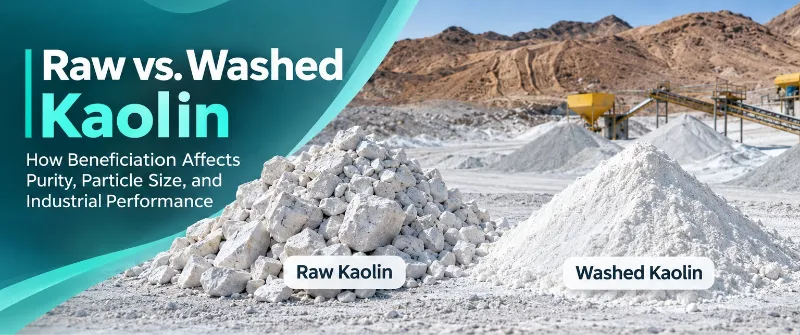
Two kaolin samples can look almost identical and still behave differently in manufacturing. One may contain coarse quartz particles that interfere with ceramic processing. Another may have a finer particle size distribution but contain iron-bearing impurities that affect the color of the finished product.
This is why the difference between raw vs. washed kaolin matters beyond appearance.
Washing and beneficiation can change the proportion of unwanted minerals, control particle size distribution, and improve the suitability of kaolin for specific industrial processes. However, washing does not automatically produce a high-purity material, and not every manufacturing application requires washed kaolin.
For industrial buyers, the important question is not simply whether a kaolin product has been washed. It is what the processing has changed, which impurities remain, and whether the resulting material meets the requirements of the intended application.
This guide explains the practical differences between raw and washed kaolin, how wet processing works, what it can and cannot improve, and how to evaluate kaolin quality before purchasing.
Raw vs. Washed Kaolin: What Is the Main Difference?
Raw kaolin is kaolin-bearing material obtained from a natural deposit before significant beneficiation, while washed kaolin has undergone water-based processing to disperse the clay and separate selected unwanted particles or minerals.
Raw kaolin may be crushed, dried, screened, or subjected to other basic preparation steps. Its mineral composition and particle size distribution remain closely related to the original deposit.
Washed kaolin, sometimes called water-washed kaolin or wet-processed kaolin, passes through a more selective processing route. Depending on the deposit and the required final specification, this may include dispersion, degritting, particle classification, mineral separation, dewatering, and drying.
One distinction is particularly important: washing is not the same as calcination.
Washing is primarily a physical separation process, although chemical treatments may be added in more advanced beneficiation systems. Calcination involves heating kaolin to modify the mineral structure and its properties.
The term raw kaolin can also be used commercially to describe uncalcined material, including material that has already been washed. For an accurate comparison, this article uses raw to mean unbeneficiated or minimally processed kaolin.
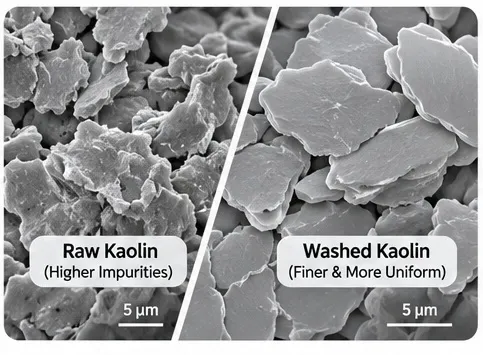
Raw Kaolin vs. Washed Kaolin: Quick Comparison
| Quality factor | Raw Kaolin | Washed Kaolin |
|---|---|---|
| Processing | Minimal preparation or beneficiation | Water-based dispersion and separation |
| Mineral impurities | Reflects the natural deposit | Selected impurities may be reduced |
| Particle size distribution | Often broader or less controlled | Can be classified into targeted fractions |
| Kaolinite concentration | Depends on the original ore | May increase when non-kaolinite minerals are removed |
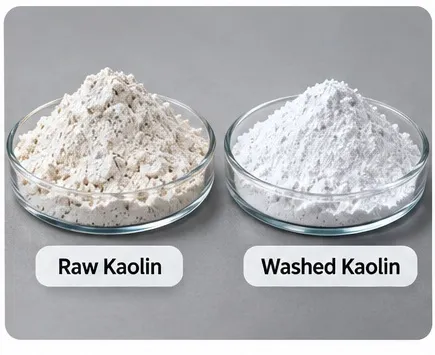
| Brightness | Depends on natural mineral composition | May improve if color-producing impurities are removed |
| Coarse abrasive particles | May remain in the material | Can be reduced through degritting and classification |
| Processing complexity | Generally lower | Generally higher |
| Industrial suitability | Suitable where natural material meets specifications | Useful where refined particle or purity requirements apply |
These are general processing differences, not guaranteed specifications. A naturally clean raw kaolin may perform better than a poorly processed washed grade.
How Does the Kaolin Washing Process Work?
The purpose of kaolin washing is to separate useful clay particles from unwanted material while producing a particle size distribution suitable for further processing or industrial use.
In a typical wet beneficiation system, kaolin passes through several stages. The exact sequence depends on the deposit, the available equipment, and the product specification.
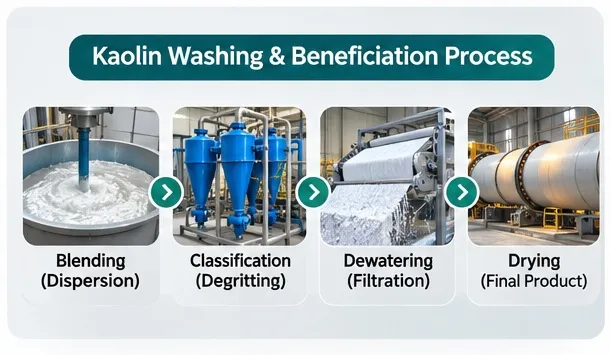
1. Blunging and Clay Dispersion
Mined kaolin is mixed with water to form a slurry. Mechanical agitation helps break down clay aggregates and release particles from the surrounding material.
Dispersing agents may be used to prevent particles from sticking together, making subsequent separation more effective.
This stage does not necessarily grind individual kaolinite crystals into smaller particles. Its main function is to separate aggregates and distribute particles throughout the slurry.
Why it matters: Poor dispersion can reduce the efficiency of later classification. Fine kaolin trapped inside aggregates may behave like larger particles and be separated incorrectly.
2. Degritting and Coarse Particle Removal
Natural kaolin deposits can contain quartz, feldspar, sand-sized particles, and other relatively coarse minerals.
Degritting removes a portion of these unwanted materials using equipment such as screens, hydrocyclones, or other classification systems.
For a ceramic manufacturer, removing coarse quartz can be particularly important. Remaining abrasive or oversized particles may affect processing equipment, slurry behavior, and product uniformity.
However, degritting alone cannot guarantee the removal of every quartz particle. Fine quartz particles may remain mixed with the kaolinite fraction.
3. Particle Size Classification
After the coarser material has been separated, the kaolin slurry may undergo additional classification.
Hydrocyclones, centrifuges, or other separation equipment can produce fractions with different particle size distributions.
The purpose is not always to obtain the finest possible material.
A paper-coating formulation may require a relatively fine and controlled particle distribution, while a ceramic body may benefit from a particular balance of fine and coarser particles to achieve suitable casting, drying, and firing behavior.
Particle size classification is therefore best understood as a way to produce a controlled distribution, not simply to make kaolin finer.
4. Additional Impurity Separation When Required
Some deposits contain iron-bearing minerals, titanium minerals, mica, or organic coloring substances that are not adequately separated by basic washing and classification.
Depending on how these impurities occur, processors may use additional beneficiation methods such as:
- Magnetic separation for certain magnetic or weakly magnetic mineral impurities.
- Flotation for selected mineral separation applications.
- Chemical bleaching or leaching to address particular color-producing impurities.
These treatments are not automatically part of every washed kaolin production process.
Their effectiveness depends on whether the impurities are present as separate mineral particles, surface coatings, or elements incorporated into mineral structures.
5. Dewatering and Drying
After beneficiation, the processed slurry is concentrated through thickening, filtration, or other dewatering methods.
Depending on the product requirements, the material may then be dried or prepared for shipment as a slurry.
Drying and subsequent handling also require attention. A kaolin product with an appropriate particle size distribution can still form aggregates during drying, storage, or transport.
For this reason, the dispersibility of the delivered product should not be assumed from particle size information alone.
Which Impurities Can Kaolin Washing Actually Remove?
One of the most common misunderstandings about washed kaolin is that water removes all unwanted minerals.
It does not.
The success of beneficiation depends on the type, size, concentration, and physical association of the impurities.
Quartz and Coarse Silicate Minerals
Quartz is a common associated mineral in kaolin deposits.
When quartz occurs as relatively coarse, liberated particles, screening and classification can separate a meaningful portion from the clay fraction.
However, fine quartz particles can remain after washing, especially when their size overlaps with the useful kaolinite particles.
This is why silica content alone cannot establish how much free quartz is present. Silicon is also part of the kaolinite mineral structure.
A buyer concerned about abrasive impurities should request mineralogical information rather than relying only on total SiO₂ content.
Iron-Bearing Impurities
Iron may occur in minerals such as hematite and goethite, as surface coatings, or in forms associated with the clay minerals themselves.
Removing coarse particles containing iron can improve product quality, but simple washing may have limited effects on finely dispersed or structurally associated iron.
Additional separation or chemical treatment may be required for certain brightness or color specifications.
Titanium-Bearing Minerals
Titanium-bearing impurities can affect optical properties and may be difficult to remove when present in very fine mineral particles.
Certain separation methods can reduce specific titanium-containing minerals, but complete removal is not a realistic assumption.
Mica, Feldspar, and Other Associated Minerals
These minerals may be partly removed when their physical characteristics allow effective separation from kaolinite.
The extent of removal depends on particle liberation and the selected processing method.
The practical lesson is straightforward: washed kaolin should be evaluated by measured mineral composition and performance, not by the processing label alone.
How Beneficiation Changes Kaolin Purity and Particle Size
The value of washing becomes clearer when we examine the properties that industrial buyers actually test.
Kaolinite Content and Mineral Purity
Kaolin is a natural clay material containing varying proportions of kaolinite and associated minerals.
Beneficiation can increase the concentration of kaolinite when undesirable non-kaolinite particles are selectively removed.
However, higher Al₂O₃ content alone does not prove that the product is free of impurities, and total chemical analysis does not reveal every mineral phase.
X-ray diffraction (XRD) can help identify and assess crystalline mineral phases, while X-ray fluorescence (XRF) provides elemental or oxide composition.
These methods answer different questions and are more useful when interpreted together.
Particle Size Distribution: Why D50 Is Not Enough
Industrial specifications often include particle size measurements such as D10, D50, and D90.
- D10: 10% of the measured particle population is finer than this size.
- D50: The median particle size.
- D90: 90% of the measured particle population is finer than this size.
These definitions depend on the measurement basis, such as volume distribution in laser diffraction.
A D50 value may look acceptable even when a product contains an unwanted coarse fraction.
For example, two kaolin samples may both have a D50 of 2 µm, while one has a D90 of 8 µm and the other has a D90 of 25 µm.
The values in this example are illustrative, not Vornaco product specifications.
The second sample contains a more pronounced coarse tail, which may matter in applications sensitive to oversized particles.
Buyers should therefore compare the complete distribution curve, the measurement method, and the degree of sample dispersion used during testing.
Brightness and Whiteness
The appearance of kaolin is influenced by both mineral composition and particle characteristics.
Removing certain iron-bearing or titanium-bearing impurities can improve brightness, particularly when the impurities contribute to undesirable coloration.
However, washing does not always increase brightness significantly. Some deposits are naturally bright, while others require additional treatment.
Brightness and whiteness should also not be treated as interchangeable measurements. They are evaluated using different methods, color spaces, and measurement conditions.
When appearance is important, buyers should request the actual test method and measured values.
Rheology and Dispersion Behavior
Kaolin particle size, surface chemistry, mineral composition, and soluble salts can influence slurry viscosity and dispersion behavior.
Removing coarse particles or adjusting the fine-particle fraction may change the flow characteristics of a kaolin suspension.
But finer material does not automatically mean lower viscosity.
In some systems, increasing the proportion of very fine particles raises the surface area and changes water demand or suspension rheology.
For wet manufacturing processes, laboratory slurry testing under representative operating conditions is often more informative than relying on particle size data alone.
When Does Washed Kaolin Offer a Real Industrial Advantage?
The advantages of washed kaolin are application-specific.
Rather than treating washed kaolin as universally superior, manufacturers should determine which quality problem the additional processing is intended to solve.
Ceramic Manufacturing: Managing Grit and Firing Quality
In ceramic production, coarse mineral impurities and unwanted coloring oxides can influence body preparation, surface appearance, and firing results.
Washed kaolin may be advantageous when the process requires lower coarse residue, more consistent mineral composition, or tighter control of selected impurities.
However, highly refined kaolin is not necessarily the best option for every ceramic body.
Plasticity, casting behavior, drying shrinkage, firing temperature, and compatibility with other ingredients all matter.
A practical evaluation should include residue testing, body trials, and fired-product inspection rather than mineral analysis alone.
Paper Manufacturing: Particle Control and Optical Requirements
Kaolin used in paper applications may require controlled fine-particle distribution and optical properties.
Wet beneficiation can help produce classified materials suitable for demanding applications, particularly where particle characteristics strongly influence coating performance.
Nevertheless, being water-washed does not automatically make a kaolin grade suitable for paper coating.
Brightness, viscosity, abrasion, dispersibility, and the requirements of the particular paper formulation must be assessed.
Paints and Coatings: Consistency Before the Label
In coatings, kaolin can function as a mineral extender or contribute to specific formulation characteristics.
The particle size distribution, brightness, dispersibility, and mineral purity of the chosen grade can affect formulation behavior.
Washed kaolin may provide advantages where controlled particle characteristics or reduced unwanted minerals are important.
Yet some coating formulations use specially engineered, surface-modified, or calcined grades. Basic water washing alone does not produce every property required for those applications.
For a broader understanding of commercial grades across industries, see Vornaco’s guide to kaolin grades, properties, and industrial uses.
When Can Raw Kaolin Be the Better Choice?
Not every application benefits enough from beneficiation to justify its additional cost.
Raw or minimally processed kaolin may be suitable when the deposit already provides acceptable mineral composition and when the manufacturing process can accommodate its natural particle distribution.
This may be relevant to selected ceramic bodies, construction-related formulations, or other applications where ultra-fine particle classification and high brightness are not essential.
For example, a manufacturer using kaolin as one component in a blended ceramic body may find that a locally available raw material satisfies production requirements after basic preparation.
Switching to a finer washed product could change water demand, casting behavior, or drying characteristics without producing a corresponding improvement in the final product.
The appropriate decision depends on testing, not on assuming that additional processing always produces better results.
How to Evaluate Raw and Washed Kaolin Before Buying
For industrial procurement teams, a processing description is useful background information, but it should not replace technical qualification.
A reliable assessment should connect the material specifications to the manufacturing problem being solved.
Essential Quality Parameters
| Parameter | Why it matters | Useful evaluation |
|---|---|---|
| Mineral composition | Identifies kaolinite and associated minerals | XRD mineralogical analysis |
| Chemical composition | Measures major oxides and selected impurities | XRF or suitable chemical analysis |
| Particle size distribution | Identifies fine and coarse fractions | D10, D50, D90 and full distribution |
| Coarse residue | Detects oversized or abrasive particles | Wet sieve or residue testing |
| Brightness or color | Assesses appearance-related requirements | Defined optical measurement method |
| Moisture content | Affects delivered weight and process preparation | Moisture analysis |
| Slurry behavior | Reveals dispersibility and flow characteristics | Application-relevant rheology testing |
| Firing behavior | Important for ceramic applications | Controlled firing trials |
Not all these tests are necessary for every purchase. Selection should reflect the intended use and the most significant process risks.
Questions Worth Asking a Kaolin Supplier
Before approving a sample or negotiating a bulk order, manufacturers should clarify:
- Is the kaolin unbeneficiated, water-washed, chemically treated, or thermally processed?
- Which separation stages were used, and which unwanted minerals were targeted?
- Are particle size values measured using a defined and repeatable method?
- Is mineralogical analysis available to distinguish kaolinite from associated minerals?
- How consistent are the relevant properties between production batches?
- Can a representative sample be evaluated under actual manufacturing conditions?
A label such as high purity or fine grade is less useful than measurable, application-specific acceptance criteria.
Compare Performance Before Comparing Price
A lower purchase price does not always produce a lower manufacturing cost.
For instance, a kaolin with a broader particle distribution may require additional screening or dispersion work. Conversely, a premium washed product may offer little economic advantage when the process does not require its refined characteristics.
A practical comparison should consider delivered material cost, usable yield, processing requirements, reject rates, and the effect of the kaolin on final product quality.
This is especially relevant when evaluating different mineral sources for recurring industrial orders.
Washed Kaolin Is Not the Same as Calcined Kaolin
Water washing and calcination address different material requirements.
Washing is primarily used to separate mineral fractions and improve selected physical or compositional characteristics.
Calcination changes kaolinite through thermal treatment, including dehydroxylation under appropriate conditions, producing material with different structural and functional properties.
A washed kaolin product can also be used as the feed material for further processing, including calcination.
For a separate explanation of the changes caused by heat treatment, read Calcined Kaolin vs. Raw Kaolin: Differences and Applications.
Keeping these processing routes distinct helps prevent unsuitable product comparisons.
Conclusion: Choose Kaolin Based on What Processing Actually Delivers
The main difference between raw and washed kaolin is not simply that one material is natural and the other is refined.
Kaolin beneficiation creates value when it selectively removes unwanted components or produces particle characteristics that improve a specific manufacturing process.
Washed kaolin may be a better choice when coarse impurities, mineral composition, or particle size consistency limit product quality. Raw kaolin may remain appropriate when its natural characteristics already satisfy production requirements.
Neither designation guarantees industrial performance.
Before choosing a grade, determine which properties influence your process, examine relevant test results, and evaluate representative material under actual operating conditions.
Looking for Kaolin for Your Industrial Application?
Material selection starts with clear technical requirements. Whether you are evaluating raw, washed, or other industrial kaolin grades, understanding the desired particle distribution, mineral composition, and production conditions can help narrow the options.
Explore Vornaco’s Kaolin Supplier and Exporter page for product and bulk supply information, or contact Vornaco to discuss your application and sourcing requirements.
Frequently Asked Questions
1. What is the main difference between raw and washed kaolin?
Raw kaolin is unbeneficiated or minimally processed material obtained from a natural deposit. Washed kaolin undergoes water-based processing to disperse particles and separate selected impurities or size fractions. The actual differences depend on the original deposit and the processing method.
2. Is washed kaolin always purer than raw kaolin?
No. Washing can improve purity when unwanted minerals are successfully separated, but the result depends on impurity type, particle size, and mineral associations. A naturally clean raw deposit may have better characteristics than a poorly beneficiated material.
3. Does washing kaolin increase its whiteness?
It can improve brightness or whiteness when color-producing impurities are removed. Basic washing may have limited effects on iron or titanium associated with very fine particles or mineral structures. Actual color measurements are needed to confirm improvement.
4. Can kaolin washing remove iron impurities?
Some iron-bearing mineral particles can be reduced through appropriate separation methods. However, ordinary washing does not necessarily remove finely distributed or structurally associated iron. Additional beneficiation may be required.
5. Does washed kaolin have a smaller particle size?
Not necessarily in every case. Wet classification can produce a finer or more controlled particle size distribution, but the final specification depends on the selected fraction and processing objectives.
6. Is washed kaolin better for ceramics?
Washed kaolin may be beneficial when coarse impurities, unwanted coloring minerals, or inconsistent particle distribution affect ceramic production. However, the right grade also depends on plasticity, slurry behavior, drying, and firing performance.
7. Is washed kaolin more expensive than raw kaolin?
Wet beneficiation generally requires additional processing equipment, water management, and energy. These steps may increase production costs, but the actual selling price also depends on deposit quality, product specifications, supply conditions, and the market.
8. What tests should buyers request for washed kaolin?
Useful tests may include chemical analysis, mineralogical composition, particle size distribution, coarse residue, moisture, brightness, and application-specific performance. The appropriate testing package depends on the manufacturing process.