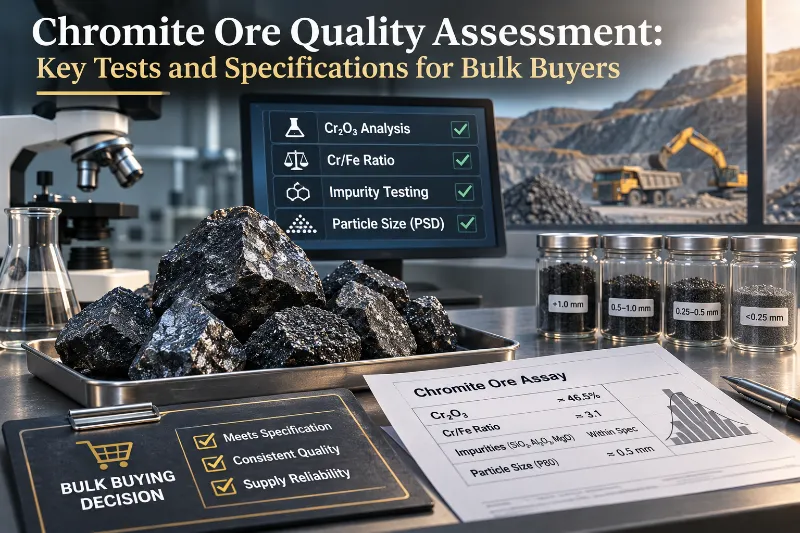
A chromite ore shipment may meet the requested chromium oxide grade and still perform differently from what a buyer expects. Two samples with similar Cr₂O₃ content can have different chromium-to-iron ratios, silica levels, particle size distributions, and responses to industrial processing.
That difference matters when purchasing chromite in bulk. A laboratory report showing an acceptable Cr₂O₃ percentage is useful, but it does not tell the whole story. Buyers also need to know how the sample was collected, which impurities were measured, whether the reported values represent the shipment, and how the material’s characteristics relate to its intended use.
Chromite ore quality assessment is the process of evaluating chemical composition, physical characteristics, sampling reliability, and laboratory results to determine whether a particular ore or concentrate meets the requirements of an industrial application.
This guide explains the essential quality parameters, common testing methods, and practical checks that help industrial buyers assess chromite ore before committing to a bulk purchase.
1. What Determines Chromite Ore Quality?
Chromite is a chromium-bearing mineral belonging to the spinel group. Its composition varies naturally because chromium, iron, magnesium, and aluminum can occur in different proportions within the mineral structure.
Commercial chromite ore may also contain associated minerals, including silicates and other gangue materials. As a result, the quality of a chromite shipment depends on more than the presence of chromite itself.
For industrial buyers, six factors deserve particular attention:
- Chromium oxide content (Cr₂O₃): Indicates the chromium-bearing component of the ore.
- Chromium-to-iron ratio (Cr/Fe): Helps determine suitability for particular metallurgical processes.
- Impurity levels: Especially silica, phosphorus, sulfur, and other constituents relevant to the intended application.
- Particle size distribution: Affects handling, processing, and preparation requirements.
- Moisture content: Influences delivered wet weight, handling, and dry-basis calculations.
- Sampling and analytical reliability: Determines whether the reported characteristics represent the actual material.
None of these parameters should be assessed independently of the intended application.
For example, a ferrochrome producer and a refractory manufacturer may evaluate the same chromite concentrate differently because their process requirements are not identical.
2. Cr₂O₃ Content: The Starting Point for Chromite Ore Analysis
Chromium oxide content, usually expressed as a percentage of Cr₂O₃ by mass, is one of the most widely used commercial indicators of chromite grade.
In general, a higher Cr₂O₃ concentration indicates a greater proportion of chromium oxide in the material. However, it does not automatically establish superior performance in every industrial process.
A buyer comparing two chromite concentrates should ask:
- Are the Cr₂O₃ results reported on a dry basis?
- Were both samples analyzed using comparable laboratory methods?
- Does the reported grade represent the entire shipment?
- What are the accompanying iron and impurity concentrations?
- Does the application require a particular minimum chromium content?
Why a Higher Cr₂O₃ Percentage Is Not Always Enough
Consider two hypothetical chromite concentrates:
| Parameter | Concentrate A | Concentrate B |
|---|---|---|
| Cr₂O₃ | 46% | 46% |
| Total Cr | 31.5% | 31.5% |
| Total Fe | 20% | 16% |
| Approximate Cr/Fe | 1.58 | 1.97 |
Illustrative example only. These are hypothetical analytical values, not specifications or test results for Vornaco products. Cr/Fe is calculated from elemental chromium and iron on a mass basis.
Both concentrates have the same reported Cr₂O₃ content. Nevertheless, Concentrate B has a higher chromium-to-iron ratio.
That difference may influence how a metallurgical buyer evaluates the two materials.
It would be incorrect to describe either concentrate as universally better without considering the furnace configuration, burden composition, target alloy, and processing conditions.
Practical takeaway: Treat Cr₂O₃ as the starting point of chromite quality assessment, not as a complete purchasing specification.
3. Understanding the Cr/Fe Ratio in Chromite Ore
The chromium-to-iron ratio expresses the relationship between elemental chromium and elemental iron in the analyzed material.
It is particularly relevant when assessing chromite for ferrochrome production.
How Is the Cr/Fe Ratio Calculated?
When elemental chromium and total iron are reported as mass percentages:
Cr/Fe ratio = Total Cr (%) ÷ Total Fe (%)
If a laboratory reports Cr₂O₃ rather than elemental chromium, the chromium percentage can be estimated using the stoichiometric conversion:
Total Cr (%) ≈ Cr₂O₃ (%) × 0.6842
For example, a hypothetical ore containing 45% Cr₂O₃ and 18% total iron would have:
Total Cr ≈ 45 × 0.6842 = 30.79%
Cr/Fe ≈ 30.79 ÷ 18 = 1.71
The resulting approximate chromium-to-iron ratio is 1.71:1.
The conversion assumes that the Cr₂O₃ value represents the reported total chromium expressed as its oxide equivalent.
Why Buyers Should Check the Reporting Basis
Laboratory reports do not always express iron in the same way.
Iron may be reported as elemental Fe, FeO, or Fe₂O₃ equivalents. Using the iron oxide percentage directly in place of elemental iron can produce an incorrect Cr/Fe calculation.
Before comparing quotations, confirm that the chemical results use consistent units and reporting conventions.
Does Every Metallurgical Process Require the Same Cr/Fe Ratio?
No.
Acceptable chromium-to-iron ratios depend on the ferrochrome product, furnace technology, ore blend, and processing economics.
Some operations can use lower-ratio chromite as part of an appropriately designed burden, while others require different feed characteristics.
A single universal Cr/Fe threshold should therefore not be used to approve or reject every chromite shipment.
4. Which Impurities Matter Most in Chromite Ore?
A chromite certificate of analysis should provide enough chemical information to evaluate the material against the buyer’s process requirements.
The importance of each impurity varies by application.
Silica (SiO₂)
Silica is a major parameter to examine when evaluating chromite ore for metallurgical applications.
Its concentration can affect slag chemistry, flux requirements, and the overall characteristics of the furnace burden.
However, the operational effect depends on the composition of the complete feed mixture rather than the silica percentage of a single material in isolation.
Buyers should request a reported SiO₂ value and establish an acceptable range for their process.
Silica also illustrates why material names alone are not sufficient for industrial purchasing. The same chemical constituent can be undesirable in one mineral feedstock while serving as the principal component of another industrial material. For example, industrial silica products are evaluated for their own intended uses and specifications, which are different from the limits applied to silica within chromite ore.
Alumina (Al₂O₃)
Alumina is a significant constituent of many chromite ores and concentrates.
Its importance depends on the application. In metallurgical processing, alumina contributes to slag chemistry. In refractory applications, the relationship between alumina and other oxide constituents can be especially relevant.
A high or low alumina percentage should not automatically be interpreted as a quality advantage without considering the material’s end use.
Magnesium Oxide (MgO)
Magnesia is another important component in chromite chemistry.
In ferrochrome production, MgO influences the overall slag composition and can affect process requirements. In refractory applications, the balance between MgO, Al₂O₃, Cr₂O₃, and other oxides also deserves attention.
Phosphorus and Sulfur
Phosphorus and sulfur may be important when evaluating chromite for metallurgical use because their transfer into products or processing streams can affect compliance with downstream requirements.
The acceptable concentrations depend on the intended product and operating conditions.
For critical applications, buyers should specify the required analytical detection limits rather than accept a laboratory report that simply leaves these parameters unreported.
Other Constituents
Depending on the application, chemical analysis may also consider calcium oxide, titanium dioxide, manganese-bearing constituents, and other relevant elements or oxides.
The goal is not to request every possible laboratory test. It is to identify which measurements affect material acceptance and industrial performance.
5. Chromite Ore Quality Parameters: What Should Buyers Test?
The following table provides a practical starting point for preparing a chromite ore testing specification.
| Quality parameter | What it helps evaluate | Common assessment approach |
|---|---|---|
| Cr₂O₃ content | Chromium oxide grade | Validated chemical analysis |
| Total iron | Iron concentration and Cr/Fe calculation | Elemental or equivalent chemical analysis |
| Cr/Fe ratio | Chromium-to-iron relationship | Calculation from compatible analytical results |
| SiO₂ | Silica content | Chemical analysis |
| Al₂O₃ and MgO | Major oxide composition | Chemical analysis |
| Phosphorus and sulfur | Application-relevant impurities | Suitable laboratory methods |
| Particle size distribution | Sizing and process compatibility | Sieve analysis or an appropriate sizing method |
| Moisture | Wet-weight and dry-weight relationship | Defined moisture determination method |
| Mineralogical composition | Chromite phases and associated minerals | X-ray diffraction or other suitable mineralogical techniques |
These are assessment categories rather than universal acceptance limits. Buyers must establish tolerances according to their application, contractual requirements, and agreed testing procedures.
6. How Is Chromite Ore Tested in a Laboratory?
Different laboratory methods answer different questions. An analytical technique suitable for determining total chemical composition may not reveal how the elements are distributed among individual mineral phases.
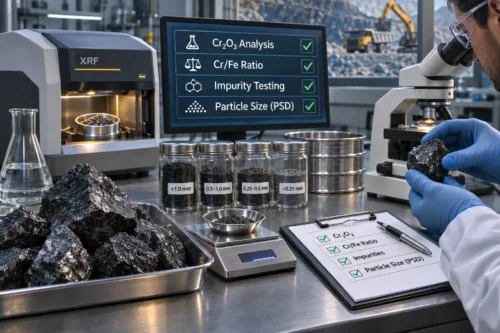
X-Ray Fluorescence (XRF)
X-ray fluorescence is commonly used for the chemical characterization of mineral materials.
With appropriate sample preparation and calibration, XRF can provide information about major oxides such as Cr₂O₃, Fe-bearing oxides, SiO₂, Al₂O₃, and MgO.
Its advantages include multi-element analysis and relatively efficient laboratory workflows.
However, analytical reliability depends on calibration, matrix effects, sample preparation, and the laboratory’s validated procedures.
Wet Chemical Analysis
Validated wet chemical methods can be used to determine selected constituents, including chromium.
Such methods may be useful for reference measurements, confirmation testing, or resolving discrepancies between analytical reports.
The appropriate procedure should be selected based on the element being measured, the required uncertainty, and the relevant standard or contractual method.
X-Ray Diffraction (XRD)
XRD is useful for identifying crystalline mineral phases.
For chromite ore, mineralogical examination can help distinguish chromite-bearing phases from associated minerals.
This is valuable when a bulk chemical result does not fully explain the behavior of the material during beneficiation or subsequent processing.
XRD does not replace chemical assay results. It provides complementary mineralogical information.
Particle Size Analysis
Sieve analysis can be used to assess the distribution of particle sizes within a representative sample.
For materials containing very fine particles, additional measurement methods may be appropriate.
The reported particle size distribution should correspond to the actual delivery condition and the agreed sampling procedure.
A useful distinction: Chemical analysis tells the buyer what is present in the material. Mineralogical and physical testing help explain how that material is structured and may behave during processing.
7. Why Representative Sampling Is Critical Before Bulk Purchasing
Even accurate laboratory equipment cannot compensate for a sample that does not represent the shipment.
A chromite consignment may contain material from different production batches, stockpile sections, or processing stages. Local variations in particle size and mineral composition can affect the result obtained from a small sample.
If a sample is collected only from the accessible surface of a stockpile, the analysis may not represent the entire lot.

What Should a Chromite Sampling Plan Include?
A suitable sampling plan should define:
- The lot being evaluated: The specific stockpile, production batch, or shipment.
- Sampling locations and frequency: How increments are distributed across the lot.
- Sample collection procedure: How material is collected without introducing avoidable bias.
- Sample preparation: How increments are combined, reduced, crushed, or otherwise prepared.
- Sample identification: How traceability is maintained.
- Retention samples: Whether sealed material is kept for possible verification or dispute resolution.
International Standard ISO 6153:1989 addresses increment sampling of chromium ores for determining chemical composition and moisture content.
The important commercial point is straightforward: a high-quality laboratory report is only as useful as the sampling procedure supporting it.
Should Buyers Request Independent Testing?
Independent testing may be especially useful for high-value transactions, unfamiliar supply chains, or situations where the consequences of receiving off-specification material are significant.
Where appropriate, the buyer and seller can agree on a recognized inspection organization, laboratory, sampling point, and dispute-resolution procedure.
An independent report does not remove every commercial risk, but it can provide a stronger basis for comparing analytical results and shipment acceptance.
8. How to Read a Chromite Certificate of Analysis (COA)
A certificate of analysis is a useful quality-control document, but its value depends on what the certificate actually represents.
A COA should ideally allow the buyer to identify the material analyzed, the analytical results, the testing laboratory, and the relationship between the sample and the proposed shipment.
Before accepting a report, check the following:
- Material identification: Is the sample associated with the correct product and lot?
- Sample date: When was the sample collected?
- Laboratory identity: Which organization performed the analysis?
- Test methods: Which procedures were used?
- Reporting basis: Are results expressed on a dry or wet basis?
- Units: Are chromium and iron reported consistently?
- Analytical limits: Are important low-concentration constituents measured with suitable detection limits?
- Traceability: Can the analytical report be connected to the material being purchased?
A laboratory certificate may accurately describe the submitted sample without independently proving that the sample represents an entire shipment.
This is why buyers should distinguish a supplier-provided sample report from an independently witnessed, shipment-specific inspection result.
A Practical COA Review Example
Suppose a buyer receives an analysis reporting 44% Cr₂O₃.
Before approving the purchase, the buyer could request clarification on three points:
First: Is 44% the result for the actual shipment lot or a typical value for the product category?
Second: What are the total iron, silica, phosphorus, and sulfur results, and how do they compare with the buyer’s acceptance limits?
Third: How was the sample collected, and is a retained sample available for verification?
These questions are generally more useful than asking whether the material is simply described as high-grade chromite.
9. Particle Size, Moisture, and Their Impact on Delivered Quality
Chemical composition is only part of bulk chromite procurement.
Physical characteristics can influence material handling, processing preparation, and commercial quantity calculations.
Particle Size Distribution
Chromite may be supplied in different physical forms, including lump ore, fine ore, or concentrate, depending on its origin and processing history.
A particle size distribution that is acceptable for one operation may be unsuitable for another.
For example, a processing plant that requires controlled feed sizing may need to screen or agglomerate material that falls outside its operating range.
The buyer should specify the acceptable size fractions rather than relying on broad descriptions such as coarse, fine, or standard size.
Moisture Content
Moisture affects the difference between the weight of a delivered wet shipment and the corresponding dry material.
For a simplified illustration, a shipment weighing 1,000 metric tons with 5% moisture by wet mass contains approximately:
Dry mass = 1,000 × (1 − 0.05) = 950 metric tons
This is a hypothetical calculation, not a typical chromite moisture specification.
It demonstrates why buyers should clarify whether pricing, grade calculations, and shipment acceptance are based on wet metric tons or dry metric tons.
Moisture testing also requires a defined procedure because the reported result depends on how the test is conducted.
Why Physical and Chemical Results Should Be Reviewed Together
A material may have acceptable chemical composition but require additional handling or processing because of its particle size distribution.
Likewise, two shipments with similar chemical grades may differ in delivered dry mass or processing preparation requirements.
Quality assessment should consider both dimensions before a shipment is accepted.
10. Does Beneficiation Change Chromite Ore Quality?
Beneficiation refers to processing techniques used to separate valuable mineral constituents from unwanted material or improve the characteristics of an ore product.
Depending on the ore and processing route, chromite beneficiation may involve crushing, screening, gravity separation, and other suitable mineral-processing operations.
The potential effects include:
- Increasing the concentration of chromite-bearing material.
- Reducing selected associated gangue minerals.
- Changing particle size distribution.
- Producing a concentrate with different chemical characteristics from the original feed.
However, beneficiation does not guarantee that every quality parameter will improve.
For example, concentrating chromite minerals may increase Cr₂O₃ content without producing the Cr/Fe ratio required by a particular buyer. The ratio can be influenced by the composition of the chromite minerals themselves, not merely by the amount of gangue present.
This is a reason to evaluate the actual concentrate rather than assume that processing automatically creates a suitable metallurgical grade.
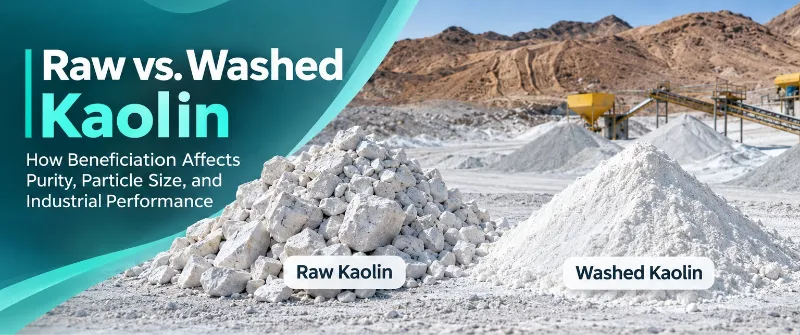
The broader principle applies across industrial minerals. In Vornaco’s comparison of raw and washed kaolin, beneficiation is examined in terms of changes to purity, particle size, and industrial performance. Although kaolin and chromite require different processing approaches, both illustrate why buyers should assess measured material characteristics rather than rely only on processing labels.
11. How Chromite Quality Requirements Differ by Industrial Application
Chromite is used in several industries, but the criteria for evaluating it are not identical.
Metallurgical Applications
For ferrochrome production, chromium content, Cr/Fe ratio, gangue composition, and feed preparation requirements are important considerations.
The appropriate limits depend on the ferrochrome production route and operating requirements.
Refractory Applications
Refractory applications require attention to mineral composition and high-temperature behavior.
The relationship between chromium-, aluminum-, magnesium-, and iron-bearing constituents may be particularly relevant, together with the presence of minerals that can affect refractoriness.
Foundry Applications
Foundry applications, particularly those involving chromite sand, require consideration of grain size distribution, mineral composition, cleanliness, and characteristics relevant to molding and casting.
A laboratory assay for Cr₂O₃ alone cannot establish the suitability of a chromite sand product for a particular foundry process.
Chemical Applications
Chemical processing may require a specific combination of chromium content, iron concentration, impurities, and material preparation characteristics.
Buyers should evaluate feedstock requirements against the process specification rather than assume that material accepted for metallurgical use is automatically suitable for chemical processing.
Why Grade Labels Can Be Misleading
Terms such as metallurgical grade, chemical grade, and refractory grade are useful commercial classifications.
However, they do not replace a detailed technical specification.
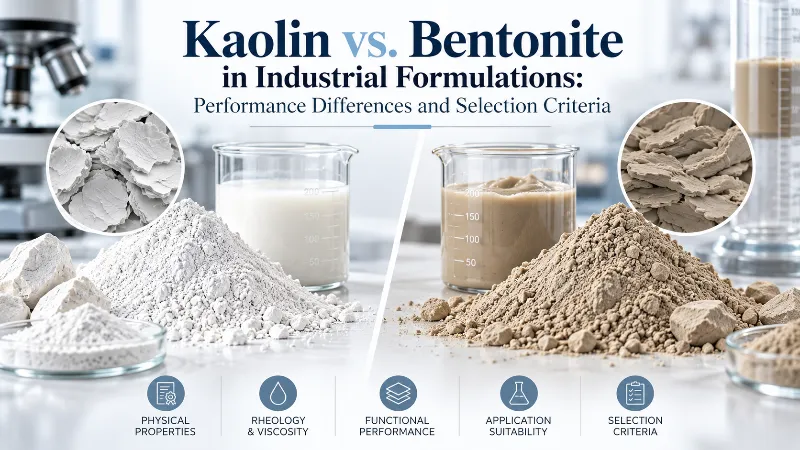
The same principle can be observed in other mineral markets. For example, kaolin grades and industrial uses differ according to material characteristics and application requirements. Chromite should likewise be assessed against its intended industrial use rather than a grade label alone.
12. Common Mistakes When Evaluating Chromite Ore
Mistake 1: Comparing Cr₂O₃ Results Without Checking Other Parameters
A comparison based only on chromium oxide may overlook significant differences in total iron, silica, and other relevant constituents.
Better approach: Compare complete analytical profiles against a common acceptance specification.
Mistake 2: Using Inconsistent Reporting Units
Comparing elemental iron with iron oxide equivalents without conversion can produce misleading Cr/Fe calculations.
Better approach: Standardize units and reporting bases before evaluating results.
Mistake 3: Accepting a Sample Report as Proof of Shipment Quality
A genuine laboratory result may still describe only a small submitted sample.
Better approach: Define representative sampling and link the analysis to the identified shipment lot.
Mistake 4: Assuming Processed Ore Always Has Better Quality
Beneficiation can improve selected material characteristics, but its effectiveness depends on the ore composition and separation process.
Better approach: Evaluate the final product using measured chemical and physical results.
Mistake 5: Ignoring Physical Specifications
An acceptable assay does not necessarily mean the material has the correct size distribution or moisture characteristics for the intended process.
Better approach: Include physical acceptance criteria alongside chemical limits.
Mistake 6: Using Universal Grade Thresholds
Industrial requirements can differ substantially between ferrochrome production, refractory materials, foundry sand, and chemical processing.
Better approach: Use application-specific specifications agreed upon by technical and purchasing teams.
13. Chromite Ore Quality Assessment Checklist for Bulk Buyers
Before approving a bulk chromite purchase, the following checklist can help organize the technical review.
| Verification question | What to confirm |
|---|---|
| Is the application clearly defined? | Metallurgical, refractory, foundry, or chemical use |
| Is the Cr₂O₃ content acceptable? | Measured result against the agreed specification |
| Is the Cr/Fe ratio suitable? | Correct calculation and application requirements |
| Are impurity limits satisfied? | Relevant chemical results and analytical limits |
| Is particle sizing acceptable? | Distribution against the required fractions |
| Is moisture accounted for? | Agreed test method and commercial weight basis |
| Is the sample representative? | Defined sampling and preparation procedure |
| Is the laboratory report traceable? | Sample identification, dates, and methods |
| Are verification arrangements defined? | Independent inspection or retesting when required |
| Are acceptance conditions documented? | Agreed specification, tolerances, and dispute procedure |
A useful purchasing specification separates mandatory acceptance requirements from optional information.

For example, a metallurgical buyer may identify minimum Cr₂O₃ content, an acceptable Cr/Fe range, maximum impurity concentrations, and particle size limits as essential requirements.
Other information may be collected to support process planning without necessarily determining shipment acceptance.
This distinction helps avoid disagreements caused by vague descriptions of material quality.
14. What Should Buyers Request Before Ordering Bulk Chromite Ore?
A well-prepared request for quotation should include enough technical information to establish whether the proposed material is suitable for the application.
Before discussing the final commercial terms, buyers can prepare a concise technical requirement covering:
- Intended industrial application.
- Required Cr₂O₃ content and Cr/Fe characteristics.
- Maximum acceptable concentrations of relevant impurities.
- Required particle size distribution.
- Moisture requirements and reporting basis.
- Requested laboratory documentation.
- Sampling and independent verification expectations.
- Estimated purchase quantity and destination.
Providing these requirements makes it easier to compare potential materials on a consistent basis.
Buyers evaluating available chromite ore for bulk industrial supply can review Vornaco’s product information and communicate their technical requirements when making an inquiry.
The final suitability of any material should be established through agreed specifications and relevant sample or shipment-specific documentation.
Conclusion: A Reliable Chromite Purchase Starts with Measurable Quality
Chromite ore quality cannot be reduced to a single chromium oxide percentage.
Cr₂O₃ content, Cr/Fe ratio, impurities, particle size distribution, moisture, and mineralogical composition all contribute to how a material should be evaluated.
Just as importantly, the reliability of those measurements depends on sampling, laboratory methods, and traceable documentation.
For bulk buyers, the most effective approach is to define the application first, establish clear acceptance criteria, and compare representative analytical results against those requirements.
A material that meets the right technical specification is more useful than one described only by a broad commercial grade.
Discuss Your Chromite Requirements with Vornaco
If you are evaluating chromite ore for an industrial application, Vornaco can be contacted to discuss your required material characteristics and bulk purchasing inquiry.
Share your intended application, required chemical composition, particle size specifications, estimated quantity, and delivery destination so the available supply options can be evaluated against your requirements.
Frequently Asked Questions
1. What is the most important quality parameter in chromite ore?
Cr₂O₃ content is an important starting point, but it should not be assessed alone. The Cr/Fe ratio, relevant impurities, particle size, and intended industrial application also influence whether chromite ore is suitable for a particular process.
2. What is a good Cr/Fe ratio for chromite ore?
There is no single Cr/Fe ratio suitable for every application. Metallurgical requirements depend on the ferrochrome production route, target alloy, furnace operation, and ore blending strategy. Buyers should use the requirements of their specific process.
3. How is Cr₂O₃ content measured in chromite ore?
Cr₂O₃ content can be determined using validated laboratory methods, including suitable XRF and wet chemical analytical procedures. Accuracy depends on calibration, sample preparation, analytical methodology, and representative sampling.
4. What impurities should be checked in chromite ore?
Commonly evaluated constituents include SiO₂, Al₂O₃, MgO, phosphorus, and sulfur, along with other elements or oxides relevant to the intended application. Their acceptable concentrations depend on the processing requirements.
5. Why is chromite ore sampling important?
Sampling determines whether a laboratory result represents the material being purchased. An accurately tested but unrepresentative sample may provide misleading information about the overall shipment.
6. Can two chromite ores with the same Cr₂O₃ content have different quality?
Yes. They may differ in Cr/Fe ratio, impurity concentrations, particle size distribution, moisture, and mineralogical composition. These differences can affect their suitability for specific industrial applications.
7. What should a chromite certificate of analysis include?
A useful COA should identify the tested material and sample, provide relevant chemical results and units, and indicate the laboratory and testing methods. Buyers should also confirm the sampling and reporting basis.
8. Does beneficiation always improve chromite quality?
No. Beneficiation may increase chromite concentration or reduce selected gangue minerals, but it does not necessarily improve every characteristic. The resulting concentrate must be assessed against its intended application.
Sources and Further Reading
The following sources support the technical framework and provide additional information about chromite composition, industrial applications, analytical methods, and representative sampling.
- International Organization for Standardization (ISO). ISO 6153:1989 — Chromium Ores: Increment Sampling.
- U.S. Geological Survey. Podiform Chromite Deposits—Database and Grade and Tonnage Models.
- Automated and Quantitative Mineralogy Applied to Chromite Ore Characterization and Beneficiation. Minerals, 2023.
- An Overview of Currently Applied Ferrochrome Production Processes and Their Waste Management Practices. Minerals, 2023.
- U.S. Geological Survey. Sampling and Milling Tests of Chromite Ore in the Hindubagh Mining District, Pakistan.