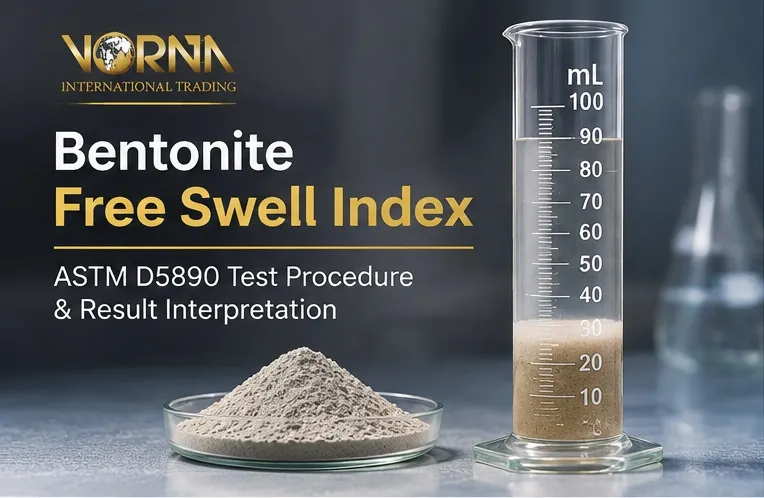
The Free Swell Index (FSI) is an important laboratory parameter used to evaluate the swelling behavior of bentonite when it comes into contact with water. It provides useful information about the ability of bentonite to absorb water and expand under defined testing conditions.
For industrial buyers, mineral processors, and geotechnical engineers, the bentonite free swell index can help compare material samples, assess product consistency, and evaluate whether a specific bentonite grade meets an application requirement.
However, a swelling index result should never be interpreted without considering the test method, sample preparation, water chemistry, and mineral composition.
One important distinction is that ASTM D5890 reports the swell index of bentonite in mL/2 g, while the soil free swell index method described in IS 2720 (Part 40) reports a percentage based on the difference between the final volumes measured in water and kerosene.
This guide explains both methods, with particular emphasis on ASTM D5890, including the required equipment, sample preparation, testing procedure, result interpretation, and common laboratory errors.
1. What Is Bentonite Free Swell Index?
Bentonite Free Swell Index is a measure of the volume expansion exhibited by a prepared bentonite sample after hydration under specified laboratory conditions.
Bentonite contains swelling clay minerals, particularly montmorillonite, whose layered structure allows water to interact with the mineral surfaces and interlayer spaces.
When bentonite is exposed to water, several processes may occur:
- Hydration of exchangeable cations.
- Adsorption of water on clay particle surfaces.
- Expansion of interlayer spaces.
- Osmotic swelling under suitable chemical conditions.
- Separation and dispersion of individual clay particles.
These processes contribute to the volume occupied by the hydrated clay.
The Free Swell Index provides an indication of this behavior under a defined test procedure.
A higher swell index generally indicates greater free expansion in the specified test liquid and under the specified conditions.
However, it does not independently establish the viscosity, filtration performance, hydraulic conductivity, or overall industrial quality of a bentonite product.
2. Why Is Free Swell Index Important in Bentonite Quality Testing?
The swelling behavior of bentonite is relevant to several industrial applications.
For example, in geosynthetic clay liners (GCLs), bentonite swelling contributes to the formation of a low-permeability barrier.
In civil engineering, swelling characteristics are important when bentonite is used in sealing systems, ponds, and other geotechnical applications.
Free swell testing can help manufacturers and buyers:
- Compare the swelling behavior of different bentonite samples.
- Evaluate consistency between production batches.
- Identify variations in material performance.
- Assess whether a product meets a specified swelling requirement.
- Investigate changes caused by mineral composition or chemical conditions.
2.1. Applications Where Swelling Performance Matters
| Application | Why Swelling Behavior Matters |
|---|---|
| Geosynthetic Clay Liners (GCL) | Supports the development of a low-permeability barrier |
| Pond and Landfill Sealing | Helps bentonite expand and fill available spaces |
| Geotechnical Applications | Contributes to sealing and containment performance |
| Civil Engineering | Provides information about hydration and expansion behavior |
| Industrial Bentonite Evaluation | Helps compare swelling characteristics between samples |
The importance of the Free Swell Index depends on the application.
For example, a high swelling index can be desirable for certain sealing applications, but it is not automatically an indication of superior performance in foundry, drilling, or absorbent applications.
3. Which Standard Is Used to Measure Bentonite Free Swell Index?
Before conducting the test, it is essential to identify which testing standard is required.
Two methods are particularly relevant.
3.1. ASTM D5890: Swell Index of Bentonite for GCL Applications
ASTM D5890 is titled:
Standard Test Method for Swell Index of Clay Mineral Component of Geosynthetic Clay Liners.
The current edition is ASTM D5890-25.
This method evaluates the swelling properties of a clay mineral in reagent water and is intended to help assess its usefulness in geosynthetic clay liners.
The result is reported in milliliters of swelling volume per 2 grams of dry bentonite:
mL/2 g
The method is based on allowing a prepared bentonite sample to hydrate in a graduated cylinder and measuring the volume occupied by the settled, swollen clay.
ASTM D5890 is an index test, not a direct hydraulic conductivity test. It also does not apply to clay materials containing polymers.
3.2. IS 2720 (Part 40): Free Swell Index of Soil
IS 2720 (Part 40) is a geotechnical soil-testing method used to evaluate the swelling potential of soils.
Unlike ASTM D5890, this method compares the volume of two soil specimens:
- One specimen in distilled water.
- Another specimen in kerosene.
The result is calculated as a percentage using the difference between the final volumes.
This method is useful when evaluating expansive soils, including highly swelling bentonitic materials.
3.3. Comparison of ASTM D5890 and IS 2720 (Part 40)
| Parameter | ASTM D5890-25 | IS 2720 (Part 40) |
|---|---|---|
| Main purpose | Swell index of clay mineral in GCL | Free swell index of soil |
| Sample quantity | 2 g | Normally 10 g per specimen |
| Liquid | Reagent water | Distilled water and kerosene |
| Measuring equipment | 100 mL graduated cylinder | Two 100 mL graduated cylinders |
| Typical waiting period | At least 16 hours after final addition in the commonly published procedure | Not less than 24 hours |
| Result unit | mL/2 g | % |
| Main application | Bentonite characterization for GCL | Identification of expansive soil potential |
Important: These two results are not interchangeable. A value of 24 mL/2 g under ASTM D5890 cannot be converted directly into a percentage under IS 2720 (Part 40).
For industrial bentonite procurement, always confirm which method is specified in the purchase agreement, product specification, or laboratory testing procedure.
4. Equipment Required for ASTM D5890 Free Swell Index Test
The ASTM D5890 method requires controlled sample preparation and appropriate laboratory equipment.
The main equipment and materials include:
| Equipment / Material | Purpose |
|---|---|
| Analytical Balance | Accurate measurement of the bentonite sample |
| 100 mL Graduated Cylinder | Measuring the final swelling volume |
| Drying Oven | Drying the sample to constant mass |
| Standard Sieves | Controlling particle-size preparation |
| Reagent Water | Providing controlled hydration conditions |
| Spatula | Gradual addition of bentonite |
| Sample Containers | Preparing and storing the test material |
| Timer | Controlling hydration and settling intervals |
| Thermometer | Recording relevant test temperature |
The accuracy of the test depends not only on the equipment but also on consistent sample preparation and testing conditions.
5. ASTM D5890 Free Swell Index Test Procedure
The following procedure summarizes the commonly published ASTM D5890 testing sequence. For contractual testing and formal compliance, laboratories should follow the complete current edition of ASTM D5890-25, including its exact apparatus, reagent, and procedural requirements.
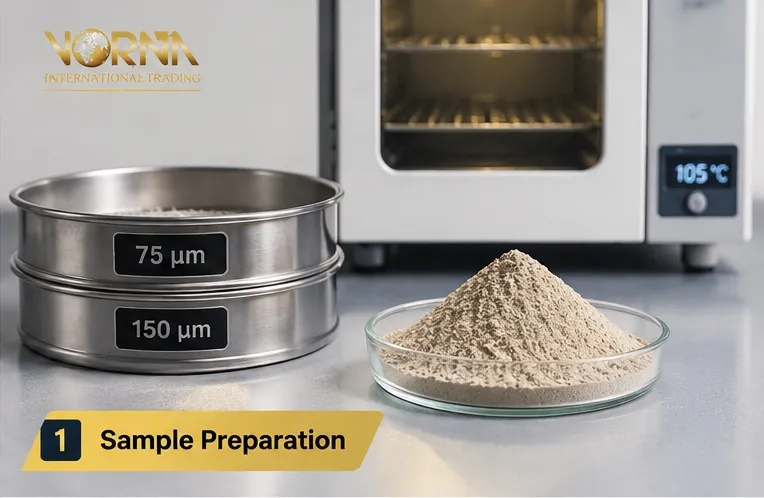
Step 1: Prepare the Bentonite Sample
The first step is to prepare a representative bentonite sample.
According to ASTM D5890-25:
- Powdered bentonite is dried to constant mass at 105 ± 5°C.
- Granular bentonite should be ground until 100% passes a 150 µm (No. 100) sieve.
- At least 65% of the granular material should pass a 75 µm (No. 200) sieve.
The prepared bentonite is then dried to constant mass at 105 ± 5°C before testing.
Representative sampling is essential. A sample taken from only one part of a bulk shipment may not reflect the properties of the entire batch.
Step 2: Weigh the Bentonite
Accurately weigh 2.00 grams of the prepared dry bentonite using an analytical balance.
The sample mass must be controlled because the final swelling volume is reported relative to 2 grams of dry material.
Step 3: Prepare the Graduated Cylinder
Use a clean 100 mL graduated cylinder.
Add approximately 90 mL of reagent water to the cylinder.
The use of reagent water is important because dissolved salts and other impurities can affect bentonite swelling.
Tap water should not be substituted when performing a standardized ASTM D5890 test unless the applicable procedure explicitly permits a different liquid.
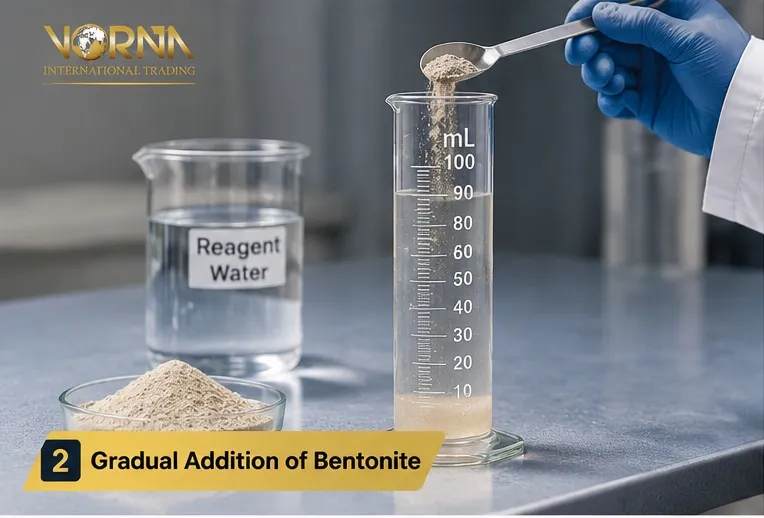
Step 4: Add Bentonite Gradually
Introduce the 2 grams of bentonite into the water gradually.
A commonly published implementation uses increments of approximately 0.1 gram.
Each increment should be allowed to hydrate and settle for at least 10 minutes before adding the next portion.
The bentonite should be distributed across the water surface rather than poured rapidly into one location.
This gradual addition helps minimize the formation of dry aggregates and allows the particles to hydrate more consistently.
Rapid addition may cause partially hydrated lumps, making the final reading less reliable.
Step 5: Bring the Cylinder to the Required Volume
After all 2 grams of bentonite have been added, use additional reagent water to bring the cylinder to the 100 mL mark.
The procedure should also ensure that bentonite particles adhering to the cylinder walls are properly washed into the suspension.
Step 6: Allow the Sample to Hydrate and Settle
Leave the graduated cylinder undisturbed for the required hydration period.
The commonly published ASTM D5890 sequence specifies a minimum period of 16 hours after the final bentonite addition.
During this period, bentonite hydrates and settles, producing an expanded clay mass at the bottom of the cylinder.
Avoid shaking, stirring, or moving the cylinder during this stage.
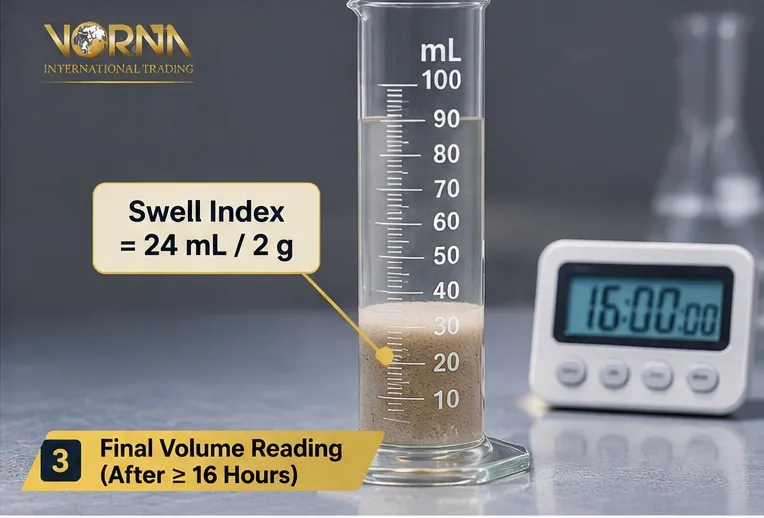
Step 7: Read the Final Swelling Volume
After the specified hydration period, read the volume occupied by the settled, hydrated bentonite.
The reading should be taken at the top of the settled clay mass, following the measurement convention in the applicable test method.
Do not include the full water column or confuse floating, low-density flocculated material with the settled clay volume.
Record the final result in mL/2 g.
6. How to Calculate Bentonite Free Swell Index
For ASTM D5890, the reported swell index is the volume occupied by the hydrated bentonite relative to the 2-gram dry sample.
The result is expressed as:
Swell Index = Final Swollen Clay Volume (mL) per 2 g of Dry Bentonite
For example:
Assume that a laboratory tests 2 grams of bentonite and records a final settled clay volume of 26 mL.
The reported result is:
Swell Index = 26 mL/2 g
This means that 2 grams of the prepared bentonite occupied a settled hydrated volume of 26 mL under the specified test conditions.
It is not a 26% swelling result.
6.1. Example of Laboratory Results
Consider three hypothetical bentonite samples tested using the same procedure.
| Sample | Dry Bentonite | Final Swollen Volume | Swell Index |
|---|---|---|---|
| Sample A | 2 g | 18 mL | 18 mL/2 g |
| Sample B | 2 g | 24 mL | 24 mL/2 g |
| Sample C | 2 g | 30 mL | 30 mL/2 g |
Under the same testing conditions, Sample C demonstrates a greater free swelling volume than Samples A and B.
However, this comparison alone does not establish that Sample C is the best material for every industrial application.
Other properties, such as montmorillonite content, filtration behavior, chemical composition, and particle-size distribution, must also be considered.
7. How to Interpret Bentonite Free Swell Index Results
The interpretation of a swell index result should be based on the intended application and the relevant product specification.
A higher value generally indicates greater free swelling under the specified test conditions.
However, ASTM D5890 does not establish one universal minimum acceptance value for all commercial bentonite products.
The required value should be defined by the product specification, technical agreement, or project requirements.
7.1. Understanding the 24 mL/2 g Requirement
Vornaco’s published bentonite specification table lists the following minimum free swelling index for its Civil/GCL grade:
Free Swelling Index: ≥ 24 mL/2 g
This is a product specification for the Civil/GCL category, not a universal ASTM D5890 acceptance threshold.
For buyers evaluating civil and geosynthetic clay liner applications, this value provides a useful reference when comparing the declared product specification with the laboratory result.
The complete range of bentonite specifications is available on the Bentonite Supplier & Exporter page.
7.2. What Does a Higher Swell Index Mean?
A higher swell index can indicate:
- Greater expansion under the specified hydration conditions.
- More pronounced swelling behavior.
- Potentially greater suitability for applications requiring high swelling capacity.
However, a high result should not be interpreted independently of the intended application.
For example, a material with a high swelling index may be suitable for certain sealing applications but may not automatically provide the required viscosity, filtration control, or binding performance for other uses.
7.3. What Does a Low Swell Index Indicate?
A lower-than-required result may indicate:
- Lower swelling capacity.
- Lower active swelling clay content.
- A calcium-dominant exchangeable cation composition.
- Inhibition caused by dissolved salts.
- Differences in particle-size distribution.
- Inadequate sample preparation or hydration.
- Variations in mineral composition.
Before rejecting a bentonite batch, the laboratory should investigate whether the low result reflects the material itself or a testing-related problem.
8. Factors That Affect Bentonite Free Swell Index
Several material and testing parameters influence the final swell index.
Understanding these factors is essential when comparing laboratory results or investigating variations between production batches.
8.1. Montmorillonite Content
Montmorillonite is the principal swelling clay mineral in many bentonite deposits.
Its layered structure and hydration behavior contribute significantly to the swelling properties of bentonite.
In general, a higher proportion of suitable swelling smectite can contribute to greater swelling capacity.
However, the relationship is not necessarily linear because exchangeable cations, mineral impurities, and chemical conditions also influence swelling.
8.2. Sodium and Calcium Content
The exchangeable cations associated with montmorillonite have a major influence on hydration and swelling.
Sodium bentonite generally exhibits greater swelling than calcium bentonite under comparable dilute-water conditions.
Calcium ions can interact more strongly with negatively charged clay surfaces and influence the spacing and hydration of clay layers.
Therefore, two bentonite samples with similar montmorillonite content may produce different swell index results.
For a detailed comparison, read:
Sodium Bentonite vs Calcium Bentonite: Differences and Uses
8.3. Water Salinity and Dissolved Ions
Water chemistry is another important factor.
Dissolved salts influence electrostatic interactions between clay particles and may suppress osmotic swelling.
Calcium and magnesium ions can also affect the exchangeable cation composition of montmorillonite.
Consequently, bentonite tested in reagent water may produce a different result from the same material tested in saline water.
This is why water quality must be controlled during standardized free swell testing.
For more information, see:
How Water Salinity Affects Bentonite Hydration and Performance
8.4. Particle Size Distribution
Particle size can influence the hydration and dispersion behavior of bentonite.
If the sample is not prepared according to the specified particle-size requirements, the final result may not be comparable with standardized laboratory values.
This is particularly important when testing granular bentonite or raw material containing coarse particles.
8.5. Sample Moisture and Drying Conditions
The test uses a controlled dry sample mass.
If the initial moisture content is not accounted for, the actual dry bentonite mass may differ from the intended 2 grams.
Inconsistent drying conditions can therefore introduce errors into the reported swelling index.
8.6. Hydration Time and Testing Conditions
Insufficient hydration time may prevent the sample from reaching the condition required for the specified final reading.
Other important conditions include:
- Water purity.
- Sample temperature.
- Sample addition rate.
- Cylinder cleanliness.
- Particle dispersion.
- Settling conditions.
These parameters should be kept consistent when comparing samples.
9. Common Errors During Bentonite Free Swell Index Testing
Incorrect laboratory practices can lead to misleading results.
The following errors should be avoided.
| Common Error | Potential Effect | Recommended Practice |
|---|---|---|
| Using tap water instead of reagent water | Changes hydration behavior | Use the liquid specified by the method |
| Adding bentonite too quickly | Creates partially hydrated aggregates | Add the sample gradually |
| Incorrect sample mass | Changes the reported index | Use an accurate analytical balance |
| Inadequate sample drying | Introduces errors in dry mass | Dry to constant mass as specified |
| Incorrect particle-size preparation | Reduces comparability | Follow ASTM sieve requirements |
| Reading before the required hydration period | Underestimates final swelling | Follow the specified settling time |
| Disturbing the cylinder | Changes the settled clay volume | Keep the cylinder undisturbed |
| Including floating flocculated material | Produces an incorrect reading | Measure the settled clay mass |
| Reporting the result in the wrong unit | Creates incorrect comparisons | Report ASTM results in mL/2 g |
9.1. Why Bentonite Lumps Can Affect Test Results
Poor dispersion during sample preparation can result in partially hydrated aggregates.
These aggregates may prevent uniform hydration and affect the final volume measurement.
Gradual addition of bentonite and appropriate sample preparation help reduce this problem.
For more information about preventing agglomeration during industrial preparation, see our article:
Preventing Bentonite Lumps During Industrial Mixing: Hydration, Dispersion, and Process Control
10. Is Free Swell Index Enough to Determine Bentonite Quality?
No. Free Swell Index is an important characterization parameter, but it is not a complete measure of bentonite quality.
A reliable industrial evaluation should consider several properties together.
| Test Parameter | What It Evaluates | Typical Relevance |
|---|---|---|
| Free Swell Index | Expansion in a specified liquid | Civil/GCL and sealing applications |
| Montmorillonite Content | Active swelling clay fraction | Mineralogical quality |
| Cation Exchange Capacity | Ability to exchange cations | Mineral activity and chemical behavior |
| Moisture Content | Water present in the material | Storage and processing |
| Particle Size | Fineness and distribution | Dispersion and product consistency |
| Viscosity | Flow resistance of a suspension | Drilling applications |
| Fluid Loss | Filtration behavior | Drilling and sealing applications |
| Green Compression Strength | Binding performance in molding sand | Foundry applications |
The appropriate combination of tests depends on the intended use.
For example, drilling-grade bentonite requires evaluation of its relevant viscosity and fluid-loss specifications. Free Swell Index alone cannot establish API or OCMA compliance.
For drilling-specific material information, visit Vornaco’s Drilling Bentonite page.
Similarly, foundry-grade bentonite should be evaluated using relevant molding and binding performance tests rather than relying only on swelling results.
11. How Buyers Should Evaluate Free Swell Index in a Bentonite COA
A Certificate of Analysis (COA) provides important information about the measured properties of a particular production batch.
When reviewing the free swell index reported by a supplier, buyers should verify the following:
1. Test Standard
Confirm whether the result was measured according to ASTM D5890 or another specified procedure.
2. Result and Unit
Check whether the reported value is expressed in mL/2 g or as a percentage.
3. Product Grade
Confirm that the test requirement applies to the purchased grade.
4. Sample Preparation
Review whether the sample was prepared according to the applicable standard.
5. Testing Conditions
Check the test liquid, sample drying, hydration period, and relevant laboratory conditions.
6. Acceptance Criteria
Compare the measured value with the agreed product specification rather than a general internet reference.
7. Batch Identification
Make sure the COA corresponds to the actual production batch or shipment being evaluated.
For bulk purchases, buyers should request batch-specific laboratory documentation and confirm that the reported test results are representative of the supplied material.
12. Frequently Asked Questions About Bentonite Free Swell Index
What is the Free Swell Index of bentonite?
The Free Swell Index is a laboratory measure of the volume expansion of bentonite after hydration under specified testing conditions. Under ASTM D5890, the result is expressed in mL/2 g.
What is ASTM D5890 used for?
ASTM D5890 is used to evaluate the swell index of the clay mineral component of geosynthetic clay liners (GCLs). It provides an index of swelling behavior in reagent water.
How much bentonite is required for the ASTM D5890 test?
The method uses a 2-gram dry bentonite specimen for the swell index determination.
How long does the bentonite free swell test take?
The commonly published ASTM D5890 procedure requires a minimum hydration period of 16 hours after the final sample addition. Sample preparation and incremental hydration also require additional time.
What is a good Free Swell Index for bentonite?
There is no universal acceptance value for all bentonite applications. The required minimum depends on the product grade and application specification. For example, Vornaco lists a minimum of 24 mL/2 g for its Civil/GCL category.
What is the difference between ASTM D5890 and IS 2720 Part 40?
ASTM D5890 measures the swell index of bentonite in reagent water and reports the result in mL/2 g. IS 2720 Part 40 compares soil volumes in distilled water and kerosene and reports free swell index as a percentage.
Does sodium bentonite have a higher Free Swell Index than calcium bentonite?
Sodium bentonite generally exhibits greater swelling capacity than calcium bentonite under comparable dilute-water conditions. However, the actual result depends on mineral composition, exchangeable cations, and testing conditions.
Does water salinity affect bentonite swelling?
Yes. Dissolved salts can suppress swelling by changing electrostatic interactions and hydration behavior. Calcium and magnesium ions can also affect the exchangeable cation composition of bentonite.
Can a high Free Swell Index guarantee good bentonite quality?
No. A high swell index indicates greater expansion under the specified test conditions, but overall quality also depends on mineral composition, chemical characteristics, particle size, and application-specific performance.
Conclusion
The Bentonite Free Swell Index is a useful parameter for evaluating the swelling behavior of bentonite under controlled laboratory conditions.
ASTM D5890 provides a standardized approach for measuring the swell index of the clay mineral component used in geosynthetic clay liners, with results reported in mL/2 g.
However, accurate interpretation requires more than reading the final volume. Sample preparation, particle size, drying conditions, water chemistry, and hydration time all influence the measured result.
For industrial buyers, the most reliable approach is to compare laboratory results against the exact product specification and evaluate swelling behavior alongside other relevant quality parameters.
By applying a consistent test method and reviewing the complete technical documentation, manufacturers and buyers can make more informed decisions when selecting bentonite for civil, geotechnical, and other industrial applications.
Technical References
- ASTM International. ASTM D5890-25, Standard Test Method for Swell Index of Clay Mineral Component of Geosynthetic Clay Liners.
- Bureau of Indian Standards. IS 2720 (Part 40): 1977, Methods of Test for Soils – Determination of Free Swell Index of Soils.
https://law.resource.org/pub/in/bis/S03/is.2720.40.1977.pdf - Johns, D. G. and Shamrock, J. S. Swell Index Testing of GCL Bentonites With General and Hazardous Waste Leachates. GeoAfrica 2009 Conference.
https://library.geosyntheticssociety.org/wp-content/uploads/resources/proceedings/A.21%20Swell%20Index%20Testing%20of%20GCL%20Bentonites%20With%20General%20And%20Hazardous%20Waste%20Leachates.pdf - Di Emidio, G. Hydraulic and Chemico-Osmotic Performance of Polymer Treated Clays. Ghent University, 2010.
- Vornaco. Bentonite Supplier & Exporter – Product Specifications.
https://vornaco.com/product/bentonite/